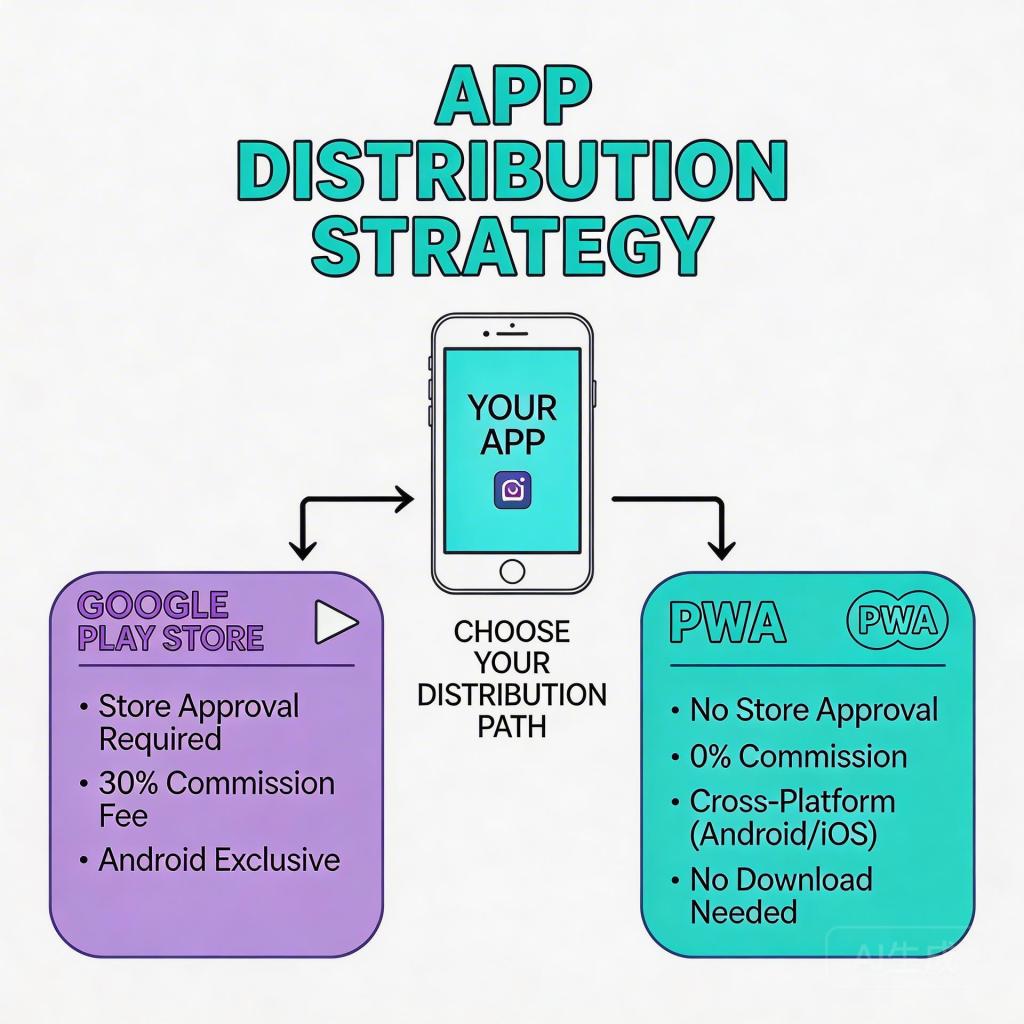
In 2026, Google Play has become an increasingly unreliable foundation for overseas Android app distribution. Review cycles are stretching longer, content policies are tightening, and the 30% commission continues to erode margins. More game studios and AI app teams are asking the same question: is there a better way to reach Android users?
This guide takes a business decision-making perspective to evaluate Google Play alternatives for 2026, with a focus on PWA distribution and what it actually means for your bottom line.
→ Want to bypass Google Play entirely? See how ROiBest PWA works — no submission, no cut, 1.2x installs.
Why Google Play Is Becoming a Liability for App Teams
The problems with Google Play are not new, but in 2026 they have crossed a threshold from “manageable inconvenience” to “strategic risk.” Three issues are driving teams to look for alternatives.
Review Risk: Policies Are Tightening, Takedowns Are Increasing
On March 4, 2026, Google Play introduced new Age-Restricted Content policies targeting dating, matchmaking, and social apps. Thousands of apps — including many that are fully compliant by any reasonable standard — faced review delays, rejections, or preemptive takedowns. The policy language is broad enough that even borderline-compliant content triggers manual review queues that can stretch for weeks.
Additionally, Google Play’s new Developer Identity Verification requirement, mandatory for all new accounts by June 30, 2026, adds friction for teams that operate through third-party distribution accounts or regional entities. This is particularly relevant for Chinese overseas teams managing multiple markets from a single operation.
30% Commission: The Math Is Simple and Painful
Google Play charges a 30% commission on in-app purchases (15% for qualifying subscription apps). For gaming and subscription-based AI apps with strong monetization, this is not an abstraction — it is a direct transfer of profit to Google. On $1 million in monthly IAP revenue, $300,000 goes to Google Play.
The Epic Games antitrust settlement with Google (effective by June 30, 2026) will require Google to open alternative billing systems, but implementation details remain unclear. Teams cannot count on this to meaningfully reduce their commission burden in the near term.
Post-Uninstall Disconnection: Lost Users, Higher Reactivation Costs
When a user uninstalls a native Android app, the push notification channel goes dark. For apps where lifetime value (LTV) depends on re-engagement — gaming, social, subscription — this means higher paid reactivation costs every time a user churns. There is no passive retention mechanism once the app is gone.
Android App Distribution Channels: 2026 Landscape
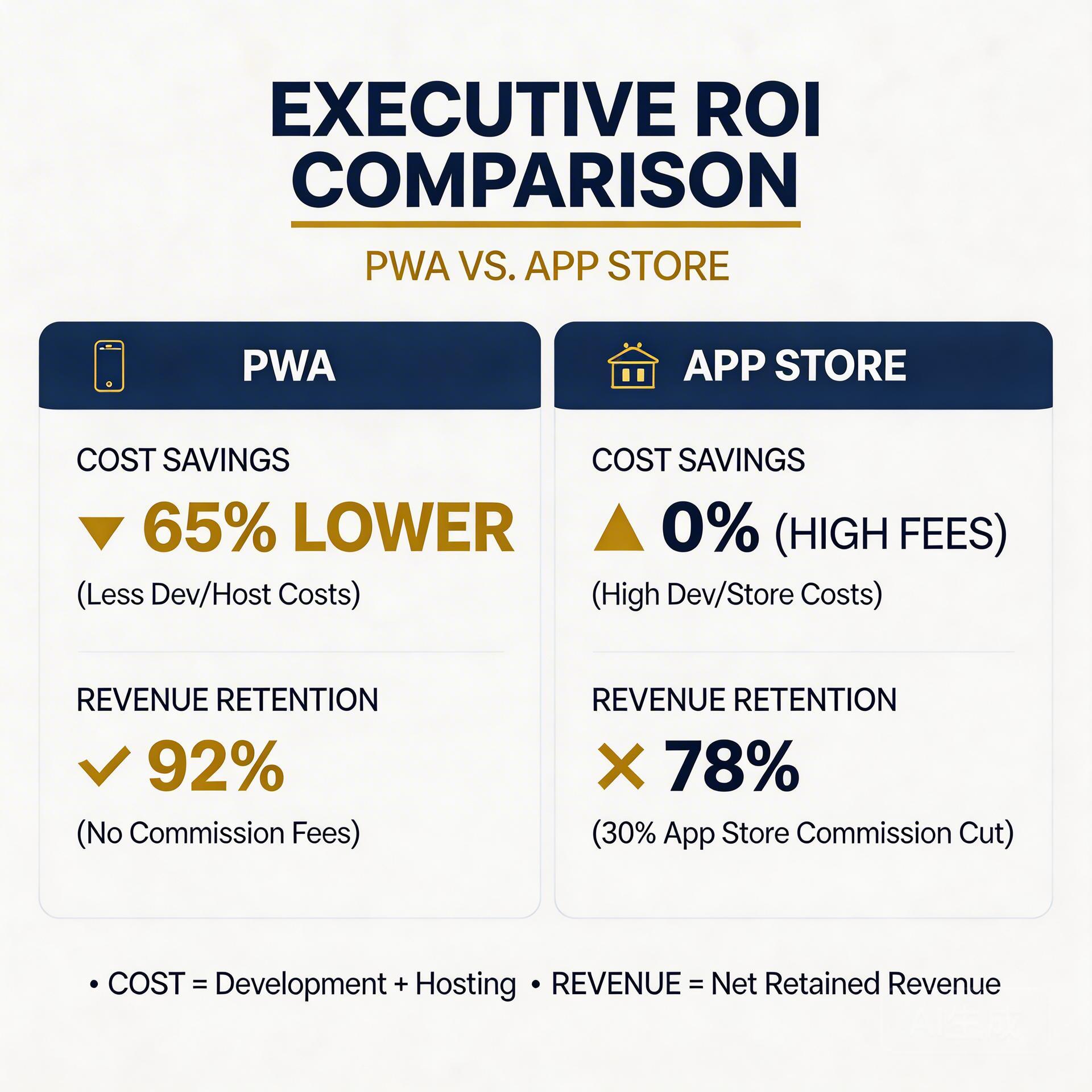
Teams exploring Google Play alternatives have several options, each with distinct trade-offs.
Third-Party Android App Stores
Amazon Appstore, Samsung Galaxy Store, and regional stores like Huawei AppGallery offer an alternative to Google Play, but they come with their own review processes, limited reach in most target markets, and fragmented distribution management. For teams already struggling with one app store, managing three or four simultaneously is rarely the answer.
Direct APK Distribution
Distributing APK files directly bypasses all app stores, but introduces significant friction. Users must enable “install from unknown sources” in their device settings, trust a download link, and navigate a clunky install flow. Install conversion rates are substantially lower than any store-based distribution, and there are no push notification capabilities.
PWA (Progressive Web App) Distribution
PWAs install directly from a browser to the device home screen. No app store review. No commission. Push notifications that persist even after the icon is removed from the home screen. Installation conversion rates that exceed native app downloads by 1.2x, according to ROiBest operational data.
For business-critical criteria — speed to market, cost structure, user reach, and retention capability — PWA distribution outperforms all other Google Play alternatives for the use cases where Google Play is most problematic.
PWA as a Google Play Alternative: Business Value Analysis
The PWA market reached $1.3 billion in 2024 and is projected to grow to $3.9 billion by 2027. This is not a niche technical solution — it is an increasingly mainstream distribution channel with a proven track record across gaming, social, and subscription app categories.
From a business perspective, PWA distribution offers four core advantages over Google Play:
- No review, no takedown risk. PWAs are not subject to Google Play’s content policies or review queues. Policy changes that would ground your native app have no effect on your PWA distribution. Updates deploy instantly — no 7-14 day review wait.
- 100% revenue retention. Without Google Play processing in-app purchases, there is no commission. Every dollar of IAP revenue stays with your business. For high-monetization apps, this change in revenue structure is transformative.
- Push notifications after uninstall. Chrome-based PWA push notifications remain active even when users remove the app icon from their home screen. This is a capability that native Android apps categorically cannot provide, and it changes the economics of user retention.
- Higher install conversion rates. The PWA install path — click link, see landing page, tap “Add to Home Screen” — eliminates multiple friction points in the Google Play download flow. ROiBest data shows 1.2x higher install conversion vs native app downloads.
Gaming BC Apps: How PWA Changes the Distribution Economics
Gaming BC (betting/casino-style games) is the category where PWA distribution has the clearest and most immediate business case. Google Play’s review criteria for this category are highly restrictive and inconsistently applied, making approval unpredictable and takedown risk persistent.
Consider a mid-sized gaming team with $700,000 in monthly IAP revenue. Running through Google Play, 30% — $210,000 — goes to Google each month. Over a year, that is $2.52 million transferred to the platform. Switching to PWA distribution recovers that entire amount.
Beyond the commission math, the operational advantage is significant. When Google Play is your distribution channel, every new event, feature, or campaign must wait for review approval. Teams running live service games — where timing is everything — cannot afford 10-14 day delays between content decision and content delivery. PWA eliminates this bottleneck entirely: decisions made Monday can be live Monday.
For gaming BC teams specifically, PWA also removes the developer account risk entirely. There is no Google Play developer account to be suspended, no policy violation to trigger removal, no reinstatement process to navigate. The distribution infrastructure is owned and controlled by the team, not licensed from a platform that can revoke access at any time.
AI Social Apps: PWA as the Practical Path Around Review Restrictions
AI social and companion apps represent one of the fastest-growing app categories in 2025-2026, and also one of the most heavily scrutinized by Google Play. The March 2026 Age-Restricted Content policy directly targeted this segment, and the effects have been severe: review timelines stretching to weeks, frequent rejections citing vague policy violations, and constant uncertainty about which features will trigger a new review.
For AI app teams, PWA distribution offers a practical alternative with several distinct advantages:
- Immediate launch capability. Products can go live the day they are ready, without waiting for a review queue that may or may not produce a favorable outcome.
- Rapid content iteration. AI app experiences often need to evolve quickly based on user feedback. PWA allows continuous deployment without review gating.
- Full data ownership. Without Google Play as an intermediary, user data and behavioral signals belong entirely to the operating team — no platform data layer between the app and its analytics.
- Subscription revenue retention. Subscription-based AI apps keep 100% of recurring revenue rather than sharing 15-30% with Google Play.
For teams primarily targeting Chinese overseas users in Southeast Asia and the Middle East, PWA’s install mechanic — adding directly to the home screen from a browser — aligns well with how these users interact with mobile web content. The install barrier is lower than it might appear in Western markets.
Install Conversion Rate Comparison: PWA vs Google Play
Install conversion rate measures what percentage of users who begin the install process actually complete it. This is where distribution channel choice has a direct and measurable impact on user acquisition efficiency.
The Google Play install flow contains multiple steps: find the app (search or follow a link to the store listing), review the store page, tap Install, wait for download to complete, open the app. Each step loses a fraction of users. The total drop-off from “arrived at Play Store listing” to “completed install” is substantial, particularly on lower-end devices common in emerging markets where download waits are longer.
The PWA install flow is materially shorter: click promotional link, arrive at branded landing page, tap “Add to Home Screen,” done. The ROiBest platform shows this path converts at 1.2x the rate of the Google Play equivalent — a difference that compounds across every paid acquisition campaign.
There is an additional advantage for paid traffic: PWA landing pages can be A/B tested, iterated, and optimized with the same rigor as any other conversion page. Google Play store listings are comparatively static and offer limited optimization levers. Teams running Facebook Ads, TikTok Ads, or Google UAC see measurably better ROAS when the destination is an optimized PWA landing page versus a fixed store listing.
Revenue Retention: What Saving 30% Actually Means
The 30% Google Play commission is a line item that many teams have accepted as a fixed cost of Android distribution. PWA distribution changes that assumption entirely. Let’s look at what this means at different revenue scales.
- $100K/month IAP revenue: $30K saved per month → $360K per year
- $500K/month IAP revenue: $150K saved per month → $1.8M per year
- $1M/month IAP revenue: $300K saved per month → $3.6M per year
These are not optimization gains — they are complete cost eliminations. The recovered revenue can be redirected to user acquisition, product development, or carried directly to profit. At any meaningful scale, the commission saving alone more than justifies the switch to PWA distribution.
ROiBest handles the full PWA launch process. Teams do not need engineering resources to implement or maintain the distribution infrastructure. The transition from Google Play to PWA distribution is a business decision, not a development project — and the economics of that decision are straightforward.
Common Concerns: Will Users Accept PWA?
The most frequent objection to PWA distribution is user acceptance: will users who expect to download apps from a store actually install a PWA? This concern is worth examining carefully, because the data does not support the assumption that PWA installs are a second-class experience.
Concern: Users only trust app store downloads
Reality: The PWA install experience on Chrome-based Android is visually and functionally very close to a native install. Users see a branded landing page, tap a clear call-to-action (“Add to Home Screen”), and the app icon appears on their home screen. The experience is familiar enough that many users do not distinguish it from a native install — and the conversion data confirms this. Install rates are higher, not lower.
Concern: PWA features are limited compared to native apps
Reality: For the categories where PWA distribution makes the most business sense — gaming, social, subscription apps — the core feature set required (authentication, payments, push notifications, media playback, offline capability) is fully supported. ROiBest’s platform is specifically optimized for the performance requirements of Southeast Asian and Middle Eastern markets, ensuring load times and user experience meet the standards of the target audience.
Concern: SEO and discoverability will suffer
Reality: PWA landing pages are fully SEO-optimized and compatible with all paid acquisition channels. Unlike app store listings, PWA landing pages can be continuously iterated based on performance data. Many teams find that their per-install cost from paid channels actually decreases after switching to PWA, because the landing page can be optimized in ways a fixed store listing cannot.
Concern: Push notifications won’t be as effective
Reality: PWA push notifications (Chrome-based) are more capable than native app push in one critical respect: they continue working after the user removes the app icon from their home screen. For retention-focused apps, this is a significant advantage over native Android push, not a limitation.
Conclusion: When to Choose PWA Over Google Play
Google Play remains a viable distribution channel for certain app categories — productivity tools, content apps, established brands with strong organic search presence in the Play Store. For these categories, the trade-offs favor staying in the store ecosystem.
But for a growing number of app teams in 2026, the calculus has shifted. PWA distribution is the right primary channel when:
- Review risk is material. Gaming BC, AI social, dating, and matchmaking apps face unpredictable Google Play reviews. PWA removes that variable entirely.
- Monetization is strong. Monthly IAP revenue above $50K means the 30% commission is causing real profit loss. The economics of PWA pay off quickly at this scale.
- Speed to market matters. Seasonal campaigns, live events, rapid content updates — these cannot wait 10-14 days for review approval. PWA enables immediate deployment.
- Retention is LTV-critical. Apps where push notification-driven re-engagement is a core part of the business model benefit from PWA’s post-uninstall push capability.
- Audience is in emerging markets. Southeast Asian and Middle Eastern users show strong PWA install acceptance, and the lower device friction of PWA install plays well in these markets.
The shift from Google Play to PWA distribution is not a technical migration — it is a business strategy decision. The question is not whether PWA can work, but whether your team is ready to stop paying 30% of your revenue to a platform that increasingly treats you as a liability rather than a partner.
ROiBest has helped dozens of overseas app teams make this transition. The process is managed end-to-end, so your team focuses on growth while the distribution infrastructure is handled by specialists.
Skip the app store. Go live instantly, keep 100% of your revenue.
ROiBest helps Android app teams launch PWAs — no review process, no 30% Google Play cut, and push notifications that work even after uninstall. Teams see up to 1.2x higher install conversion rates vs native app downloads.
 WebApp中文站
留下评论