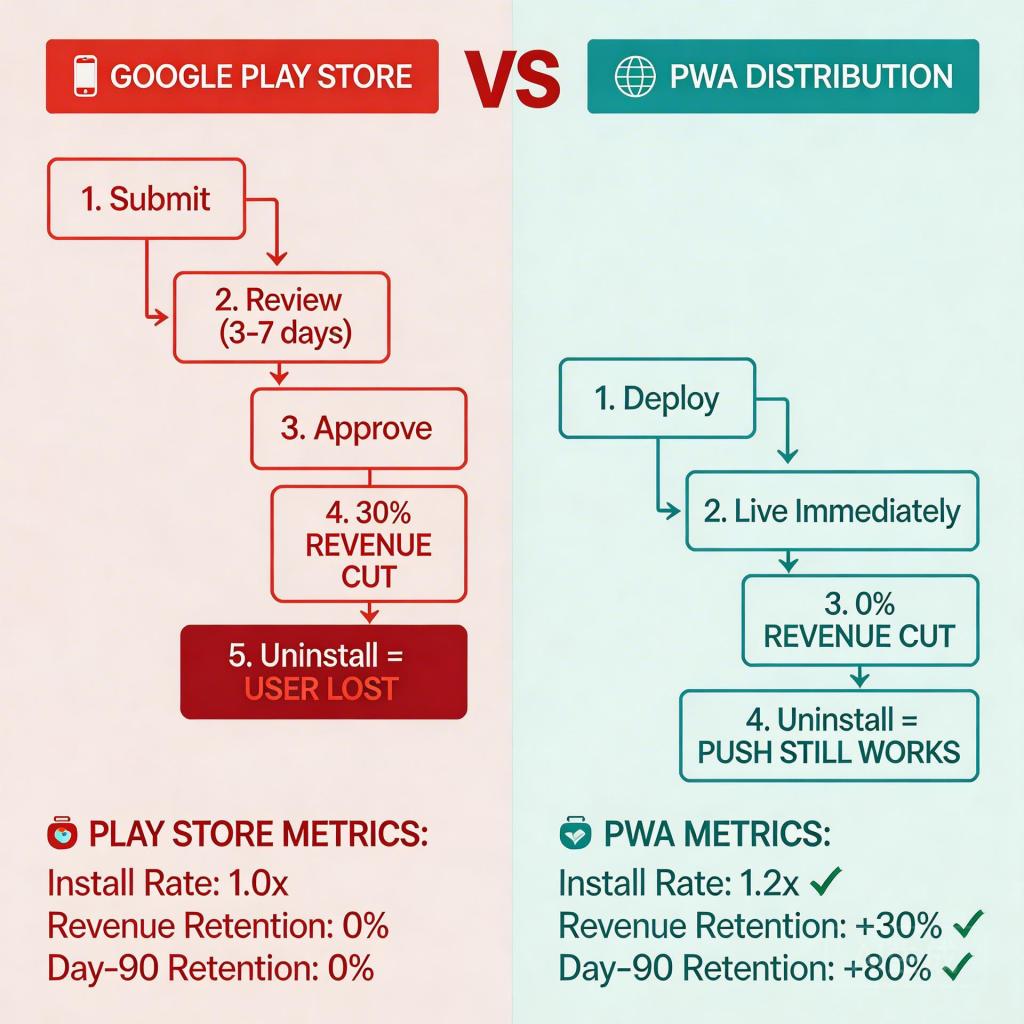
In 2026, Android app teams distributing through Google Play face a set of structural challenges that haven’t changed — they’ve gotten worse. Review times are longer. Rejection rates for gaming and AI apps have increased. The 30% Google Play commission continues to erode margins. And for apps that get approved, uninstall removes your push notification channel entirely.
PWA (Progressive Web App) distribution has emerged as the proven alternative for teams that need to bypass these constraints — and in 2026, the PWA-to-Google Play install rate gap has widened to 1.2x in favor of PWA. This guide covers every major dimension of Google Play alternatives for Android app distribution, from the economics to the implementation options to how to choose the right approach for your team.
→ Want to bypass Google Play entirely? See how ROiBest PWA works — no submission, no cut, 1.2x installs.
Why Teams Are Moving Away From Google Play in 2026
Google Play remains the dominant Android app discovery channel. But for specific app categories and business models, it’s a poor distribution channel. Understanding why is the starting point for choosing the right alternative.
The Approval Problem
Google Play’s review process has become more stringent since 2023. Gaming apps with in-app purchases face elevated scrutiny. AI-powered apps — particularly AI social, AI dating, and AI companion apps — face category-level restrictions that result in delayed approvals and higher rejection rates.
For time-sensitive launches (campaign go-lives, seasonal events, rapid iteration), waiting 3–7 days for Play Store approval is a business problem. A promotional campaign with a fixed start date can’t wait for app review cycles.
The Revenue Problem
Google Play charges 15% commission on the first $1M in annual revenue and 30% on everything above. For mobile games and subscription apps, this is a structural margin hit. An app generating $500K monthly in in-app purchase revenue pays $150K to Google — every month.
PWA distribution bypasses this commission entirely. All in-app purchases processed through your own payment system (Stripe, Paddle, direct payment gateway) keep 100% of revenue minus the payment processor fee (typically 2.9% + $0.30 per transaction). At scale, this difference is significant.
The Retention Problem
When a user uninstalls a Google Play app, your access to that user ends. You cannot send them push notifications, re-engage them with in-app prompts, or reach them through any platform-level mechanism. Your CRM is the only path — and that depends on whether you captured their contact information before they left.
PWA push notifications are browser-based. They persist even after the PWA icon is removed from the home screen. A user who “uninstalls” a PWA by removing the icon is still reachable if they previously granted push notification permission. This fundamentally changes the retention economics for mobile game teams with high churn cycles.
The Complete Landscape of Google Play Alternatives in 2026
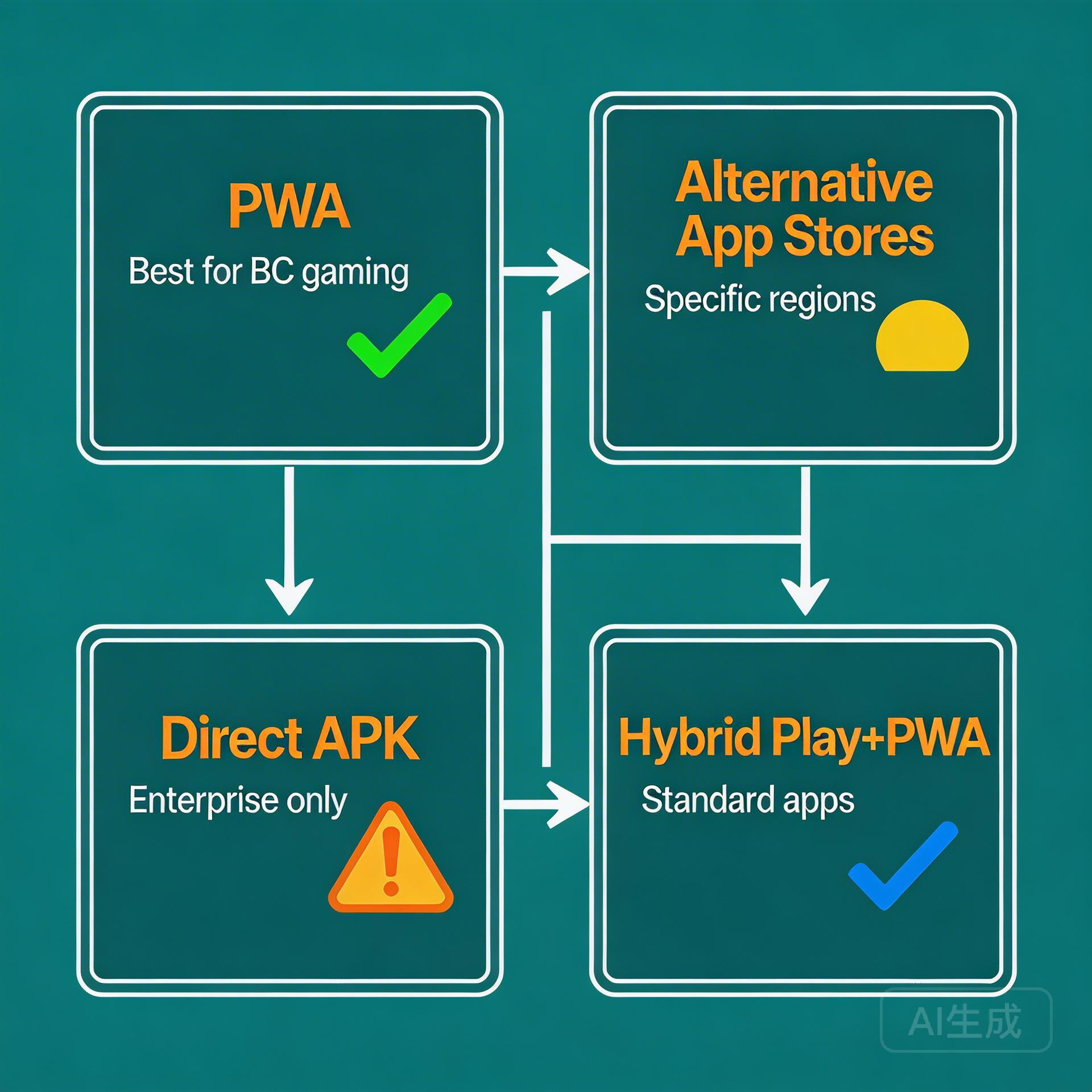
There are four realistic alternatives to Google Play for Android app distribution. Each has different use cases, economics, and technical requirements:
Option 1: Progressive Web Apps (PWA)
Best for: Teams that want the closest possible equivalent to a native app experience, with full control over distribution, revenue, and user data.
How it works: Users install the PWA directly from the browser by accepting an “Add to Home Screen” prompt. The PWA appears as a standalone app on the home screen with its own icon, launches in full-screen mode, and can access most native device APIs (push notifications, camera, geolocation, offline caching).
Key advantages:
- No app store review — instant deployment
- No commission on revenue
- Push notifications persist after icon removal
- 1.2x higher install conversion rate vs Google Play listing
- Faster updates — changes go live immediately without store approval
Limitations:
- No presence in Google Play discovery (search, browse, recommendations)
- Requires your own traffic acquisition strategy (paid ads, SEO, social)
- Some advanced native APIs still limited on Android Chrome (though coverage has expanded significantly in 2025–2026)
Install rate data: PWA install pages convert at 15%–30% for high-intent traffic vs 10%–22% for equivalent Google Play listing traffic. For teams running paid acquisition, the lower install funnel friction translates directly to lower cost-per-install.
Option 2: Alternative Android App Stores
Best for: Teams in specific geographic markets where alternative stores have significant user bases (Samsung Galaxy Store, Huawei AppGallery, Amazon Appstore).
How it works: Submit a standard APK to third-party Android app stores. Users discover and install your app through these stores instead of Google Play.
Key advantages:
- App store discovery channel remains available
- Some stores charge lower commissions (Amazon Appstore: 20%)
- Samsung and Huawei stores pre-installed on many Android devices
Limitations:
- Still requires app review (though typically faster than Google Play)
- Combined user base is much smaller than Google Play
- Push notifications still lost on uninstall
- Revenue commission still applies
Option 3: Direct APK Distribution
Best for: Enterprise apps, region-specific deployments, or teams with a direct channel to their users (email list, SMS, existing web users).
How it works: Distribute an Android APK file directly to users (via website download, email attachment, QR code). Users install with “allow from unknown sources” enabled.
Key advantages:
- No app store dependency whatsoever
- No commission
- Complete control over distribution
Limitations:
- Requires users to enable “unknown sources” — significant friction for consumer apps
- No automatic update mechanism (users must download new APK for each update)
- Push notifications lost on uninstall
- Trust and security concerns for consumers
Option 4: Hybrid PWA + Native
Best for: Teams that want Google Play presence for discovery while using PWA as the primary conversion and retention channel.
How it works: Maintain a lightweight Google Play listing that captures organic discovery traffic, while driving paid acquisition directly to the PWA install page. PWA handles monetization (no commission) and retention (push notifications).
This hybrid approach is increasingly common for mid-size gaming and AI app teams: Google Play is a billboard, PWA is the actual product distribution channel.
PWA Distribution: What the Numbers Say in 2026
For teams evaluating PWA distribution, the economic case has become significantly stronger over the past two years.
Install conversion rate comparison (2025–2026 benchmarks):
- Google Play listing (from paid ad): 10%–22% average install rate
- PWA install page (from paid ad, optimized): 15%–30% average install rate
- Gap: 1.2x–1.4x in favor of PWA for equivalent traffic
Revenue retention comparison (monthly example):
- App generating $200K/month in in-app purchases via Google Play: retains $140K (30% commission)
- Same app via PWA + direct payment: retains $194K (2.9% payment processor fee only)
- Monthly difference: $54K — or $648K per year
Retention comparison (90-day cohort data, gaming apps):
- Google Play: day-90 retention 8%–12%
- PWA with push re-engagement: day-90 retention 14%–20%
- Driver: post-uninstall push notifications recover 15%–25% of lapsed users
Related: PWA Push Notification After Uninstall Guide 2026 — how to set up the push retention system that drives these numbers.
Choosing the Right Distribution Strategy for Your App Type
BC Gaming Apps
PWA is the clear recommendation. BC gaming apps face the highest risk of Google Play rejection and the highest revenue commission impact. PWA provides:
- Instant deployment for new game versions
- No commission on in-app purchases
- Push notification retention that compensates for high churn rates typical in BC gaming
- Bypass of Google Play content policies that restrict certain BC gaming content
AI Social / AI Dating Apps
PWA is strongly recommended. These apps face category-level scrutiny on Google Play in many markets. PWA distribution removes the rejection risk entirely. The install funnel for AI social apps on PWA also outperforms Play Store — users are often directed from social media ads (Meta, TikTok) directly to a web-based install page, which is a more seamless funnel than app store redirect.
Casual Mobile Games (Standard Content)
Hybrid approach recommended: Google Play for discovery + PWA as the primary monetization and retention channel. Maintain a lean Google Play presence to capture organic search traffic, while routing paid acquisition to the PWA install page where the install rate is higher and revenue commission is eliminated.
Enterprise and B2B Apps
Direct APK distribution or PWA depending on the use case. For internal enterprise tools, APK distribution to managed devices is often the simplest path. For external-facing enterprise apps, PWA provides the best combination of accessibility (no store required), updates (instant), and control.
How to Evaluate PWA Distribution Platforms
If you’re choosing a PWA distribution platform rather than building your own, evaluate these criteria:
- Time to live: How quickly can you go from APK/codebase to a live PWA install page? Best-in-class platforms deliver under 48 hours.
- Push notification capability: Does the platform support push notifications that persist after icon removal? This is the core retention differentiator.
- Payment integration: What payment gateways are supported? Can you integrate your existing Stripe, Paddle, or custom payment system?
- Analytics depth: Can you track install rate by traffic source, session depth, and in-app event completion?
- Compliance and uptime: What’s the SLA? Can the platform handle your traffic volume during campaign launches?
For teams looking to move quickly, see how PWA landing page install conversion rate optimization works in practice — the setup process and expected timelines.
Transitioning from Google Play to PWA: A Migration Roadmap
For teams currently on Google Play who want to add or migrate to PWA, here’s the practical sequence:
- Audit your current app for PWA compatibility: Does your app use features that have no PWA equivalent? (Most common: certain payment APIs, deep device integration). Identify any gaps.
- Start with a parallel PWA launch: Don’t shut down Google Play immediately. Launch the PWA alongside the Play Store listing and run split-traffic tests with paid acquisition.
- Measure install rate and CPI side by side: Run identical ad creatives to both Google Play and PWA landing pages. Compare install rate, CPI, and post-install engagement.
- Migrate monetization to direct payments: Integrate your payment gateway into the PWA. Test the checkout flow end-to-end before removing Google Pay.
- Set up push notification re-engagement: Configure the push notification system before moving users from Play Store to PWA — this is the retention infrastructure that compensates for losing Play Store’s notification system.
- Gradual traffic migration: Shift paid acquisition traffic from Play Store 25% → 50% → 75% → 100% PWA over 60–90 days, monitoring CPI and post-install metrics at each step.
Summary: The Complete Google Play Alternative Framework for 2026
The decision tree for Android distribution in 2026:
- BC gaming or AI social app facing Play Store restrictions: → PWA distribution (ROiBest)
- Standard gaming or consumer app with paid acquisition: → Hybrid (Play Store for discovery + PWA for paid acquisition and monetization)
- App with strong organic Play Store presence and low rejection risk: → Keep Play Store, add PWA as revenue optimization layer
- Enterprise or internal tool: → PWA or direct APK depending on device management setup
The economics of PWA distribution are compelling in 2026: 1.2x higher install rates, 0% commission, and a retention advantage through post-uninstall push notifications. For teams where any of these advantages directly address a current business problem, PWA is no longer a “someday” consideration — it’s an immediate distribution upgrade.
Skip the app store. Go live instantly, keep 100% of your revenue.
ROiBest helps Android app teams launch PWAs — no review process, no 30% Google Play cut, and push notifications that work even after uninstall. Teams see up to 1.2x higher install conversion rates vs native app downloads.
 WebApp中文站
留下评论