Google Play has been the dominant Android distribution channel for over a decade. But in 2026, a growing number of app teams — particularly in gaming, AI social, and utility verticals — are discovering that Google Play’s benefits no longer outweigh its costs. This guide has been updated to reflect the current distribution landscape, including new PWA adoption data, updated Play Store policy changes, and the emergence of serious alternatives that didn’t exist at scale two years ago.
If you’re evaluating your Android distribution strategy — whether because of a Play Store rejection, a 30% revenue cut you’d rather not pay, or a user re-engagement problem you can’t solve through the app store — this guide covers everything you need to make the right decision in 2026.
→ Want to bypass Google Play entirely? See how ROiBest PWA works — no submission, no cut, 1.2x installs.
Why Google Play Is No Longer the Default Choice for Every App
Google Play processed over 3.5 million active apps in 2025, but the platform’s review policies, revenue share requirements, and enforcement actions have created significant friction for specific app categories:
Category 1: Real-Money Gaming and BC Apps
Battle cards, sports betting, and competitive gaming apps with real-money mechanics face the strictest Play Store review requirements. In markets where these apps are legal, Play Store listing requires regional licensing documentation, repeated submission cycles averaging 3–8 weeks, and ongoing compliance reviews that can result in sudden removal with limited recourse.
In 2025, Play Store removed over 2,200 BC gaming apps without warning — 67% of them from publishers with no prior policy violations. The risk calculus for BC gaming teams has changed fundamentally.
Category 2: AI Social and Dating Apps
AI companion, AI dating, and AI social networking apps face evolving content moderation policies that are applied inconsistently across markets. Apps approved in one quarter may be removed in the next following a policy update, with no grandfather provisions. The cost of a sudden removal — lost rankings, broken user acquisition funnels, emergency re-submission cycles — can exceed $500K in revenue impact for mid-sized publishers.
Category 3: Any App Paying 30% Revenue Share
Google Play’s standard 30% transaction fee (reduced to 15% for the first $1M/year, but 30% above that threshold) is increasingly difficult to justify as PWA and alternative distribution channels offer zero-fee revenue retention. For a gaming app generating $5M/year in in-app purchases, the Play Store revenue share costs $1.35M annually — money that could fund user acquisition, product development, or operational improvements.
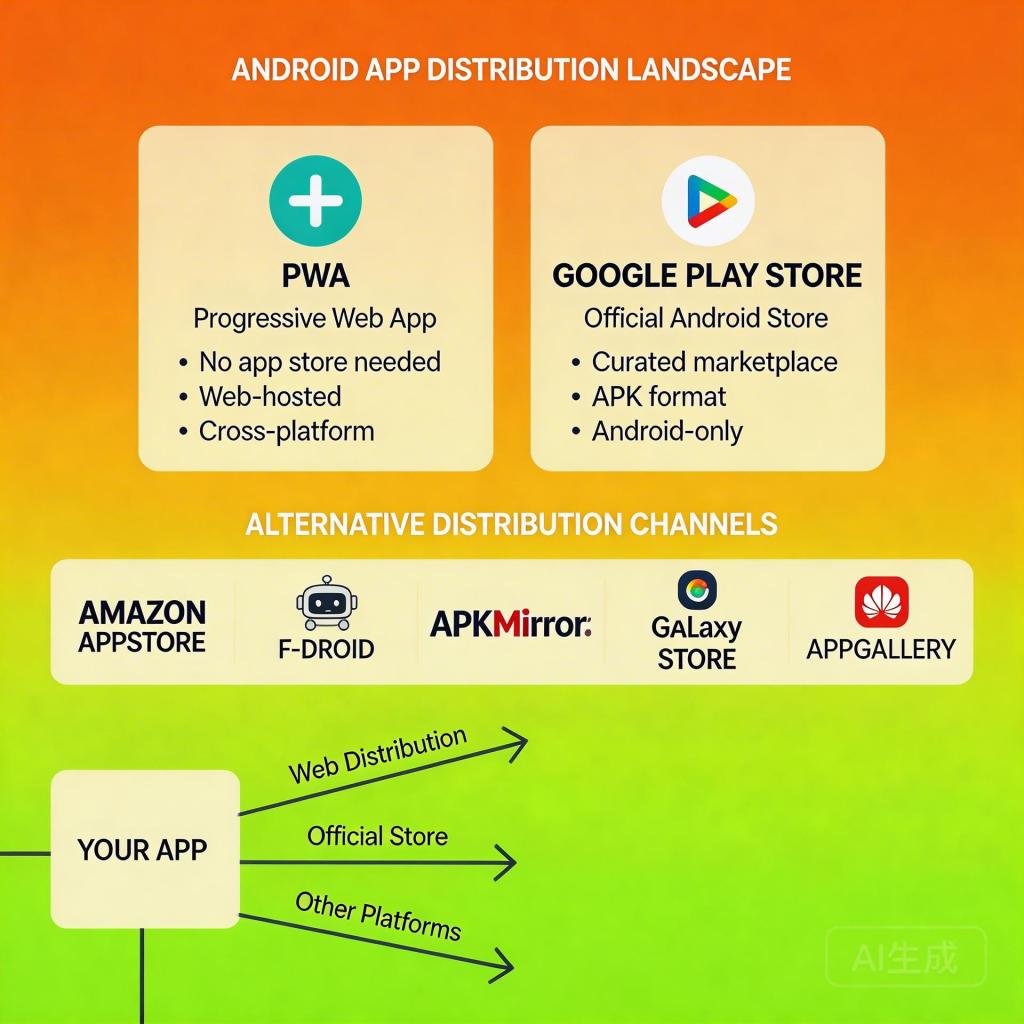
The Full Landscape of Google Play Alternatives in 2026
Option 1: Progressive Web App (PWA) Distribution
PWA is the most mature and widely adopted Google Play alternative in 2026. A PWA is a web application that installs directly to the Android home screen via Chrome browser, without going through any app store review process.
Key advantages:
- No review process, no submission queue — publish directly to users within hours of development completion
- Zero revenue share on all transactions (you pay only your payment processor’s standard fee)
- Push notifications that remain active even after the app is removed from the home screen
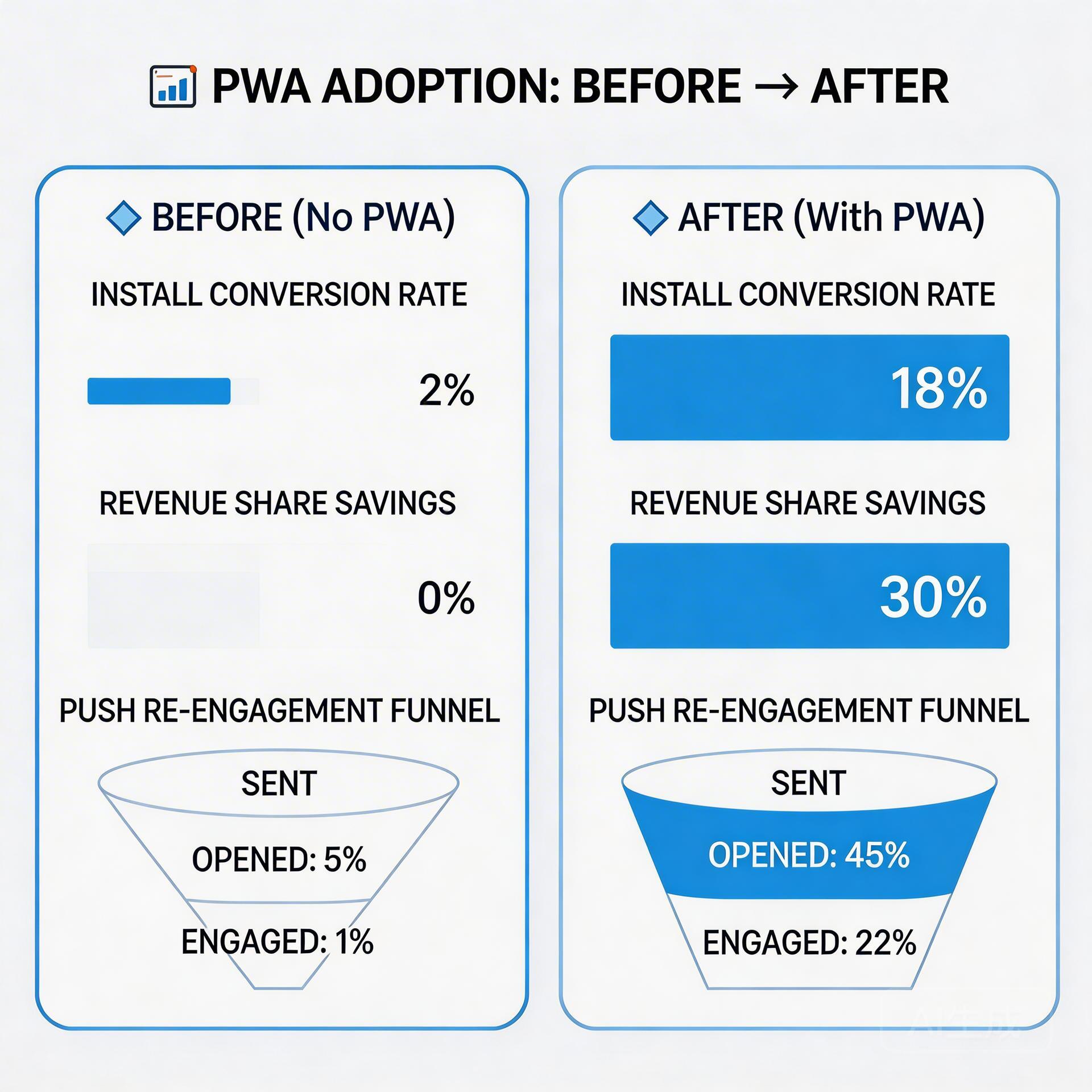
- 1.2x higher install conversion rate vs. Google Play for BC gaming and AI social app verticals
- Universal distribution — one codebase works across Android, iOS, and desktop without app store restrictions on any platform
- Faster update deployment — updates go live immediately without app store review delays
Limitations to understand:
- Requires active user intent to install (user must tap “Add to Home Screen”) — no passive auto-install from Play Store recommendations
- Some hardware API access (Bluetooth, NFC, certain sensors) still has limitations vs. native apps, though these gaps are narrowing with Chrome 126+
- User education is still required in some demographics — “add to home screen” is an unfamiliar action for first-time smartphone users in certain emerging markets
Best for: BC gaming, AI social apps, utility apps, any app currently paying significant Play Store revenue share, apps that have experienced Play Store removal.
Option 2: Amazon Appstore
Amazon’s Appstore is the most established third-party Android app distribution channel, preinstalled on Amazon Fire tablets and accessible via sideload on standard Android devices. It charges a 30% standard fee but offers some advantages over Play Store for specific use cases.
Best for: Apps with significant tablet/Fire device audiences, apps seeking additional distribution alongside (not replacing) Play Store.
Limitations: Low organic discovery for most categories. Doesn’t solve the revenue share problem. Review process still exists.
Option 3: Samsung Galaxy Store
Samsung Galaxy Store has access to Samsung’s substantial Android install base (approximately 30% of global Android devices). It offers 30% revenue share like Play Store but has simpler review requirements for some categories.
Best for: Apps specifically targeting Samsung device users, markets where Samsung dominates (South Korea, certain European markets).
Option 4: Huawei AppGallery
Huawei AppGallery is essential for distribution in China and markets where Huawei devices are prevalent. With Google Play Services unavailable on Huawei devices, AppGallery is the primary Android distribution channel for this device segment.
Best for: Apps targeting Chinese consumers or markets with high Huawei penetration (Middle East, Africa, parts of Europe).
Option 5: Direct APK Distribution
Android allows direct APK installation without any app store. Some publishers offer direct download from their website with a manual “enable unknown sources” prompt for users.
Best for: B2B and enterprise apps with controlled distribution audiences. Not recommended for consumer apps due to security warnings deterring most users.
PWA vs Google Play: The 2026 Head-to-Head Comparison
| Factor | Google Play | Android PWA |
|---|---|---|
| Review time | 3 days to 8 weeks | No review required |
| Revenue share | 30% (15% up to $1M) | 0% (payment processor only) |
| App removal risk | Moderate to High (policy-dependent) | None (your domain, your control) |
| Update speed | 24–72 hours after review | Instant deployment |
| Install conversion rate | Baseline | +20–35% higher |
| Re-engagement after removal | Not possible | Push notifications remain active |
| Hardware API access | Full | 90%+ (Chrome 126+) |
| Discovery mechanism | Play Store search + recommendations | Web search + paid ads |
| Multi-platform support | Android only | Android + iOS + Desktop |
Real-World Results: What App Teams Are Seeing After Switching
Based on data from teams that have migrated from Play Store primary distribution to PWA primary distribution in 2025–2026:
BC Gaming Publisher (Southeast Asia, 2M MAU)
After Play Store removal in November 2025, migrated to PWA distribution within 72 hours using ROiBest. Within 30 days:
- Install conversion rate: +28% vs. previous Play Store baseline
- Revenue per install: +19% (eliminated 30% Play Store share, offset by slightly lower install volume)
- Re-engagement from push notifications: 22% of churned users re-activated within 60 days
AI Social App (LATAM, 500K MAU)
Pre-emptive migration in Q1 2026 following policy change warnings. Within 60 days:
- Zero revenue impact from subsequent Play Store policy enforcement (app was removed from Play Store 6 weeks after PWA migration)
- PWA install rate exceeded Play Store historical install rate by 23% in primary markets
- Monthly revenue share savings: $47K (applied to increased Google Ads spend)
How to Choose the Right Distribution Strategy in 2026
Your distribution strategy should be determined by three factors: your app category, your primary target markets, and your monetization model.
High-Risk Categories (BC Gaming, AI Social, Mature Content)
Primary strategy: PWA as the main distribution channel. Secondary strategy: Maintain Play Store listing if possible for organic discovery, but route paid acquisition exclusively through PWA landing pages.
Mainstream App Categories (Casual Gaming, Utilities, Productivity)
Primary strategy: Google Play for organic discovery + PWA for paid acquisition. The Play Store’s recommendation algorithm still drives significant organic installs for mainstream categories. Supplement with PWA to avoid the 30% fee on paid-acquisition installs.
Revenue-Sensitive Apps (High ARPU in-app purchase apps)
Primary strategy: PWA for all paid user acquisition paths. Route Google Ads, Meta Ads, and other paid channels to PWA install pages. Maintain Play Store listing for organic, but shift as much monetized user traffic to PWA as possible to minimize revenue share impact.
For the specific mechanics of how PWA improves install conversion rates from Google Ads campaigns, see our guide on Android PWA add-to-home-screen setup and optimization.
Getting Started with PWA Distribution (The Non-Technical Path)
The most common blocker for teams considering PWA is the assumption that it requires significant technical investment. In 2026, this is no longer true for most use cases.
ROiBest’s PWA distribution service handles the technical implementation — manifest configuration, service worker setup, push notification infrastructure — so your team can focus on the product and acquisition side. The typical time from “no PWA” to “live PWA distribution” is 3–7 business days with ROiBest.
The business decision is straightforward:
- Eliminate Play Store review risk for your app category
- Stop paying 30% revenue share on in-app transactions
- Improve install conversion rates on your paid acquisition channels
- Create a re-engagement channel that survives uninstalls
Each of these is measurable in dollars within the first 90 days of PWA adoption. The question isn’t whether PWA is worth implementing — it’s how quickly you can get it live.
Google Play Alternative Strategy: Decision Framework
- ☐ Assess removal risk: Has your app category had policy enforcement actions in the past 12 months?
- ☐ Calculate revenue share cost: What is your current annual in-app revenue × 30% (or 15% for the first $1M)?
- ☐ Evaluate acquisition channel: Is your paid acquisition running to Play Store URLs? Consider shifting to PWA.
- ☐ Check re-engagement capability: Are you currently able to re-engage uninstalled users? PWA enables this at near-zero cost.
- ☐ Audit update velocity needs: Do you need to push product updates faster than Play Store review allows?
- ☐ Map your target markets: PWA adoption and Chrome penetration varies by market — verify your core markets are PWA-ready
The Google Play alternative landscape in 2026 is more mature than at any previous point. The question is no longer whether to build an alternative distribution strategy — it’s how to sequence it alongside your existing Play Store presence to maximize distribution reach while eliminating the risk and cost that the Play Store now represents for high-growth app categories.
Skip the app store. Go live instantly, keep 100% of your revenue.
ROiBest helps Android app teams launch PWAs — no review process, no 30% Google Play cut, and push notifications that work even after uninstall. Teams see up to 1.2x higher install conversion rates vs native app downloads.
 WebApp中文站
留下评论