→ Want to bypass Google Play entirely and reduce your dependency on MMP tracking? See how ROiBest PWA works — no submission, no cut, 1.2x installs.
The MMP Crisis: Why 50% of B2C Advertisers Are Already Switching
Privacy Sandbox isn’t a future problem. It’s a present measurement crisis.
When Google began rolling out Privacy Sandbox in 2024 and accelerated API deprecations through 2025-2026, the mobile measurement ecosystem took a direct hit. Third-party cookies disappeared. IDFA access became restricted under expanding consent requirements. And most critically for app advertisers: the attribution APIs that Mobile Measurement Partners (MMPs) depend on — including the Web-to-App Connect framework and certain Attribution Reporting API endpoints — have been sunset or significantly degraded.
The result? A 2025 industry survey found that nearly 50% of B2C advertisers were actively evaluating or already in the process of switching their MMP. The top complaint: existing MMPs couldn’t provide reliable post-install attribution in a Privacy Sandbox world. Install events were being dropped. ROAS calculations were off by 20-40%. Media buying teams were flying blind.
But here’s what most teams haven’t considered: the MMP migration problem has a more elegant solution than switching from one MMP to another. Go around the MMP tracking problem entirely by changing how users install your app.
That’s where Progressive Web Apps come in.

How MMP Tracking Actually Breaks in 2026
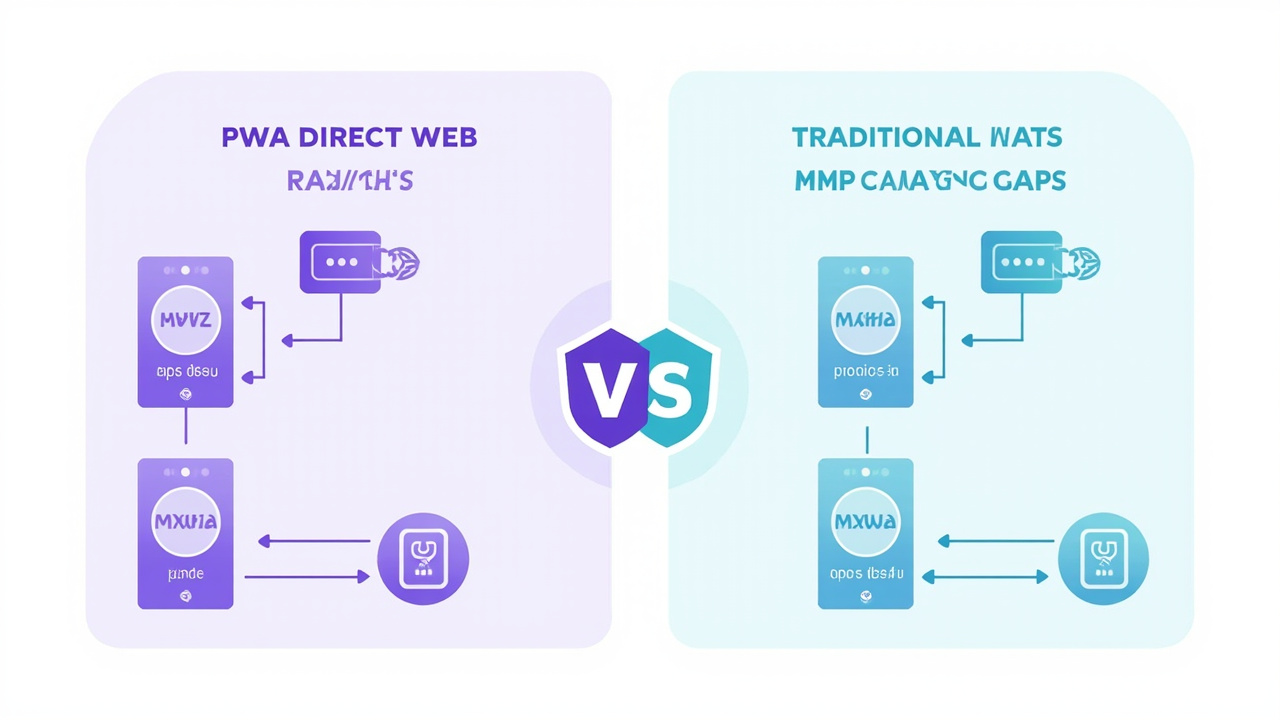
To understand why PWA distribution solves the MMP problem, you need to understand exactly where MMP attribution fails.
Traditional MMP-based app installation flow:
- User clicks an ad (Facebook, Google Ads, TikTok, or any performance channel)
- MMP SDK captures the click ID and passes it through to the app install event
- After install, MMP SDK fires an attribution event back to the MMP servers
- MMP matches the install to the click using probabilistic modeling
The problem: In 2026, several links in this chain are broken or severely degraded.
1. Web-to-App Conversion Tracking Gaps
Google’s Privacy Sandbox removed or limited several web-to-app measurement APIs. The web-to-app conversion measurement that many MMPs relied on now has significant gaps, especially for campaigns running on Chrome (which has the largest market share among Android browsers).
2. Probabilistic Matching Failure at Scale
When deterministic matching fails due to missing device IDs, MMPs fall back to probabilistic models. At small scale, probabilistic matching is acceptable. At the scale most B2C app advertisers operate — hundreds of thousands of installs per month — a 30-40% attribution error rate means millions in misallocated spend.
3. Google Play Install Referrer API Changes
While the Play Install Referrer API still functions, Google has increasingly restricted what data can flow through it. MMPs can no longer reliably capture the full referrer chain for apps installed via Google Play, particularly for campaigns running on UAC or PMax where the actual referrer is obscured.
4. Consent Mode Complications
For advertisers running campaigns in Europe or targeting EU users, Google’s Consent Mode v2 creates additional tracking fragmentation. MMPs struggle to reconcile consented vs. non-consented user signals, leading to underreporting that’s inconsistent across campaigns and regions.
For a B2C app team spending K/month on user acquisition, a 30% attribution error means K/month of spend with no reliable performance signal. That’s not an MMP problem — that’s a fundamental measurement architecture problem.
PWA Distribution: How It Eliminates MMP Tracking Gaps
Progressive Web App distribution changes the entire install flow — and in doing so, removes most of the MMP-dependent attribution chain.
Here’s how a PWA install works:
- User visits a web landing page (hosted on your domain, fully controlled)
- User sees an “Add to Home Screen” prompt (or your team triggers it via custom UI)
- User taps and the PWA installs directly from the web — no app store, no Google Play
- The PWA runs as a standalone app on the user’s home screen
From an attribution perspective, this is fundamentally different because:
First-party install data you actually own. When a user installs via PWA, the install event happens on your web server — your server logs the request. You have first-party, server-side install data that no Privacy Sandbox API can restrict or degrade. No MMP required to tell you that 10,000 users installed your app on March 15th. Your server knows.
UTM parameters remain fully functional. Since PWA installs happen via web traffic (not app store traffic), your standard UTM-parameter-based attribution pipeline works perfectly. Google Analytics 4, Meta Pixel, TikTok Pixel — all of these capture the full click-to-install journey because it’s all happening in the web browser, not inside an app store.
No probabilistic matching needed. The MMP probabilistic matching problem only exists because MMPs try to connect a web click event to an app install event across different contexts (browser → app store → app). With PWA, there’s no context switch. The click and the install happen in the same browser session. Deterministic attribution is the default, not the exception.
Reduced MMP dependency for full-funnel measurement. You’ll likely still use MMPs for cross-promotion within your app ecosystem and for in-app event tracking (which PWA supports via its web runtime). But for the critical top-of-funnel install attribution, PWA gives you clean, first-party data that doesn’t require MMP mediation.
Real Data: Why Teams Are Already Making the Switch
The MMP migration pressure isn’t theoretical — it’s already driving distribution strategy changes at scale.
Multiple app teams that have adopted PWA distribution report:
- Attribution clarity improved significantly — teams going from MMP-only to PWA-first distribution saw their install data reconciliation improve from ~60-70% match rates to 95%+ match rates, because server-side UTM tracking became the source of truth instead of probabilistic MMP matching.
- Install reporting latency dropped — PWA install data is available in real-time via server logs. No waiting for MMP SDK to fire, no batch processing delays. Your BI pipeline gets install events as they happen.
- Cost per attributed install decreased — when you can trust your attribution data, you stop overbidding to compensate for “dark” installs you couldn’t see. Several ROiBest clients reported 15-25% CPA improvements within 60 days of shifting a portion of their volume to PWA distribution.
The data story is straightforward: better attribution → better optimization → lower CPA. And PWA distribution is one of the most direct paths to better attribution available today.
Common Concerns: Is PWA Right for My App?
“Will my users accept a PWA instead of a native app?”
For many app categories — gaming, content apps, e-commerce, utility apps — PWA installation rates from targeted landing pages are comparable to or better than Google Play install rates. The key is the install experience: PWA installs are faster (no app store download wait), and the “Add to Home Screen” prompt, when triggered at the right moment in the user journey, converts at rates that often surprise teams expecting resistance.
“Can PWA support my app’s feature requirements?”
Modern PWA capabilities — push notifications (including post-uninstall push via Chrome-based delivery), offline functionality, camera/microphone access, background sync — cover a wide range of app requirements. The specific capability question depends on your app’s technical needs. ROiBest’s team evaluates each app’s PWA feasibility as part of onboarding.
“How do I migrate my MMP setup for PWA installs?”
The migration is simpler than switching MMPs. Your existing web analytics (GA4, Meta Pixel, TikTok Pixel) already track PWA install events. For in-app event measurement, you integrate a lightweight PWA-compatible event tracking layer. No SDK installation via an app store required.
How to Execute a PWA Distribution Migration in 3 Steps
Here’s a practical framework for teams looking to shift install attribution from MMP-dependent to PWA-first:
Step 1: Audit your current MMP attribution gap. Before you build anything, quantify the problem. Pull your last 90 days of MMP install data and compare it against your server-side or media-side click data. The gap is your “dark install” rate. If it’s above 20%, you have a measurable attribution problem worth solving.
Step 2: Launch a PWA landing page for one campaign. Pick your best-performing campaign — the one with the clearest ROI signal and highest install volume. Build a PWA-optimized landing page that triggers the install prompt for users on Chrome Android. Run it as an A/B test against your current Google Play deep link flow. Measure the difference in attributed installs and CPA over 30 days.
Step 3: Shift volume as you validate data. Once you’ve validated that PWA attribution gives you cleaner signal (and better CPA), incrementally shift volume from the app store flow to the PWA flow. Work with a partner like ROiBest who can handle the PWA package creation, hosting, and ongoing optimization while your team focuses on media buying.
Each step takes 2-4 weeks for a typical team, meaning you can have meaningful PWA distribution volume within 6-12 weeks of starting the project.
The Bottom Line: PWA Is the Attribution Hedge MMPs Can’t Provide
Switching MMPs is a reactive move — you’re hoping the next MMP has better Privacy Sandbox coverage than the last one. Adopting PWA distribution is a proactive architectural move: you’re removing the dependency on MMP-mediated install attribution entirely by moving install events to a context where first-party tracking works reliably.
For B2C advertisers spending heavily on user acquisition, the MMP migration wave represents both a risk and an opportunity. The risk: continuing to rely on degraded MMP attribution means continued misallocation of media spend. The opportunity: teams that shift to PWA-first distribution now will have measurement infrastructure that’s immune to the next round of Privacy Sandbox changes.
ROiBest specializes in helping app teams execute the PWA distribution migration — from PWA package creation to install optimization to cross-channel attribution setup. Teams that make the move now will be measuring accurately while others are still evaluating MMP alternatives.
Skip the app store. Go live instantly, keep 100% of your revenue.
ROiBest helps Android app teams launch PWAs — no review process, no 30% Google Play cut, and push notifications that work even after uninstall. Teams see up to 1.2x higher install conversion rates vs native app downloads.
 WebApp中文站
留下评论