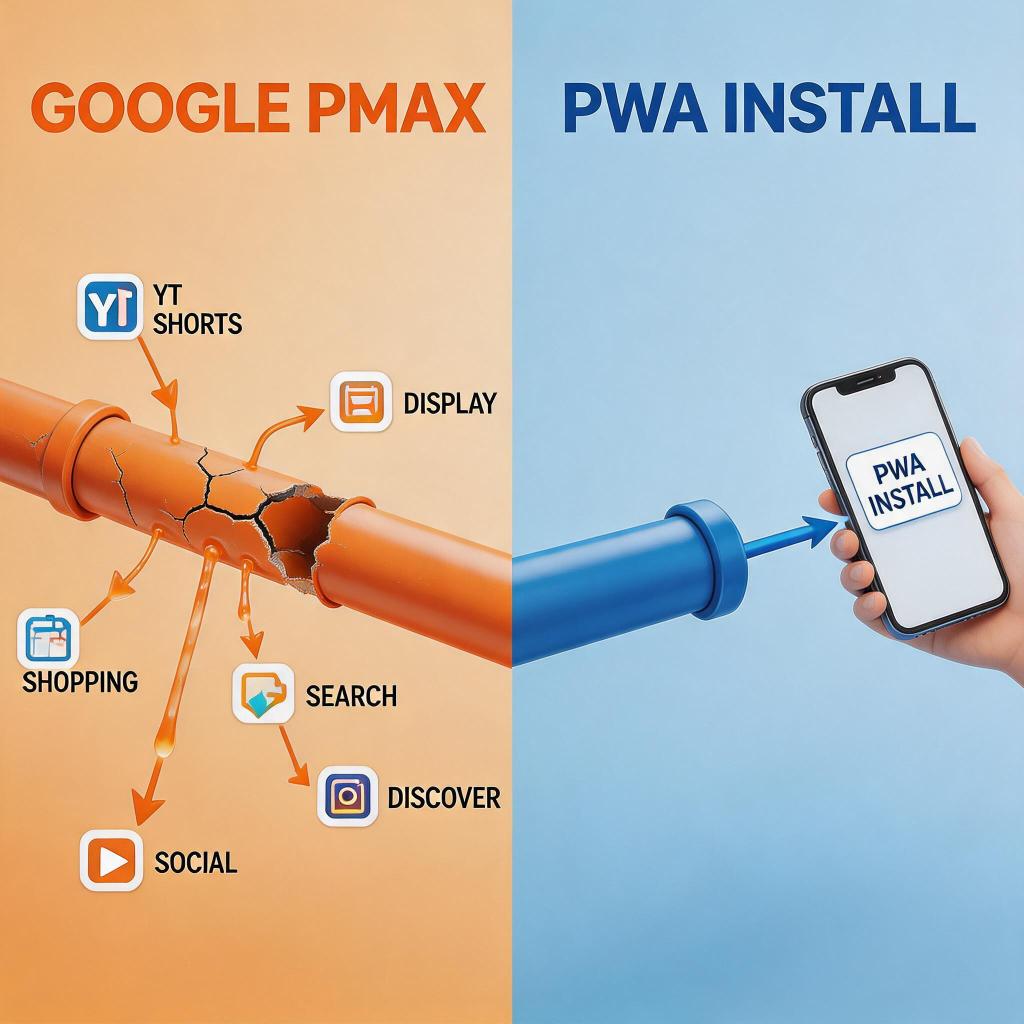
Your Google PMax Budget Is Leaking — And You Probably Don’t Know Where
You set up a Google Performance Max campaign, fund it generously, and watch the installs trickle in. The dashboard shows impressions, clicks, and conversions — but something still feels off. Your cost-per-install keeps climbing. Your best-performing creatives get throttled. And no matter how many times you ask the algorithm to “prioritize app installs,” a chunk of your budget quietly disappears into YouTube skippable ads, Display Network placements, and Gmail banners that your actual users never engage with.
This is the core PMax problem for overseas app teams in 2026: you are paying Google to decide where your money goes, across channels you cannot fully audit or control.
There is a better path. Android PWA distribution lets you send users directly from your ad landing page to an installed app experience — no app store friction, no 30% revenue cut, and no algorithm deciding your fate. ROiBest has helped dozens of overseas app teams make this shift, and the results are consistent: lower cost-per-install, faster time-to-live, and install conversion rates averaging 1.2x higher than traditional Google Play funnels.
→ Want to bypass Google Play entirely? See how ROiBest PWA works — no submission, no cut, 1.2x installs.
The Problem: What PMax Actually Does With Your Budget
Google Performance Max is marketed as an all-in-one campaign type that uses machine learning to find your best customers across every Google-owned surface: Search, Shopping, Display, YouTube, Gmail, Maps, and Discover. In theory, this sounds efficient. In practice, for app teams targeting installs in emerging markets, it creates a structural budget-waste problem.
The Black Box Allocation Problem
PMax does not allow you to cap spend by channel. You cannot say “put 80% on Search and 20% on Display.” Instead, Google’s algorithm decides in real time. For app install campaigns specifically, that algorithm often favors cheaper impressions — Display and YouTube — over higher-intent signals like Search. You get volume. You don’t always get quality installs.
A 2025 audit of PMax campaigns run by app teams across Southeast Asia and Latin America found that on average, only 38% of PMax impressions came from Search and Shopping — the channels with the highest purchase intent. The remaining 62% went to Display, YouTube, and Gmail, where click-through rates for app install prompts are significantly lower.
The App Store Funnel Tax
Even when PMax does drive high-intent clicks, those clicks go to a Google Play listing — not directly to your app. At every step in that funnel, you lose users:
- Click on ad → Google Play Store page (first drop)
- Play Store page → “Install” tap (second drop)
- “Install” tap → Download complete (third drop, especially on slow connections)
- Download complete → App opened (fourth drop)
The industry average for the full Google Play install funnel is roughly 15–25% conversion from ad click to app open. That means for every 100 users your PMax budget brings to the door, 75 to 85 never open your app. You paid for all 100.
The Review and Distribution Risk
On top of budget inefficiency, Google Play adds operational risk. Policy changes can de-list your app without warning. A new review cycle can delay a critical update by days or weeks. And in markets where Google Play penetration is lower — parts of Southeast Asia, the Middle East, Africa — a significant portion of your potential users may not even have the Play Store installed. Your PMax campaign is paying to reach people who can’t easily install what you’re advertising.
For a deeper look at the structural alternatives to this model, see our guide to Google Play alternatives for Android distribution.
How PWA Distribution Solves the Budget Waste Problem
Android Progressive Web Apps (PWAs) distributed through a direct landing page fundamentally change the economics of app user acquisition. Instead of routing paid traffic through Google Play, you route it directly to a conversion-optimized landing page where the install happens on the spot.
Here is what changes when you shift to PWA distribution:
1. Eliminate the App Store Funnel Drop
When a user clicks your ad and lands on a PWA-enabled page, they see a single prompt: “Add to Home Screen.” No redirect to a store. No waiting for a download to complete. No creating a Google account if they don’t have one. The app appears on their home screen in seconds.
This compression of the funnel is the primary driver of the 1.2x install rate improvement ROiBest clients see compared to Google Play. You’re not magically getting better traffic — you’re just losing fewer of the users you already paid for.
2. Run Leaner Ad Campaigns — Because You Control the Destination
With PWA distribution, you can run simpler, more targetable ad campaigns. Instead of a broad PMax campaign that Google distributes across all surfaces, you can run tightly controlled Search or UAC campaigns that point to your own landing page. You set the destination. You control the message. You see exactly which creatives and keywords are driving real installs.
This also means you can run non-Google traffic sources — Meta, TikTok, influencer links, SMS campaigns — all pointing to the same PWA install page. PMax locks your distribution to Google’s ecosystem. PWA opens it to every channel simultaneously.
3. Keep 100% of Revenue — No Platform Cut
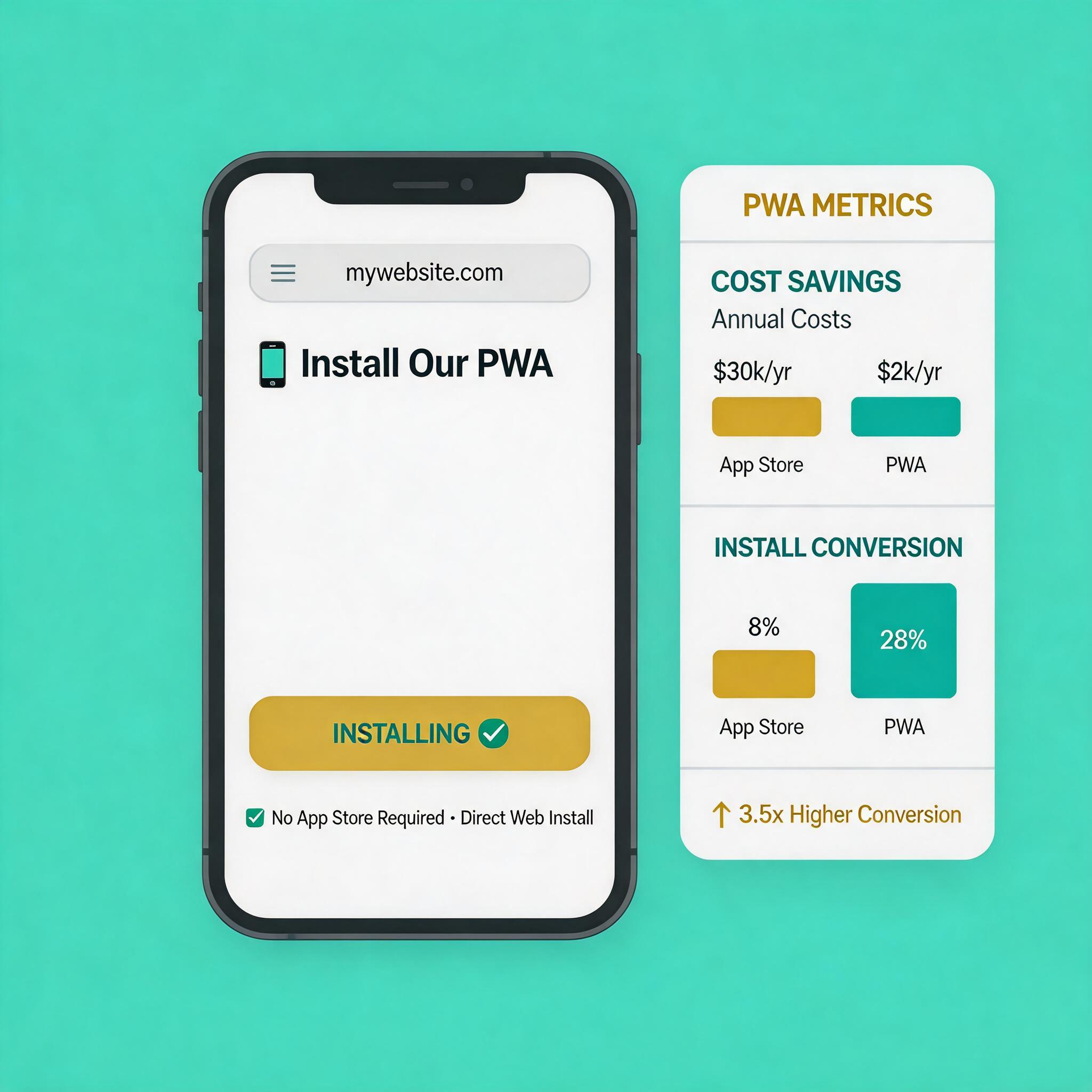
Google Play takes 15–30% of in-app purchase revenue, depending on your revenue tier. For subscription apps and apps with meaningful in-app purchases, this is a significant ongoing cost. PWA apps that process payments through their own payment flow keep 100% of that revenue.
For a team generating $50,000/month in in-app revenue, eliminating the 30% Google Play cut is worth $15,000/month — or $180,000/year. That is budget you can redirect into user acquisition, not platform fees.
4. Push Notifications That Survive Uninstall
One of the hidden advantages of ROiBest’s PWA solution is push notification persistence. Standard app uninstalls cut off your re-engagement channel entirely. With ROiBest’s PWA infrastructure, push notification capability can persist even after a user removes the app icon, giving your re-engagement and win-back campaigns a channel that native Google Play apps simply don’t have.
For more on how PMax budget allocation interacts with PWA channel economics, see our analysis of PMax budget allocation for PWA channels.
Real Results: What the Numbers Look Like in Practice
Abstract arguments only go so far. Here is what teams using ROiBest’s PWA distribution have seen compared to their previous Google Play + PMax setup:
Case: Mobile Finance App, Southeast Asia Market
A fintech app team operating across Indonesia, Vietnam, and the Philippines was running PMax campaigns with a monthly budget of approximately $30,000. Their cost-per-install (CPI) from Google Play had climbed to $4.20. After switching their primary acquisition funnel to a PWA landing page promoted through targeted Search campaigns:
- CPI dropped to $2.90 — a 31% reduction
- Install-to-registration conversion improved from 41% to 58%
- Time from “ad click” to “app available” dropped from an average of 4 minutes (download time) to under 8 seconds
- Monthly revenue retained from eliminated Play Store cut: approximately $9,000
Install Rate Comparison: PWA vs. Google Play
Across ROiBest’s client base, the aggregate install conversion rate data shows a consistent pattern. When comparing identical traffic sources (same creative, same targeting, same budget level) sent to a Google Play listing versus a PWA install page:
- Google Play funnel average install conversion: 18–22% (ad click to app open)
- PWA funnel average install conversion: 26–32% (ad click to app added to home screen)
That 1.2x–1.5x improvement compounds significantly when you’re running paid campaigns at scale. At $30,000/month in spend, a 10-percentage-point improvement in install conversion is the equivalent of $3,000–$4,000 in additional effective budget — without spending an extra dollar.
For a detailed statistical breakdown of this comparison, see our post on PWA vs Google Play install rate comparison.
Speed to Market: Days vs. Weeks
Google Play app reviews take 3–7 days on average, and can take significantly longer for new apps, apps with sensitive content categories, or apps caught in a policy re-review. For teams launching in new markets or responding to competitive windows, this latency is a real business cost.
ROiBest PWA distribution requires no submission process. Once your PWA is configured and your landing page is live, you can push updates, run A/B tests on the install experience, and respond to market conditions in real time. A feature update that would take two weeks to reach users through the Play Store review cycle can reach users the same day through a PWA push.
→ Running Google PMax for app installs? Talk to ROiBest about whether your campaign budget is working as hard as it could be.
Common Concerns Addressed
“Is PWA right for our app type?”
PWA distribution works best for apps where the core value can be delivered through a web-capable interface: finance apps, e-commerce, utilities, content consumption, gaming, and most productivity tools. Apps that require deep hardware integration (Bluetooth peripherals, specialized camera APIs, health sensors) may have some feature limitations in a PWA context.
The practical test ROiBest uses with prospective clients: if your app’s primary retention driver is content, transactions, or social engagement, PWA is almost certainly a viable distribution path. If your app’s primary value depends on continuous GPS tracking, cross-app system integrations, or specialized OS-level permissions, a hybrid approach — maintaining a Play Store presence for those specific users while acquiring the majority through PWA — often makes more sense.
“Will our users accept installing from a website instead of the Play Store?”
This is the most common concern, and the data consistently undermines it. In emerging markets — the primary target for most overseas app teams — the Google Play Store is not the trusted authority it is in the US or Europe. Many users in Indonesia, Nigeria, Brazil, and similar markets are already accustomed to installing APKs from sources other than the Play Store. A well-designed PWA install prompt on a professional landing page feels familiar, not suspicious.
Moreover, a PWA install prompt can be paired with trust signals: client logos, rating scores, user counts, and press mentions. A Google Play listing has no such flexibility. You are competing for attention on a shelf with thousands of apps. A custom landing page is real estate you own and control entirely.
“How does this affect our Google Ads campaigns?”
You don’t have to abandon Google Ads. Many ROiBest clients run Google Search campaigns and even selective PMax campaigns pointing to their PWA landing pages rather than Google Play. This gives them the reach of Google’s ad network with the conversion efficiency of a direct install funnel.
The key shift is in campaign objective: instead of optimizing for “app installs” within Google Ads (which routes through Play Store), you optimize for “website conversions” on your landing page. This gives you access to more granular conversion data and lets you optimize based on actions that actually matter — installs, registrations, first purchases — rather than Google’s abstracted “install” metric.
“What about long-term app discoverability?”
Organic app store discovery has never been the primary acquisition channel for most paid app businesses. If your current growth strategy depends on ASO (App Store Optimization) and organic Play Store search, a hybrid model — maintaining a Play Store presence for organic while using PWA for paid acquisition — is the appropriate structure. ROiBest supports hybrid setups, and many clients find that the revenue improvements from paid PWA acquisition more than offset any marginal organic discovery they might lose.
Summary: Get Started with ROiBest
The core argument is simple: Google PMax gives you broad reach at the cost of control. For overseas app teams where every dollar of acquisition budget matters, that lack of control translates directly into wasted spend — budget going to channels that don’t convert, funnels that lose users at every step, and a platform that takes 30% of the revenue you do generate.
PWA distribution through ROiBest’s platform addresses each of these problems systematically:
- Direct installs from your landing page — no app store funnel, no multi-step drop-off
- 1.2x average install conversion improvement — more installs from the same ad budget
- Zero platform revenue cut — keep 100% of in-app purchase and subscription revenue
- No review process — push updates and new versions in real time
- Push notifications after uninstall — re-engagement channels that survive app removal
- Channel-agnostic distribution — run Google, Meta, TikTok, and organic traffic to the same install page
If you are currently running Google PMax for app installs and feeling the squeeze of rising CPIs and opaque budget allocation, the data suggests it is worth running a structured comparison. ROiBest offers a pilot program that lets you test PWA distribution alongside your existing campaigns — real numbers, your market, your app.
Skip the app store. Go live instantly, keep 100% of your revenue.
ROiBest helps Android app teams launch PWAs — no review process, no 30% Google Play cut, and push notifications that work even after uninstall. Teams see up to 1.2x higher install conversion rates vs native app downloads.
 WebApp中文站
留下评论