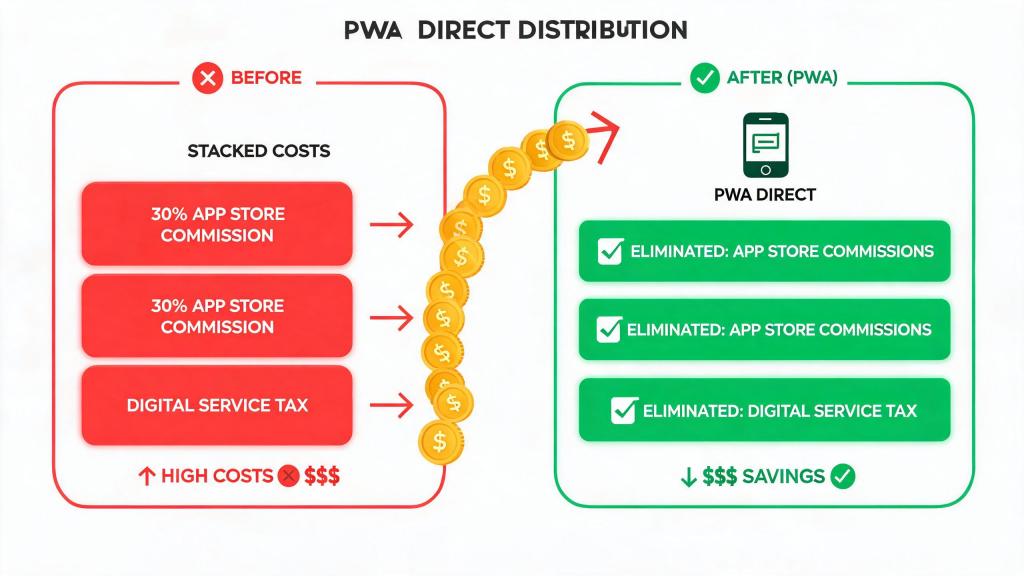
If you run ads on Meta and distribute your app through Google Play, 2026 is about to get more expensive. Starting July 1, Meta will add “location fees” — surcharges of 2% to 5% — on every ad impression served in six countries. Meanwhile, Google Play still takes up to 20-25% of your in-app revenue through commissions and billing fees. For cross-border app teams, these two cost layers compound into a serious margin problem.
But there is a way to eliminate both. PWA (Progressive Web App) distribution bypasses the app store entirely — no commission, no review process, no platform-imposed taxes passed on to you. And services like ROiBest handle the entire packaging and deployment, so your team does not need to touch a line of code.
→ Want to bypass Google Play entirely? See how ROiBest PWA works — no submission, no cut, 1.2x installs.
Meta Digital Service Tax: What the New Location Fees Mean for Advertisers
Meta announced in March 2026 that it will begin charging advertisers “location fees” on ad impressions delivered to users in six countries. These fees are Meta’s way of passing Digital Service Taxes (DST) directly to advertisers — taxes that Meta had previously absorbed since these countries first enacted them.
Here is the country-by-country breakdown, effective July 1, 2026:
- Austria: 5% surcharge
- France: 3% surcharge
- Italy: 3% surcharge
- Spain: 3% surcharge
- Turkey: 5% surcharge
- United Kingdom: 2% surcharge
Several critical details make these fees more impactful than they initially appear:
The fee is based on where ads are shown, not where your business is located. If you are based in Southeast Asia or China but running campaigns targeting UK or European audiences, you pay the surcharge. This is especially relevant for cross-border e-commerce and app teams targeting Western markets.
Location fees are invisible in Ads Manager. They do not appear in your campaign reporting metrics. They only show up on your invoice. This means your in-platform ROAS calculations will be wrong — your actual cost per acquisition is higher than what Meta reports.
Campaign budget optimization does not account for these fees. If you set a $10,000 budget, Meta will spend $10,000 on impressions and then add location fees on top. Your total invoice could be $10,200 to $10,500, depending on the audience geography. VAT is then calculated on the combined total of ad spend plus location fee, adding another layer.
More countries are likely coming. Google, Amazon, and Apple have been passing DST costs to advertisers since 2020. With more than 40 countries worldwide either implementing or considering digital service taxes, the list of countries subject to these surcharges will almost certainly expand. Canada, India, Kenya, and several Latin American nations have active DST proposals. For cross-border operators targeting multiple regions, this is not a one-time cost increase — it is a structural trend.
Real Cost Impact: A Worked Example
Consider a mid-size cross-border app team spending $50,000 per month on Meta ads, with 40% of impressions delivered in DST-affected countries (a common split for teams targeting European and Turkish markets):
- Ad spend in DST countries: $20,000
- Average blended DST surcharge (assuming a mix of UK, France, Italy, Spain): approximately 3%
- Monthly location fee: $600
- Annual location fee cost: $7,200
- Add VAT on the surcharge (e.g., 20% in UK, 19-22% in EU): another $1,200-$1,600 per year
Total added annual cost from Meta DST alone: approximately $8,400 to $8,800. And that figure assumes current rates with only six countries. As more nations adopt DST, the percentage of your impressions subject to surcharges will grow.
Google Play Commission + Digital Tax: The Double Cost Pressure for Cross-Border Apps
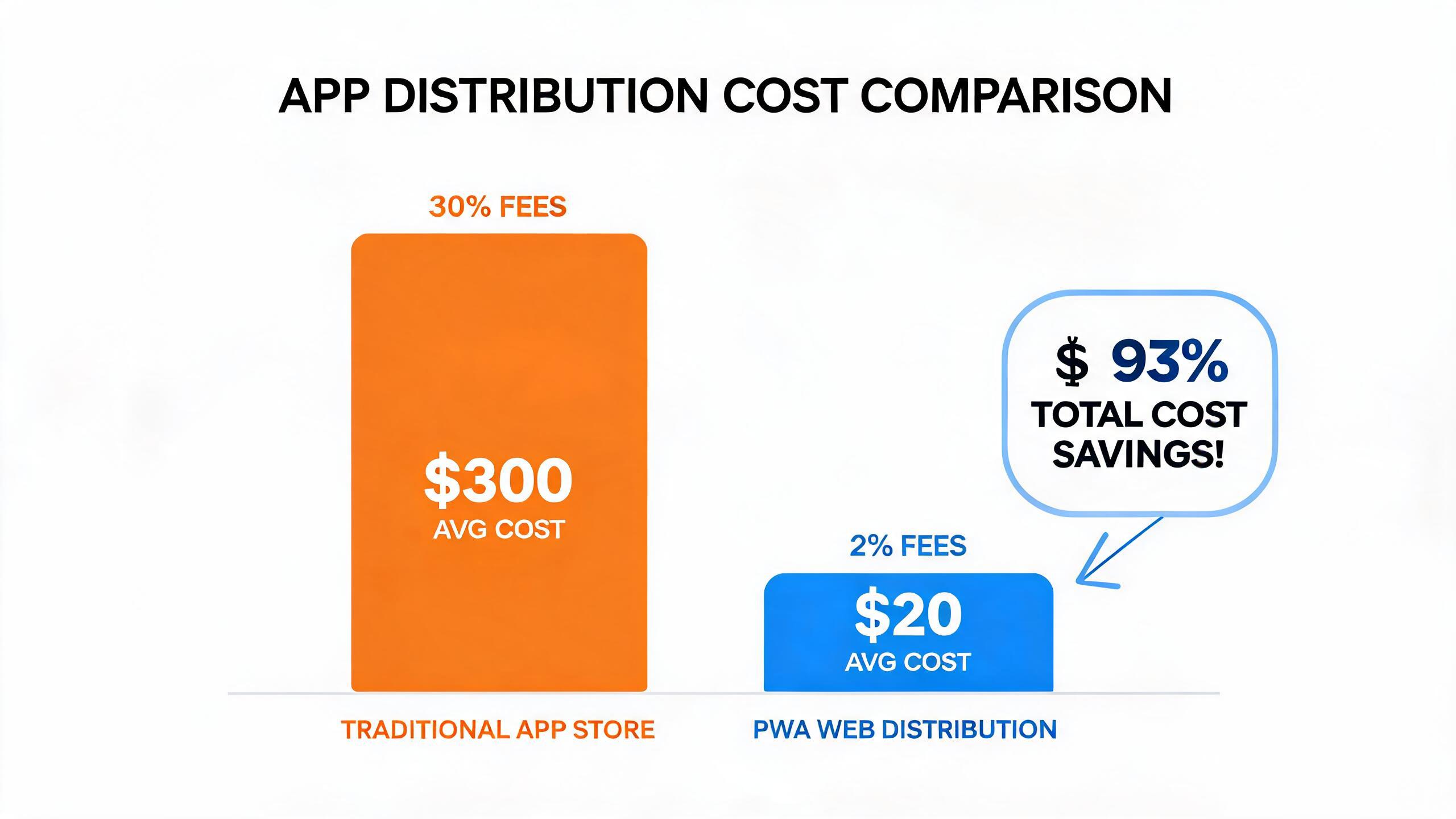
Meta’s new location fees do not exist in isolation. For app teams distributing through Google Play, they layer on top of an already expensive distribution model.
Google Play’s Current Fee Structure (2026)
Following the landmark Epic Games v. Google settlement, Google Play has restructured its commission rates. As of mid-2026, the fee structure in the US, UK, and EEA is:
- In-app purchases (new installs): 20% service fee + 5% if using Google’s billing system = up to 25%
- Subscriptions: 10% service fee + 5% billing fee = up to 15%
- First $1 million in annual revenue: Reduced rates apply under the Small Developer program
While the headline “30% is dead” sounds like good news, the practical reality for most cross-border app teams is still steep. If your app generates $100,000 per month in in-app revenue through Google Play, you are handing over $20,000 to $25,000 to Google every single month. That is $240,000 to $300,000 per year in platform fees alone.
The Compounding Problem
Now combine both cost layers for a cross-border app team doing $50,000/month in Meta ad spend and $100,000/month in Google Play in-app revenue:
- Meta DST surcharges: ~$7,200-$8,800/year (and growing as more countries adopt DST)
- Google Play commissions: $240,000-$300,000/year (at 20-25%)
- Total platform taxes and fees: $247,200 to $308,800 per year
For many cross-border teams, especially those in competitive verticals like gaming, fintech, or social apps, this level of platform cost directly impacts whether the business is viable. Every dollar lost to commissions and surcharges is a dollar that cannot be reinvested in user acquisition, product development, or market expansion.
Additional Hidden Costs of Google Play Distribution
The commission is the headline number, but Google Play distribution carries other costs that rarely make it into budget projections:
- Review delays: App updates can take days or even weeks for review. For apps that rely on rapid iteration (A/B testing, feature launches, compliance updates), each delay has an opportunity cost.
- Rejection and removal risk: Policy changes can result in app removals with little notice. Cross-border apps in categories like finance, social, and gaming face higher scrutiny and more frequent policy enforcement actions.
- Update fragmentation: Users must manually update apps or wait for auto-updates. This creates version fragmentation, increases support costs, and slows adoption of new features.
- Geographic restrictions: Google Play availability and policies vary by country. Some markets have limited Play Store penetration, forcing teams to maintain alternative distribution channels anyway.
PWA Distribution: Skip the Platform, Eliminate Both Cost Layers
Progressive Web Apps offer a fundamentally different distribution model. Instead of submitting your app to Google Play and paying commissions on every transaction, a PWA is installed directly from a web link — no store, no middleman, no revenue share. And because there is no app store submission, there are no platform-imposed tax surcharges passed through to you either.
Here is how a PWA distribution strategy works in practice, using a service like ROiBest that handles the technical packaging:
Step 1: Convert Your Existing App to a PWA Package
ROiBest takes your existing web-based app or mobile app and packages it as a PWA optimized for Android devices. You do not need to rebuild your app or hire PWA developers. The service handles the technical conversion, including service worker configuration, manifest files, and install prompts.
The result is an app that looks and behaves like a native Android app — it has an icon on the home screen, runs in its own window, supports push notifications, and works offline. Users cannot distinguish it from a native app downloaded from Google Play.
Step 2: Distribute Directly Through Your Ad Campaigns
Instead of sending users to a Google Play listing, your Meta ads (or any other traffic source) link directly to your PWA install page. Users tap “Install” and the app is added to their device in seconds — no store account required, no download queue, no 200MB APK to wait for.
This is where the cost savings become dramatic:
- Zero Google Play commission: All in-app purchases and subscriptions go directly to your payment processor. You keep 100% of revenue minus standard payment processing fees (typically 2.9% + $0.30).
- No DST pass-through on distribution: Since there is no app store intermediary, there is no platform to pass digital service taxes to you. Your Meta ad costs still include the location fee, but the Google Play revenue share — which is where the real money leaks — is completely eliminated.
- Higher install conversion rates: ROiBest clients report up to 1.2x higher install conversion rates compared to Google Play downloads. The reason is friction reduction — no store redirect, no account sign-in, no download progress bar. The user goes from ad click to installed app in under 10 seconds.
Step 3: Retain Users With Push Notifications That Survive Uninstall
One of the most powerful features of PWA distribution through ROiBest is push notification capability that continues to work even after a user removes the app icon from their home screen. This is a critical advantage for re-engagement and retention, especially in markets where users frequently clear space on their devices.
With Google Play distribution, once a user uninstalls your app, your only re-engagement channel is paid ads — bringing you right back to the rising cost problem. With PWA distribution, you maintain a direct communication channel at zero marginal cost.
Step 4: Deploy Updates Instantly, No Review Process
PWA updates are server-side. When you push a new version, every user gets it automatically the next time they open the app. There is no app store review process, no approval wait time, and no version fragmentation. This is especially valuable for cross-border teams that need to respond quickly to regulatory changes, market conditions, or competitive moves.
Step 5: Scale Across Markets Without Platform Restrictions
Google Play availability and policies vary significantly across markets. Some countries have low Play Store penetration, and certain app categories face regional restrictions. PWA distribution eliminates these barriers entirely. Your app is accessible from any Android browser in any country. There are no geographic restrictions, no category-specific policies, and no risk of removal due to platform policy changes.
The Financial Impact: A Side-by-Side Comparison
Let us revisit our earlier example — a cross-border app team with $50,000/month in Meta ad spend and $100,000/month in in-app revenue — and compare the two distribution models:
Google Play Distribution (Current Model):
- Meta ad spend: $600,000/year
- Meta DST surcharges: ~$8,000/year
- Google Play commission (20-25%): $240,000-$300,000/year
- Total platform costs: ~$248,000-$308,000/year
- Net revenue after platform fees: $700,000-$752,000/year (from $1.2M in-app revenue)
PWA Distribution via ROiBest:
- Meta ad spend: $600,000/year
- Meta DST surcharges: ~$8,000/year (unchanged — you still pay on ad impressions)
- Google Play commission: $0
- Payment processing (2.9%): ~$34,800/year
- Total platform costs: ~$42,800/year
- Net revenue after platform fees: ~$957,200/year (from $1.2M in-app revenue)
Annual savings from switching to PWA distribution: approximately $205,000 to $265,000. That is a 27% to 35% reduction in total platform costs, or enough to fund an entirely new market expansion.
Summary and Action Checklist
The cost environment for cross-border app distribution is shifting decisively against teams that rely solely on traditional app store channels. Meta’s new digital service tax surcharges add 2-5% on top of ad spend in six countries (with more likely to follow). Google Play’s commissions, even after the Epic settlement, still consume 20-25% of in-app revenue. Together, these platform costs can exceed $300,000 per year for a mid-size operation.
PWA distribution is the most direct way to eliminate the largest of these cost layers. No Google Play commission. No app store review risk. Higher install conversion rates. Push notifications that work even after uninstall. And instant updates with zero approval wait time.
Here is your action checklist:
- Audit your current platform costs. Calculate your actual Google Play commission payments and Meta DST exposure based on your audience geography. Most teams underestimate these costs because they are spread across multiple invoices and reporting systems.
- Model the PWA savings. Take your monthly in-app revenue, subtract standard payment processing fees (2.9%), and compare that to your current Google Play net. The difference is your annual savings opportunity.
- Evaluate your Meta campaign geography. Identify what percentage of your impressions are served in DST countries. If it is above 20%, the Meta surcharge alone justifies reviewing your distribution strategy.
- Talk to ROiBest about a PWA pilot. You do not need to switch all traffic at once. Start with a test — redirect a portion of your ad traffic to a PWA install flow and compare conversion rates, retention, and revenue per user against your Google Play baseline.
- Plan for DST expansion. Build your 2026-2027 budget with the assumption that more countries will adopt digital service taxes and more platforms will pass those costs to advertisers. A distribution model that is insulated from platform taxes is not just a cost saving — it is a strategic hedge.
The teams that move early on PWA distribution will have a structural cost advantage over competitors still locked into app store dependency. The question is not whether platform costs will keep rising — it is whether you will keep absorbing them.
Skip the app store. Go live instantly, keep 100% of your revenue.
ROiBest helps Android app teams launch PWAs — no review process, no 30% Google Play cut, and push notifications that work even after uninstall. Teams see up to 1.2x higher install conversion rates vs native app downloads.
 WebApp中文站
留下评论