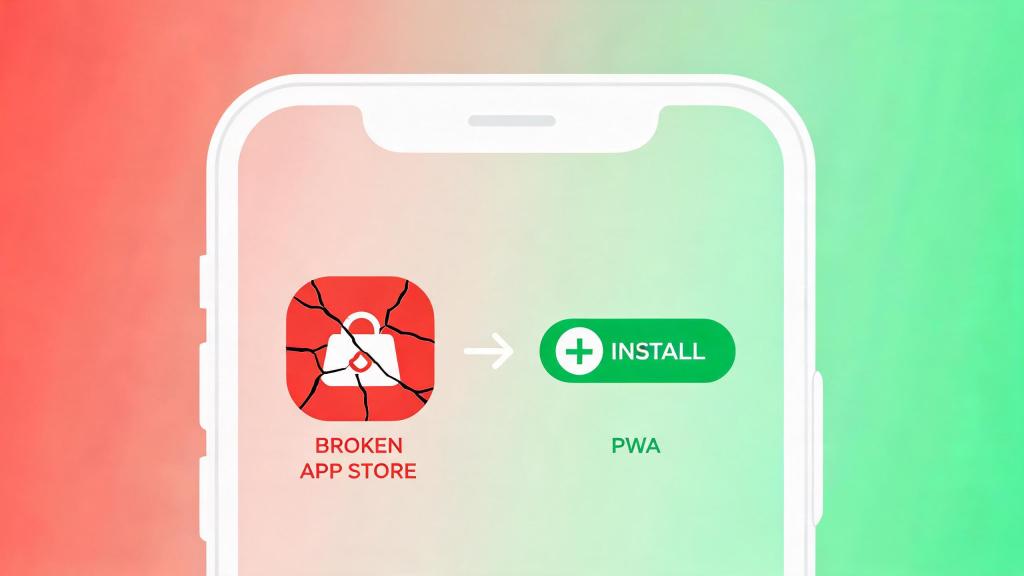
Every year, thousands of Android apps vanish from Google Play overnight. A policy update, an algorithm flag, a compliance change no one saw coming — and suddenly your revenue stream, your user base, your entire distribution channel is gone. If you are an overseas operations manager running a gaming, BC, or AI-powered app, this is not a hypothetical scenario. It is a quarterly reality. The good news: Progressive Web Apps (PWAs) offer a distribution path that no app store can take away from you.
→ Want to bypass Google Play entirely? See how ROiBest PWA works — no submission, no cut, 1.2x installs.
The Google Play Removal Problem in 2026
Google Play’s enforcement machine has become dramatically more aggressive. In 2025, Google removed over 2.3 million apps from the Play Store — up from 1.4 million the year before. The crackdown has only accelerated into 2026, with new policies around real-money gaming, AI-generated content, and cross-border financial services catching legitimate businesses off guard.
Here is what typically happens: your app passes review, accumulates users, builds revenue — and then a policy update retroactively flags your listing. You receive a vague notification citing “deceptive behavior” or “policy non-compliance.” Your appeal takes weeks. During that time, your install pipeline is dead, your paid acquisition spend is wasted, and your competitors are absorbing your organic traffic.
The categories hit hardest in 2026 include:
- Gaming and real-money entertainment apps. Stricter gambling classification rules now apply to reward-based and skill-based gaming models that were previously permitted. Social casino, casual gaming with in-app currency, and competitive skill games are all facing elevated scrutiny.
- AI-powered apps. Google’s 2026 AI content policy requires disclosure mechanisms that many apps built before Q1 2026 simply do not have, leading to retroactive removals even for apps that were fully compliant at launch.
- Financial services and BC apps. Cross-border payment, lending, and trading apps face region-specific compliance checks that trigger removals even when the app is perfectly legal in its operating market.
- Social and messaging apps. Content moderation requirements have expanded, and apps relying on user-generated content face higher barriers to maintaining compliance across jurisdictions.
The financial impact is severe. Industry data shows that the average app loses 60-80% of its daily active users within the first week of removal. Re-listing — even when the appeal is approved — rarely recovers the original organic ranking. You are essentially starting over, except now Google’s algorithm treats your app with heightened suspicion for future reviews.
For overseas operations teams managing apps across multiple markets, this creates a compounding risk. A removal in one region can trigger reviews in others. A policy change in the US store affects your listings in Southeast Asia. Your entire global distribution strategy sits on a single point of failure: Google’s review team and their interpretation of an ever-changing rulebook.
This is the core problem. And it is why forward-thinking app teams are building a distribution channel that exists entirely outside the app store ecosystem. For a comprehensive look at how teams are rethinking their Android distribution strategy from the ground up, see our pillar guide on Google Play alternatives for Android app distribution.
Why PWA Solves the Google Play Removal Problem
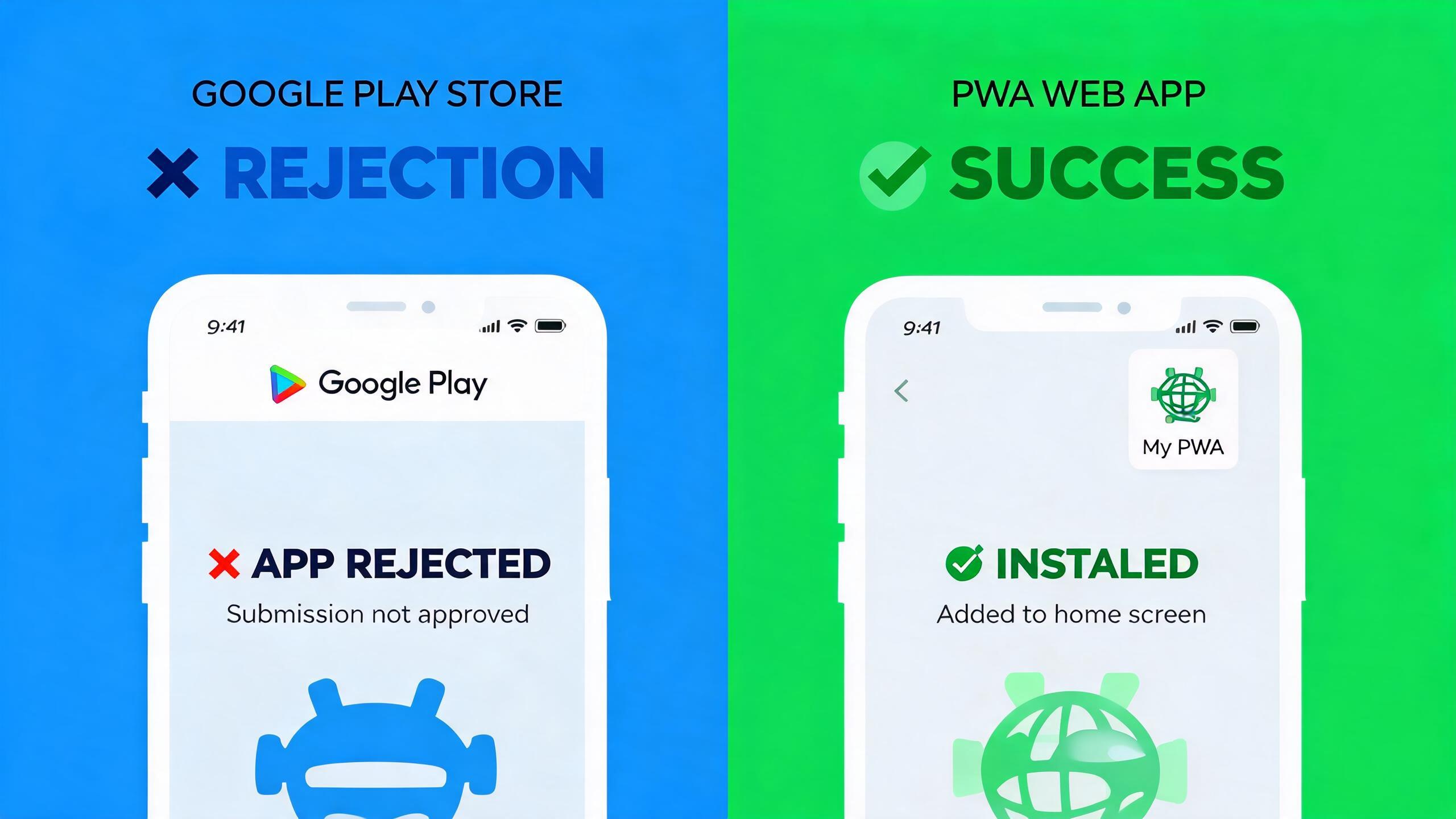
A Progressive Web App behaves like a native app on Android devices. Users install it directly from a URL — no app store involved. It sits on the home screen, launches in full screen, sends push notifications, and works offline. From the user’s perspective, it is indistinguishable from a native app. From your perspective as an operations manager, it is a distribution channel that no platform gatekeeper can shut down.
Here is why PWA distribution eliminates the core risks of Google Play dependency:
No review process means no removal risk. Your PWA lives on your own domain. There is no submission, no review queue, no policy compliance checkbox that can be retroactively reinterpreted. You update your app when you want, how you want, without waiting for approval. This is particularly valuable for gaming and BC apps that operate in regulatory gray zones across different markets — your distribution is not contingent on Google’s interpretation of your business model.
No 30% revenue cut. Google Play takes 30% of all in-app purchases and subscriptions (15% for the first $1M under their reduced rate program). With PWA distribution, you process payments directly — Stripe, PayPal, local payment gateways — and keep 100% of your revenue minus standard processing fees of 2-3%. For an app generating $500K monthly in in-app revenue, that is roughly $135K per month back in your pocket. Over a year, that is $1.6 million in recovered revenue — money that was going to Google for the privilege of being listed in a store that might remove you at any time.
Push notifications that survive uninstall. This is the feature that surprises most operations managers. With PWA push notifications, you can re-engage users even after they remove the app icon from their home screen. The notification permission persists in the browser, giving you a re-engagement channel that native apps simply cannot match. For user acquisition teams running expensive campaigns, this fundamentally changes the retention math and extends the LTV of every acquired user.
Instant deployment across all markets. When Google Play removes your app from one country’s store, your PWA is completely unaffected. It is accessible from any browser in any market. No geo-restrictions, no region-specific review teams applying different standards, no localized policy interpretations blocking your launch. You control your distribution globally from a single deployment.
The strategic advantage is clear: PWA removes the single point of failure from your distribution strategy. Even if you keep your Google Play listing active, running a parallel PWA channel means a removal event becomes a temporary inconvenience rather than a business-ending crisis. Teams building AI apps that face evolving compliance requirements are already making this move — see how AI apps are using PWA to bypass Google Play review in 2026.
Real Data: PWA vs Google Play Distribution
The business case for PWA distribution is not theoretical. These are the numbers that matter to operations managers and growth teams evaluating the switch:
Install conversion rates: up to 1.2x higher. PWA install flows consistently convert at higher rates than native app downloads from Google Play. The reason is friction. A PWA install is a single tap from a landing page — one action and the app icon is on the home screen. Compare that to the multi-step Google Play flow: store redirect, app page load, scroll through listing, tap download, wait for package to install, then open the app. Every step in the native funnel loses users. PWA compresses the entire journey into one moment of intent.
Time to market: hours, not weeks. Launching a native Android app through Google Play takes 3-7 days for initial review, plus additional review time for each significant update. A PWA can go live in hours. When your app has been removed and you need to restore distribution immediately, this speed difference is the difference between losing a week of revenue and losing a single day. For teams in fast-moving markets — gaming launches, seasonal promotions, time-sensitive campaigns — this velocity advantage compounds rapidly.
Revenue retention: 27-30% immediate increase. Teams that switch from Google Play to PWA distribution for in-app purchases see an immediate revenue increase equal to the percentage Google was previously taking. For subscription-based apps, the impact compounds monthly. A $10/month subscription that nets you $7 through Google Play nets you $9.70 through direct PWA billing after standard payment processing fees. Multiply that across your entire subscriber base and the annual difference is substantial.
User acquisition cost: 15-25% lower. Because PWA installs happen directly from your landing pages, your paid acquisition funnel is shorter and fully trackable. Teams report significantly lower cost per install when driving traffic to a PWA install page versus a Google Play listing. Attribution is cleaner because you own the entire funnel end to end — no handoff to the Play Store where tracking degrades and cross-device attribution breaks.
Update velocity: instant, 100% coverage. Native apps require users to manually update or wait for auto-updates that may take days to propagate. PWAs update automatically every time the user opens the app. Bug fixes, new features, and compliance changes deploy instantly to your entire user base. No version fragmentation, no users stuck on outdated builds, no emergency update stuck in the Play Store review queue while a critical bug is live.
Ready to see these numbers for your app? ROiBest runs a free distribution audit that compares your current Google Play metrics against projected PWA performance. Request your free audit here.
Common Concerns Answered
Operations managers and growth leads always ask the same questions when evaluating PWA as a Google Play alternative. Here are the straightforward answers:
“Will my users accept installing a PWA? It is not from the Play Store.”
Yes, and the data backs this up consistently. User behavior data from 2025-2026 shows that Android users are increasingly comfortable installing PWAs, especially when the install prompt appears within a trusted context — your website, a landing page from a paid ad, a referral link from a partner. The install experience is smooth: a bottom-sheet prompt appears, the user taps “Install,” and the app icon appears on their home screen within seconds. There is no “unknown sources” warning because PWAs install through the browser, which is already a trusted application on every Android device. For gaming and entertainment apps, where users are motivated by the content itself, the install source matters far less than the quality of the experience once they are in.
“Can PWA handle payments and subscriptions?”
Absolutely. PWAs support the full Web Payments API, and you can integrate any payment processor your business already uses — Stripe, PayPal, Razorpay, local gateways for specific markets like GCash in the Philippines or Paytm in India. You are not limited to Google Play Billing, which means you choose your payment stack, negotiate your own processing rates, and keep the revenue. ROiBest handles the payment integration as part of the PWA launch package, so your team does not need to build payment infrastructure from scratch or manage PCI compliance independently.
“What about discoverability? We rely on Play Store search for organic installs.”
This is a valid concern, and it deserves a strategic answer rather than a dismissive one. Google Play search is one discovery channel, but for most gaming, BC, and AI apps, it is not even the primary acquisition channel. The majority of installs for these categories come through paid channels (Meta Ads, Google Ads, TikTok Ads), influencer marketing, content marketing, and direct referral. All of these channels work better with PWA because they drive users directly to your install page rather than routing them through the Play Store where you lose control of the funnel. For organic discovery, your PWA landing pages are indexable by Google Search, which gives you access to a much larger search audience than Play Store search alone. Teams combining PWA distribution with intelligent ad strategies are seeing strong results — learn how in our analysis of ChatGPT Ads and PWA app distribution strategy for 2026.
“Is PWA suitable for performance-intensive apps like games?”
For the vast majority of mobile games — casual, mid-core, card games, slots, social casino, puzzle, and strategy — PWA performance on modern Android devices is excellent. WebGL and WebGPU support in Chrome and Samsung Internet means graphically rich experiences run smoothly on mid-range and flagship devices alike. AAA-level 3D games with extremely heavy GPU requirements are still better suited for native distribution, but these represent a small fraction of the Android gaming market and an even smaller fraction of the cross-border gaming category. If your game runs acceptably in a mobile browser today, it will run as a PWA. ROiBest evaluates your specific app requirements during onboarding and provides a clear recommendation on feasibility before any work begins.
“What happens if Google restricts PWA capabilities in Chrome?”
This question reveals a common misunderstanding about the PWA ecosystem. Progressive Web Apps are built on open web standards maintained by the W3C — they are not a Google product or a Chrome-exclusive feature. They work across all major browsers on Android: Chrome, Samsung Internet, Firefox, Edge, and others. Even if one browser were to restrict PWA capabilities (which would likely trigger antitrust scrutiny given the current regulatory environment), the others would continue full support. The web is a platform that no single company controls, and that is precisely why it is a more resilient distribution channel than any proprietary app store.
Get Back Online with ROiBest
If your app has been removed from Google Play — or if you are building contingency plans for when it happens — the path forward is clear. PWA distribution gives you a channel that is immune to app store politics, faster to deploy, cheaper to operate, and increasingly preferred by users who just want the app without the app store friction.
ROiBest specializes in exactly this transition. The team handles the entire PWA packaging and launch process: converting your existing app experience into a fully functional PWA, setting up payment processing with your preferred providers, configuring push notifications for re-engagement, optimizing the install flow for maximum conversion, and deploying across all your target markets simultaneously. You do not need a web development team. You do not need to learn new frameworks or rearchitect your product. You need a distribution channel that works regardless of what Google decides next — and ROiBest delivers it.
The app teams that thrive in 2026 and beyond will not be the ones hoping Google Play does not remove their listing. They will be the ones who built a distribution channel that no app store can touch — and who made that move before the next policy change forced their hand.
Skip the app store. Go live instantly, keep 100% of your revenue.
ROiBest helps Android app teams launch PWAs — no review process, no 30% Google Play cut, and push notifications that work even after uninstall. Teams see up to 1.2x higher install conversion rates vs native app downloads.
 WebApp中文站
留下评论