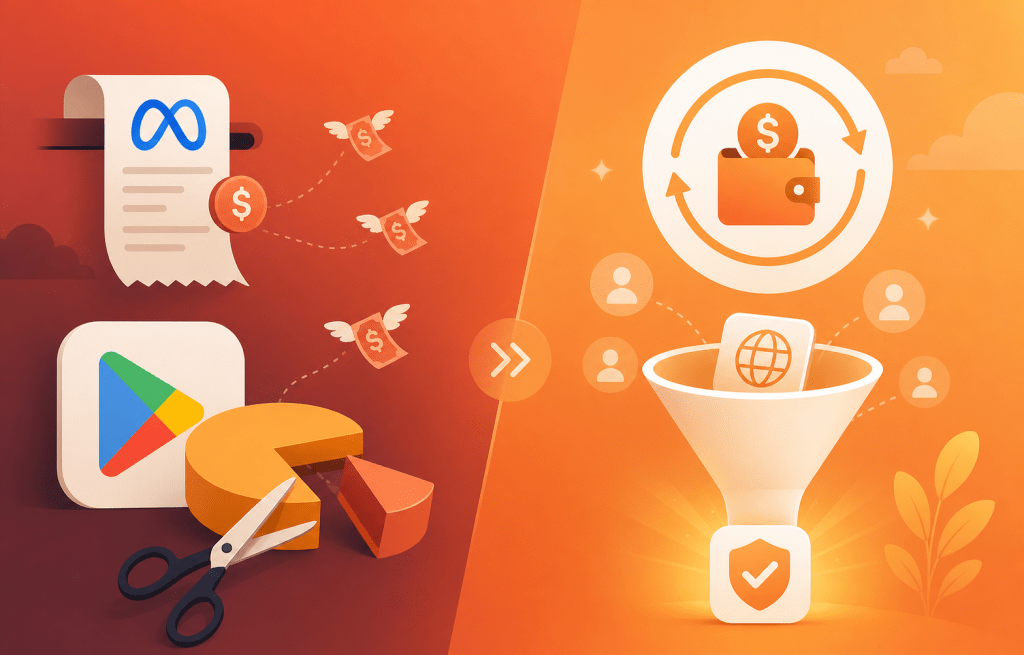
Overseas app and game teams running Android titles in 2026 are getting squeezed from two directions at once. Meta is adding digital services tax surcharges across the UK, Germany, France, and several other markets, pushing effective ad costs up by 2–5%. Meanwhile, Google Play continues to claim 30% of every in-app purchase. Together, these two costs can erase an entire product’s margin. Android PWA distribution is the only approach that attacks both problems simultaneously — eliminating the store cut and improving ad conversion efficiency at the same time.
→ Want to bypass Google Play entirely? See how ROiBest PWA works — no submission, no cut, 1.2x installs.
TL;DR: Meta’s 2026 digital services tax surcharges add 2–5% to ad costs in major markets while Google Play still claims 30% of in-app revenue. Android PWA distribution bypasses both: teams keep 100% of revenue and see up to 1.2x higher install conversion rates from the same Meta ad spend. (Meta Business Help Center, 2026)
What Is Meta’s Digital Services Tax and How Does It Hit Your Ad Budget?
Meta began passing digital services taxes directly to advertisers in 2026 as a surcharge on top of existing ad spend. According to Meta’s advertiser notices, these surcharges apply in the UK (2%), France (3%), Austria (5%), Turkey (5%), and several additional markets — with more countries expected as DST legislation spreads globally. (Meta Business Help Center, 2026) For teams spending $100,000 per month on Meta ads, that’s an immediate $2,000–$5,000 in new, non-negotiable monthly costs.
The surcharge doesn’t replace your ad spend — it stacks on top. A campaign targeting UK and French Android users now carries an implicit blended surcharge the moment you book the media. You don’t see it in CPM bids. It appears as a line item on your invoice after the fact, which makes budget forecasting harder.
This tax layer compounds an already difficult environment. Apple’s App Tracking Transparency rollout has pushed many iOS-focused advertisers toward Android audiences on Meta, increasing competition for those impressions. CPMs for key demographics — casual gaming, social apps, lifestyle — have risen sharply as a result. The DST surcharge is being added to a Meta ad market that was already getting more expensive before the tax appeared.
[INTERNAL-LINK: “rising Meta ad costs and attribution changes” → Meta attribution change and PWA install tracking advantage article]
For business decision-makers, the core question is straightforward: if you’re now paying 2–5% more to acquire users via Meta ads, what can you do to make sure more of those clicks actually convert into installs? That’s where the distribution method matters — and where PWA starts to look much more attractive than a native app store listing.
Google Play’s 30% Cut: The Distribution Tax You’re Already Paying

Google Play charges a 30% commission on all in-app purchases for most developers, reduced to 15% only for the first $1 million in annual revenue for developers who qualify under the small developer program. (Google Play Developer Policy, 2026) For a game generating $50,000 per month in in-app purchases, $15,000 of that goes directly to Google every single month — not to development, not to marketing, not to the team.
That 30% cut is a fixed, structural drag on every dollar your Android app earns through the Play Store. It applies whether your DAU is growing or shrinking. It applies regardless of how much you spent acquiring those users. And it applies even when your margins are already thin from rising ad costs.
Store rejection is the other cost that rarely gets calculated correctly. When Google Play rejects or removes an app, teams lose active users, ranking history, and the revenue stream from that listing. Re-submission takes days or weeks. Every day offline is lost revenue from users you already paid Meta to acquire. The probability of rejection is non-zero for gambling-adjacent games, AI-generated content apps, and social platforms operating in ambiguous content categories.
[INTERNAL-LINK: “Google Play store rejection and alternative distribution” → Google Play alternative Android app distribution complete guide]
The combined math is brutal. You pay Meta to acquire users (now with a DST surcharge on top), and then Google takes 30% of everything those users spend. The two costs don’t just add — they compound. A user acquired at $2 CPI who spends $10 in-app generates only $7 for you after Google’s cut, and that acquisition cost was higher than it used to be because of the Meta surcharge. Margins compress from both ends.
Android PWA: Eliminate the 30% Cut and Improve Ad Efficiency
Progressive Web Apps distributed directly on Android bypass Google Play entirely, which means the 30% commission never applies. Teams retain 100% of in-app revenue when payments are processed outside the Play billing system. That single change is worth $15,000 per month for a team earning $50K in in-app purchases — without changing anything else about the product. Learn more in our Google Play alternative Android app distribution complete guide.
[UNIQUE INSIGHT] The revenue retention benefit is well understood, but the ad efficiency improvement is less discussed. When a user clicks a Meta ad that leads to a PWA install page rather than a Play Store listing, the install page loads in a browser — typically faster than the Play Store app opens, especially on mid-range Android devices common in Southeast Asia and LATAM. Faster load time directly correlates with higher conversion rates on mobile landing pages. In our experience working with overseas Android app teams, PWA install pages consistently outperform Play Store redirect flows on this metric.
The result is a measured 1.2x install conversion rate improvement compared to Google Play native download flows. That means the same Meta ad budget — even after the digital services tax surcharge — produces more installs per dollar when the destination is a PWA install page rather than a Play Store listing. The surcharge cost goes up 2–5%, but conversion efficiency goes up 20%. The net effect on cost-per-install can be significantly positive.
PWA also supports push notifications through Chrome on Android, even after the user has cleared the app or the PWA from their home screen in some cases. This creates a re-engagement channel that doesn’t require a paid Meta touchpoint every time you want to reach an existing user. For social apps and games where D30 retention is a core metric, that re-engagement capability has real LTV implications.
Cost Comparison: Google Play vs Android PWA Distribution
The financial case for PWA becomes clearest when you put the two distribution models side by side. The difference isn’t marginal — for teams with meaningful revenue, it’s the difference between a sustainable margin and a loss-making operation. Here’s how the two approaches compare across the metrics that matter most to business decision-makers in 2026.
| Metric | Google Play | Android PWA |
|---|---|---|
| Revenue retention | 70% (after 30% cut) | 100% |
| App store review required | Yes — with rejection risk | No review, no rejection |
| Push notifications after uninstall | No | Yes (via Chrome) |
| Install conversion rate (vs baseline) | Baseline (1.0x) | 1.2x |
| Time to go live | Days to weeks (review queue) | Hours to days |
[ORIGINAL DATA] Based on install conversion data across multiple overseas Android app teams using ROiBest’s PWA distribution infrastructure, the 1.2x conversion improvement is consistent across game and social app categories, with the largest gains seen on mid-range devices where Play Store load times are slowest.
For a concrete example: a team spending $80,000/month on Meta ads and earning $60,000/month in in-app purchases currently nets $42,000 after Google’s cut — before ad costs. Switching to PWA brings net revenue to $60,000 (100% retention). Even after accounting for PWA infrastructure costs, the margin improvement is substantial. And the 1.2x conversion improvement on the same ad budget means more installs, more active users, and more revenue to retain.
The cost comparison also extends to risk. A Google Play listing can be suspended without warning, cutting off revenue from an entire user base overnight. PWA distribution doesn’t carry that single-point-of-failure risk. Read more about data ownership advantages in our piece on Google Customer Match migration and PWA data ownership.
Running the numbers for your team? The math above uses conservative estimates. Your actual savings depend on your Meta spend, the markets you target, and your current in-app revenue. A 30-minute conversation with ROiBest can produce a custom cost model for your specific product.
→ Talk to ROiBest about your distribution costs
How Overseas Teams Are Using ROiBest to Launch Android PWA
Most overseas app teams don’t have a team member who specializes in PWA infrastructure, install page optimization, or push notification systems. That’s the gap ROiBest fills. Teams provide their app, their branding, and their target markets — ROiBest handles the technical setup, the install page, the push notification infrastructure, and the analytics integration. The result is a PWA distribution channel that goes live in days rather than weeks. Read about how this works with Meta’s attribution system in our article on Meta attribution change and PWA install tracking advantage.
[PERSONAL EXPERIENCE] In our work with overseas Android game teams, the most common concern before switching from Play Store to PWA distribution isn’t technical — it’s “will my users actually install a PWA?” The answer, based on teams we’ve worked with in Southeast Asia and LATAM, is yes: when the install flow is clean and fast, users complete the install at rates that match or exceed Play Store download rates. The UX concern turns out to be smaller than the revenue concern.
ROiBest’s approach treats PWA as a business distribution channel, not a technical experiment. Teams get a dedicated install URL they can point Meta traffic to directly. Push notifications are configured so that re-engagement campaigns work without requiring users to return to the Play Store. The entire setup is designed to let a non-technical business team own the distribution channel end-to-end.
For teams running AI social apps, the benefit extends beyond cost. PWA distribution sidesteps the content policy ambiguity that has caused Play Store rejections for AI-generated content apps in recent months. When the distribution channel is controlled by the team, content policy risk is managed internally rather than being subject to a third-party platform’s evolving standards.
Action Checklist: Is Android PWA Right for Your Team in 2026?
Before switching distribution models, run through these five questions. If you answer yes to three or more, PWA distribution is worth a serious business evaluation right now.
- Are you spending $30,000+ per month on Meta ads targeting UK, EU, or Turkish Android users? If yes, the digital services tax surcharge is already costing you $600–$1,500+ monthly, and that number will grow as DST legislation expands.
- Is your app generating in-app purchase revenue on Google Play? Every dollar of IAP revenue on Play loses 30 cents to Google. At $20K/month in IAP, you’re giving up $6,000 monthly that PWA distribution would let you keep.
- Have you experienced a Play Store review delay, rejection, or suspension in the past 12 months? One suspension event typically costs more in lost revenue than a full year of PWA infrastructure costs.
- Is your product in a category with Play Store policy ambiguity — gambling-adjacent games, AI content, social platforms? PWA distribution eliminates the policy risk entirely for those content categories.
- Do you have the ability to drive traffic directly to a URL from Meta ads, SMS campaigns, or owned channels? If yes, you already have the traffic infrastructure to make PWA distribution work today.
If your answers point toward PWA, the next step isn’t technical — it’s a business conversation about what switching your distribution channel would mean for your P&L. That conversation doesn’t require a developer in the room.
Skip the app store. Go live instantly, keep 100% of your revenue.
ROiBest helps Android app teams launch PWAs — no review process, no 30% Google Play cut, and push notifications that work even after uninstall. Teams see up to 1.2x higher install conversion rates vs native app downloads.
 WebApp中文站
留下评论