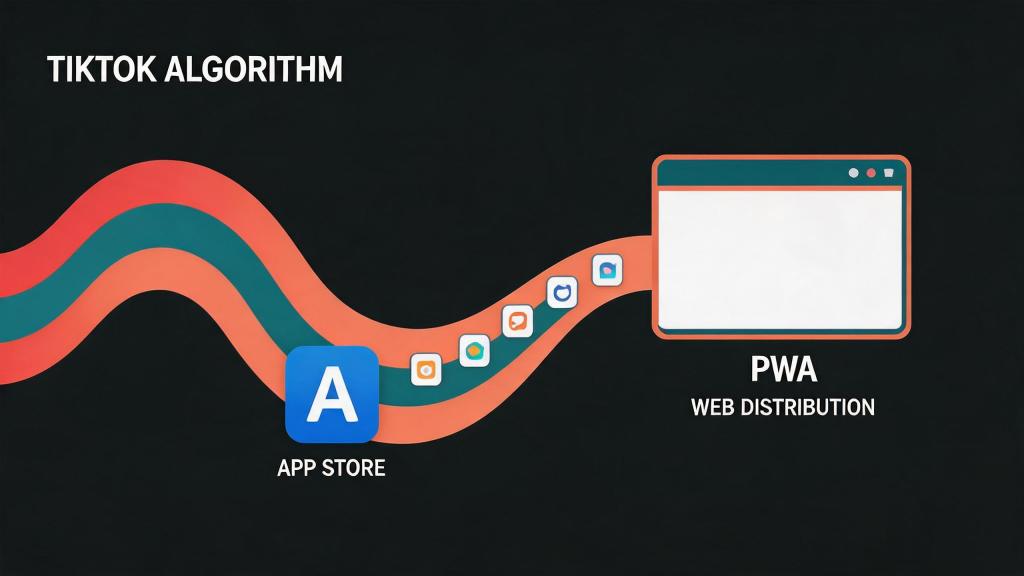
TikTok’s 2026 algorithm update is not a minor tweak. It is a structural shift toward SEO-first content ranking — and it directly threatens the paid user acquisition funnels that app teams have relied on for the past three years. If your install strategy depends on TikTok ad spend, you are now competing against organic creators who understand search intent, not just virality. The cost per install is climbing. The predictability of paid campaigns is falling. And the platforms you depend on keep changing the rules without asking.
This article breaks down what the TikTok algorithm SEO update means for app distribution teams, why platform dependency is a growing liability, and how PWA (Progressive Web App) distribution through services like ROiBest gives you a channel you actually control — with better install economics and zero app store gatekeeping.
→ Want to bypass Google Play entirely? See how ROiBest PWA works — no submission, no cut, 1.2x installs.
What Changed: TikTok’s 2026 SEO-First Algorithm Shift
In early 2026, TikTok rolled out a significant algorithm recalibration that prioritizes search-intent content over purely engagement-driven videos. Previously, TikTok’s recommendation engine was almost entirely based on watch time, completion rate, and interaction signals — likes, comments, shares. Content that performed well in the For You feed dominated distribution regardless of whether it answered a specific user query.
The 2026 update changes this calculus. TikTok now indexes video titles, captions, spoken keywords (via automatic speech recognition), and on-screen text for search ranking. Videos that match explicit search queries receive a distribution boost that can override traditional engagement metrics. In practical terms, a video titled “best budget tracking app 2026” that matches a user’s search will now outrank a viral dance video in that search context — even if the dance video has 50x more engagement.
For organic creators and SEO-savvy content teams, this is a windfall. For paid UA teams, it introduces a serious problem.
The Direct Impact on Paid User Acquisition
TikTok’s ad platform has been one of the most cost-effective channels for app installs, particularly for apps targeting younger demographics in Southeast Asia, Latin America, and the Middle East. Cost-per-install (CPI) on TikTok has historically been 30-50% lower than Meta for certain verticals.
But the SEO-first shift creates three compounding problems for paid campaigns:
- Ad inventory competition increases. As organic content gains more prominence in search results, the available ad placements in high-intent contexts shrink. TikTok’s ad auction gets more competitive precisely where intent is highest.
- Creative fatigue accelerates. Paid content now competes directly with organic videos optimized for the same keywords. Users who see an organic result that answers their query are less likely to engage with a paid ad below it.
- Attribution becomes murkier. With more organic touchpoints in the user journey, last-click attribution to paid campaigns becomes less reliable. Your CPI looks higher, but it may also be less accurate.
Industry data from Q1 2026 already reflects this. Multiple ad measurement platforms have reported a 15-25% increase in average CPI on TikTok across app install campaigns compared to Q4 2025, with the steepest increases in categories where organic SEO content is most competitive — finance apps, health and fitness, and utility tools.
The Deeper Problem: Platform Dependency as a Business Risk
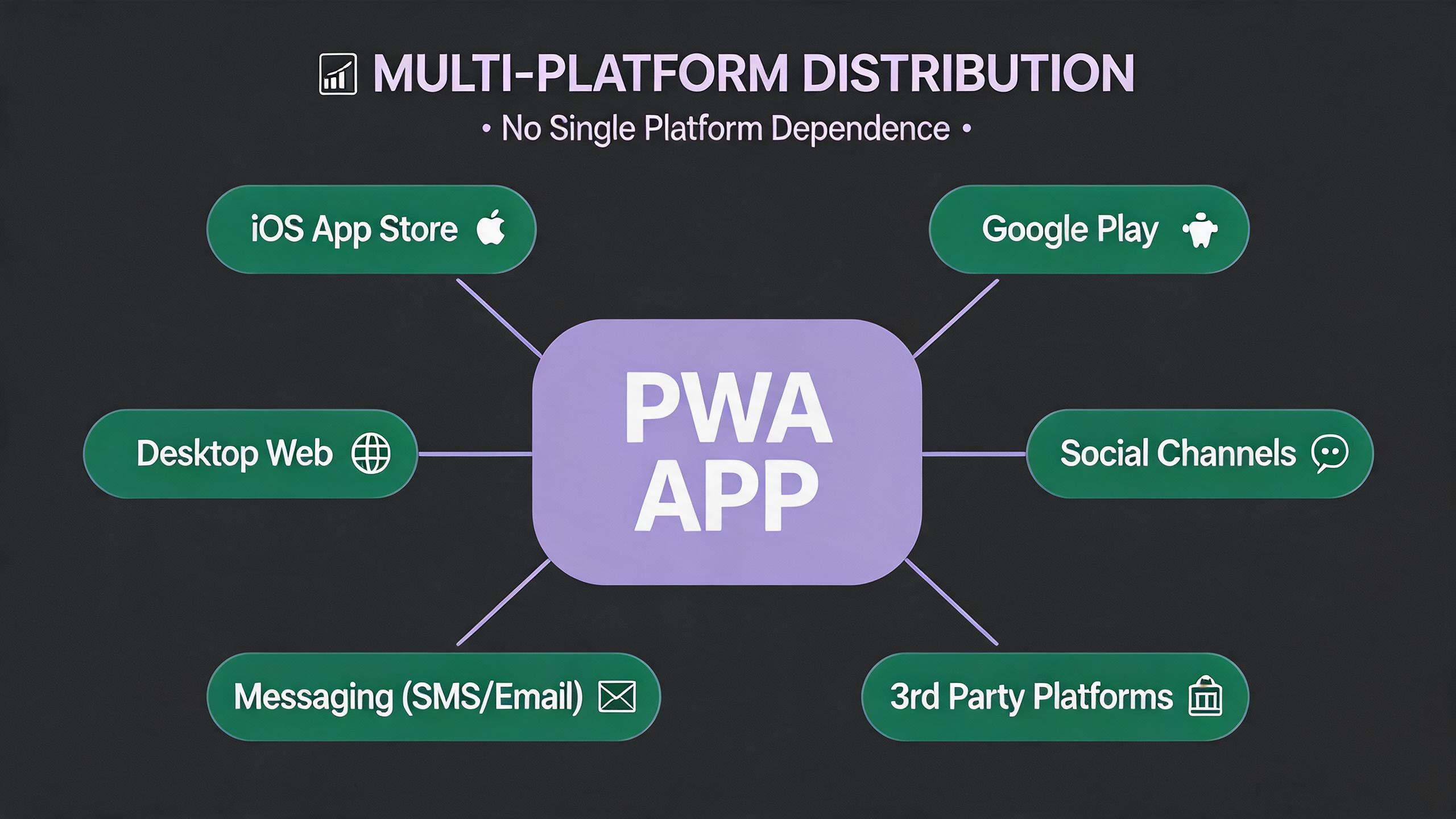
The TikTok algorithm update is not an isolated event. It is the latest example of a pattern that every app distribution team should recognize by now: the platforms you depend on will change the rules, and you have no say in the matter.
Consider the recent history:
- Google Play tightened its review policies in 2025, rejecting or suspending apps with little warning and inconsistent enforcement. Teams that relied exclusively on Google Play for Android distribution found themselves locked out of their own user base overnight.
- Apple’s App Tracking Transparency (ATT) in 2021 disrupted Meta’s entire ad targeting infrastructure, causing CPIs to spike across iOS campaigns for over a year.
- Google’s Performance Max (PMax) campaigns consolidated targeting controls, reducing the granularity advertisers had over where their budget was spent.
- TikTok itself faced potential bans in multiple markets, creating existential risk for teams that had built their entire UA pipeline on the platform.
Each of these events shares a common thread: teams that had diversified their distribution channels weathered the disruption. Teams that had concentrated their strategy on a single platform scrambled.
The TikTok SEO update is not going to kill paid UA on TikTok. But it is another data point in a clear trend — relying on any single platform for app distribution is a strategic vulnerability, not a strategy. For a comprehensive overview of distribution alternatives, see our guide to Google Play alternatives for Android app distribution.
How PWA Distribution Solves the Platform Dependency Problem
Progressive Web Apps are not a new technology. But their relevance to app distribution strategy has never been higher — precisely because they address the core vulnerability that events like the TikTok algorithm update expose.
A PWA is a web application that behaves like a native app. Users can install it directly from a browser — no app store required. It sits on the home screen, sends push notifications, works offline, and provides a native-like experience. The critical difference: you control the distribution channel.
Why PWA Distribution Matters Now
1. No app store gatekeeping. When you distribute via PWA, there is no review process, no policy changes that can delist your app overnight, and no 30% revenue cut. Your app is live the moment you deploy it. This is particularly relevant for teams in verticals where Google Play enforcement has been unpredictable — gaming, finance, dating, and social apps.
2. Direct install from any traffic source. A PWA can be installed from any link — a TikTok bio, a Google search result, a WhatsApp message, an email campaign, or a QR code on a physical product. You are not limited to a single distribution channel. When TikTok changes its algorithm, your PWA install link still works from every other channel you have built.
3. Higher install conversion rates. The PWA install flow eliminates the friction of the app store redirect. Users tap a link, see the app, and install it — often in under three seconds. Teams using ROiBest’s PWA distribution infrastructure report install conversion rates up to 1.2x higher than equivalent native app download flows. The reason is simple: fewer steps, fewer drop-offs.
4. Push notifications that survive uninstall. One of the most underappreciated advantages of PWA distribution is the ability to re-engage users even after they remove the app from their home screen. Web push notifications can reach users who have visited your PWA, giving you a re-engagement channel that does not exist with native app uninstalls.
5. Full revenue retention. With no app store intermediary, you keep 100% of your in-app revenue. For apps with significant transaction volume, this alone can justify the distribution shift. Teams running PMax campaigns alongside PWA distribution have found that the combination of lower distribution costs and full revenue retention dramatically improves unit economics.
Real Numbers: PWA Distribution vs. Traditional App Store Channels
The business case for PWA distribution is not theoretical. Here is what the data shows across teams that have adopted PWA as a primary or supplementary Android distribution channel:
| Metric | Google Play (Native) | PWA via ROiBest |
|---|---|---|
| Time to go live | 3-14 days (review) | Instant (no review) |
| Install conversion rate | Baseline | Up to 1.2x higher |
| Platform revenue cut | 15-30% | 0% |
| Risk of delisting | Moderate to high | None |
| Push notification after uninstall | Not possible | Supported |
| Dependency on platform policy | Full | None |
For teams currently spending heavily on TikTok UA, the math is worth examining closely. If your CPI on TikTok has increased by 20% due to the algorithm shift, and your Google Play conversion rate is your bottleneck, adding a PWA distribution channel can recover — and often exceed — the efficiency you have lost.
Teams that have integrated PWA distribution with their PMax budget optimization strategy report that the blended cost per acquired user drops by 15-30% when PWA is included as a landing destination alongside native app store listings.
Ready to reduce your platform dependency?
ROiBest handles the entire PWA technical stack — you focus on growth. Talk to the team →
Common Concerns About PWA Distribution — Answered
“Will users actually install a PWA? They expect app stores.”
This concern made sense in 2020. It does not hold up in 2026. Android’s PWA install experience is now virtually indistinguishable from a native app install for most users. The app appears on the home screen, opens in its own window, and behaves like any other app. In markets like India, Brazil, Indonesia, and Nigeria — where data costs are high and storage is limited — users actively prefer lightweight PWA installs over downloading a 100MB native app from the Play Store.
“We need features that only native apps support.”
The feature gap between PWAs and native apps has narrowed dramatically. PWAs now support push notifications, offline functionality, camera access, geolocation, and background sync on Android. For the majority of app categories — content apps, utility tools, e-commerce, social platforms, and gaming (casual/mid-core) — PWAs deliver a functionally equivalent experience. If your app requires hardware-level access that PWAs do not yet support (AR, NFC payments), a hybrid approach works: distribute your core experience as a PWA and reserve native for the features that genuinely require it.
“How does this work with our existing ad campaigns?”
PWA distribution integrates cleanly with existing paid campaigns. Your TikTok ad, Google PMax campaign, or Meta ad can link directly to your PWA install page instead of (or in addition to) the app store listing. The tracking works through standard UTM parameters and conversion pixels. Many teams run A/B tests — sending 50% of traffic to the app store and 50% to the PWA — and measure which path converts better. In most cases, the PWA path wins on conversion rate because of the shorter install flow.
“Is this actually compliant? Can Google penalize us?”
PWAs are a web standard supported by Google itself. Chrome on Android has built-in PWA install prompts. There is nothing gray-area about distributing your app as a PWA — it is an officially supported web capability. You are not circumventing any policy. You are using the open web as a distribution channel, which is exactly what it was designed for.
Actionable Steps: How to Start Shifting Toward PWA Distribution
You do not need to abandon your existing channels overnight. The smart approach is to add PWA as a parallel distribution channel and gradually shift budget based on performance. Here are the concrete steps:
Step 1: Audit Your Current Platform Dependency
Map out what percentage of your installs come from each channel — Google Play organic, Google Play via paid (PMax, Search, Display), TikTok, Meta, direct/referral. If more than 70% of your installs flow through a single platform, you have a concentration risk that needs addressing. The TikTok algorithm update should be your wake-up call, not your crisis.
Step 2: Launch a PWA Version Through ROiBest
ROiBest handles the technical implementation — manifest configuration, service worker setup, push notification infrastructure, install flow optimization. You do not need a PWA engineering team. The typical launch timeline is days, not weeks. Your job is to provide the app experience; ROiBest handles the distribution infrastructure.
Step 3: Run a Parallel Test With 10-20% of Your Paid Traffic
Redirect a portion of your TikTok and PMax ad traffic to your PWA install page. Measure three things: install conversion rate, Day-1 retention, and cost per retained user. Compare these metrics directly against your app store flow. Most teams see the PWA path outperform within the first two weeks of testing.
Step 4: Build Organic Distribution Channels That Feed Your PWA
This is where the TikTok SEO update actually works in your favor. Create organic TikTok content optimized for search queries related to your app category. Link to your PWA from your bio — not to the app store. You are now leveraging TikTok’s SEO-first algorithm to drive installs through a channel you own. The algorithm change that disrupted your paid campaigns becomes an organic acquisition opportunity when your landing page is a PWA you control.
Step 5: Diversify Beyond TikTok
Use your PWA as the universal landing destination across all channels — WhatsApp groups, Telegram, email campaigns, influencer partnerships, QR codes, and organic search. Every channel that can share a URL can distribute your PWA. This is the fundamental advantage: your distribution is no longer gated by any single platform’s rules, algorithms, or policies.
Summary: Take Control of Your Distribution Before the Next Platform Shift
The TikTok 2026 algorithm SEO update is a clear signal. Paid UA costs on platform-dependent channels will continue to rise. Organic competition will intensify. And the next disruptive policy change — whether from TikTok, Google Play, or Apple — is not a matter of if, but when.
PWA distribution through ROiBest gives you something no app store or social platform can: a distribution channel that you own, that no algorithm update can take away, and that converts users at rates equal to or better than native app store flows.
The teams that act on this now — while competitors are still debating whether PWAs are “real apps” — will have a structural advantage that compounds over time. Every install through your PWA is a user you acquired without platform permission and without platform taxes.
The question is not whether PWA distribution works. The data already proves that it does. The question is how long you will wait before adding it to your stack.
Skip the app store. Go live instantly, keep 100% of your revenue.
ROiBest helps Android app teams launch PWAs — no review process, no 30% Google Play cut, and push notifications that work even after uninstall. Teams see up to 1.2x higher install conversion rates vs native app downloads.
 WebApp中文站
留下评论