AI Content Labeling: Why PWA Skips Compliance Hassle 2026 | ROiBest
If your team uses AI to generate images, copy, or any creative asset inside your app or ad materials, you are already operating inside a tightening compliance window. Across Google Play, Apple App Store, and Meta’s ad network, regulators and platform policies are converging on the same demand: disclose it, label it, or face rejection. For overseas operators managing Android apps, this is no longer a future risk. It is a present-day cost — one that slows down every launch cycle, adds legal review overhead, and introduces uncertainty precisely when you need speed.
This article breaks down what the AI labeling landscape looks like in 2026, how each major platform enforces these rules, and why a growing number of Chinese overseas teams are routing around app store friction entirely by distributing via PWA.
→ Want to bypass Google Play entirely? See how ROiBest PWA works — no submission, no cut, 1.2x installs.
The AI Labeling Landscape in 2026
The regulatory pressure on AI-generated content has accelerated faster than most growth teams anticipated. What began as voluntary disclosure guidelines from major platforms has, by mid-2026, hardened into enforceable policies with real business consequences — delayed approvals, account flags, and in some cases outright removal from stores.
The European Union’s AI Act, which entered its enforcement phase in 2025, explicitly requires that AI-generated or AI-manipulated media be labeled in a machine-readable format when distributed to consumers. While the EU Act targets content distributed within the EU, its ripple effect is global: platforms operating across jurisdictions have adopted blanket policies rather than geo-specific exceptions, meaning your app targeting Southeast Asian or Latin American markets may still be reviewed against EU-aligned standards.
In the United States, the Federal Trade Commission has issued guidance stating that undisclosed AI-generated testimonials, endorsements, or product claims constitute deceptive advertising. Several state-level laws — including California’s AB 2602 and AB 1836 — add further disclosure requirements around digital likenesses and synthetic media. For apps in the health, finance, or social categories, these requirements layer on top of existing sector-specific regulations.
In China’s outbound context, SAMR and CAC guidance on AI-generated content is increasingly referenced by platforms when reviewing apps from Chinese developers targeting global users. Even if your primary market is not China, the upstream compliance posture of your team is being scrutinized at the distribution layer.
The practical result: any team using AI-generated creative assets — onboarding screens, promotional images, chatbot-style UI text, AI-personalized content feeds — needs a documented labeling process before submitting to any major app store. And that process takes time, creates bottlenecks, and introduces a new category of rejection risk that did not exist two years ago.
How App Stores Enforce AI Labeling

Platform-level enforcement varies in intensity, but the direction is uniform: stricter, faster, and increasingly automated.
Google Play updated its Developer Program Policy in early 2026 to require disclosure when apps use AI to generate content that users may reasonably perceive as human-created. This applies to in-app text, images, audio, and video. Apps in sensitive categories — health, finance, dating, children — face enhanced scrutiny, with human reviewer escalation triggered when automated systems flag AI content signals. Submission timelines for these categories now routinely run 5 to 10 business days rather than the standard 3 to 7. An appeal cycle adds another 5 to 7 days on top of that. For teams running time-sensitive campaigns — holiday promotions, new market launches, product updates tied to external events — this lag is operationally painful.
Apple App Store has taken a similar but more aggressive stance. Apple’s App Review Guidelines now require that apps using AI-generated or AI-modified content include explicit in-app disclosure at the point of content delivery. This means the disclosure cannot be buried in a terms-of-service document or a settings screen — it must be contextually visible. Apps that fail this requirement during review receive a 4.3 rejection (misleading description) or a 5.1.1 rejection (privacy violation), both of which require resubmission from scratch. Apple’s average review time for new submissions sits at 24 to 72 hours, but rejection and resubmission cycles can extend the effective time-to-market by two to three weeks.
Meta’s ad platform adds another enforcement layer for teams running paid acquisition. Since Q1 2026, Meta has required that all ads containing AI-generated creative — defined as images, video, or audio where AI materially altered the final output — carry a visible disclosure label. Ads submitted without this label are automatically held in a “pending compliance review” queue, separate from the standard ad auction. This queue has no guaranteed processing time. Teams running Meta campaigns with AI creative have reported delays of 48 to 96 hours before ads enter delivery, destroying time-sensitive bid strategies and wasting budget during high-competition windows. For a deeper look at how these delays affect ad measurement, see our analysis of ad measurement and PWA install attribution.
The compliance burden compounds quickly. A single app update with AI-generated screenshots, combined with an AI-driven onboarding sequence and Meta ad creative generated by an AI tool, could simultaneously trigger Google Play review escalation, Apple resubmission, and Meta’s compliance queue. Each of these delays is independent — they do not resolve in parallel. Your team is waiting on three separate review clocks at once.
Why PWA Distribution Sidesteps the Issue
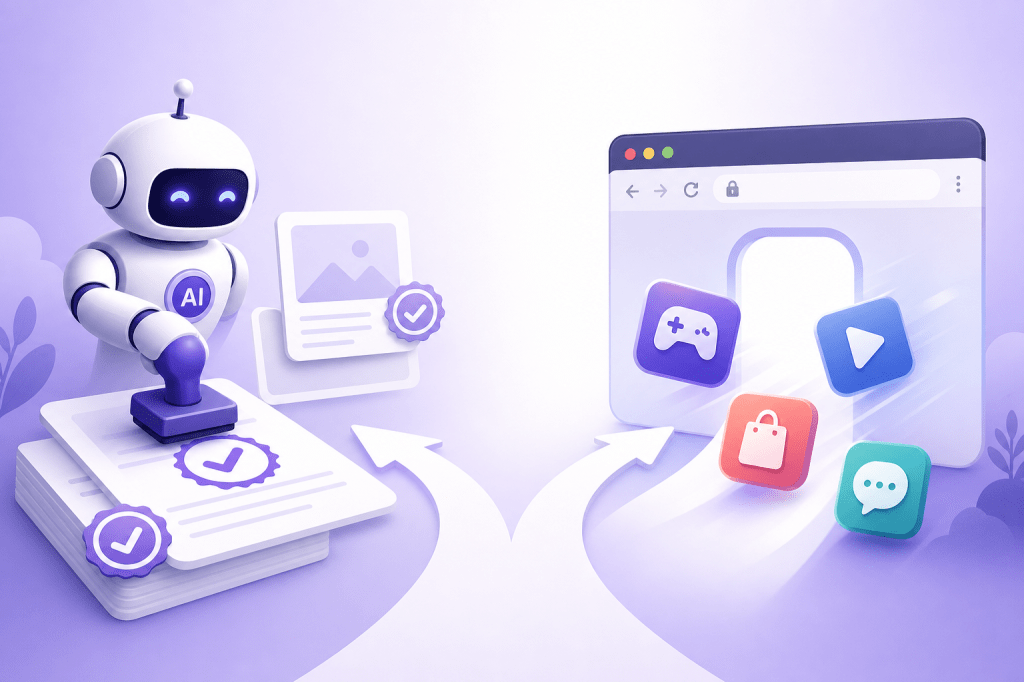
PWA — Progressive Web App — is not a workaround or a compromise product. It is a mature web-based application format that delivers native-app-like experiences through the browser, without going through any app store distribution channel. And the compliance implications of that distinction are significant.
When you distribute via PWA, there is no app store submission. No Google Play developer console upload. No Apple App Store review queue. No Meta ad creative policy review triggered by your app’s content. The app goes live when you push it live. Updates go live when you deploy them. There is no intermediary review layer that can flag your AI-generated content and hold your release.
This matters for AI labeling compliance in a specific way: the compliance obligation does not disappear, but it shifts from a platform-gated review process controlled by a third-party to a self-managed disclosure practice controlled by your team. You still need to label AI-generated content appropriately for your target market and for Meta’s ad policies when running paid acquisition. But you are no longer subject to Google Play’s automated AI content detection, Apple’s in-app disclosure placement requirements, or the submission-and-rejection cycle that those requirements create.
For overseas operators, the practical difference is this: when a compliance policy changes — and in 2026, they are changing every quarter — you can update your PWA’s disclosure copy and UI in hours, not days. You do not wait for a store review cycle to approve your compliance update before your compliant version reaches users. The loop between “policy changes” and “compliant version live” collapses from days or weeks to hours.
PWA also resolves the update deployment problem that app stores create. Under Google Play’s phased rollout system, a compliance update can take 72 hours to reach all users even after approval. Under Apple’s release schedule, your compliant update waits in a queue. With PWA, your update is live for 100% of users the moment you deploy it. For teams managing compliance risk, this is not a minor convenience — it is a structural advantage.
Teams that have already shifted to PWA distribution as part of their conversion value optimization strategy with PWA report that compliance agility is one of the most undervalued benefits of the model. The upfront decision to avoid app store dependency pays compounding dividends every time a platform updates its policies.
Real Cost and Time Comparisons
The abstract argument for PWA compliance agility is compelling. The concrete numbers make the case even more clearly.
App store submission cycle with AI labeling review:
- Initial submission prep (documentation, disclosure copy, metadata): 1 to 2 days
- Google Play review: 3 to 7 business days standard; 5 to 10 days for AI-flagged categories
- Apple App Store review: 1 to 3 days standard; 5 to 14 days with AI compliance resubmission
- First rejection cycle (common for AI content): add 5 to 7 days per platform
- Legal review of disclosure language: 2 to 5 days for teams with legal counsel involved
- Total realistic time-to-market for a new AI-content app: 2 to 4 weeks
PWA launch cycle:
- Preparation and asset finalization: 1 to 2 days
- Go-live: immediate upon deployment
- Compliance updates: deploy in hours, live for all users instantly
- Total realistic time-to-market: 24 to 72 hours
The time difference alone justifies a serious evaluation of your distribution channel strategy. But the cost picture adds further weight.
Google Play charges a 30% revenue cut on in-app purchases and subscriptions. Apple takes the same 30%, reducing to 15% only for qualifying small developers. For an app generating $100,000 per month in revenue, that is $30,000 per month flowing to a platform that simultaneously creates compliance friction for your team. PWA distribution retains 100% of that revenue — payment processing fees of 2 to 3% apply, but no platform cut.
Additionally, compliance-related rejections carry indirect costs: engineering time to revise and resubmit, marketing hold periods that freeze campaign spend, and user acquisition delays that allow competitors to capture market windows your team should have owned. These costs are real but rarely appear in a simple P&L comparison.
For teams concerned about reach and conversion, the install data is relevant: ROiBest customers report up to 1.2x higher install conversion rates via PWA versus native app store downloads, driven by frictionless one-tap install flows and the absence of app store listing abandonment. Not only does PWA cost less and launch faster — it converts better.
Common Concerns About PWA Distribution
“Will users trust a PWA as much as an app store app?”
Trust is built through the user experience, not through an app store badge. PWAs install to the home screen, operate with the full-screen native experience, and are indistinguishable from native apps in day-to-day use. For users in markets where sideloading is common — Southeast Asia, Latin America, parts of Africa — the install flow feels entirely natural. For markets where users are more accustomed to Google Play, a well-crafted landing page with clear install prompts is sufficient. Teams running high-volume paid acquisition already have the conversion optimization skills to make this work.
“What about push notifications after uninstall?”
This is one area where PWA distribution actually outperforms native app distribution. ROiBest’s PWA infrastructure supports push notification delivery even after the PWA is uninstalled from the home screen — a capability that no native app store offers. For retention campaigns and reactivation flows, this is a meaningful edge, particularly for teams whose primary growth lever is lifecycle marketing rather than pure new user acquisition.
“Are we still exposed to Meta’s AI labeling requirements?”
Yes — Meta’s ad policy applies to your ad creative regardless of where your app lives. If you run AI-generated creatives on Meta, you still need compliant labeling in your ads. But this is a narrower compliance surface than managing both app store AI content policies and ad platform policies simultaneously. And because your PWA can be updated instantly, your landing page and in-app disclosure practices can be adjusted to stay current with Meta’s requirements without triggering any store review cycle. For more detail on managing Meta policy risk during campaigns, see our breakdown of Advantage+ review risk and PWA distribution.
“Does PWA work for all app categories?”
PWA is strongest for content apps, social apps, AI-driven tools, casual games, utility apps, and subscription-based services. It is less suited for apps that depend heavily on platform-specific APIs — hardware integrations or apps in categories where Apple’s ecosystem lock-in creates structural dependencies. For the majority of Chinese overseas teams running AI-powered apps in entertainment, productivity, social, or information categories, PWA covers the full use case.
“How do we handle compliance documentation without a store submission process?”
The absence of a store submission process does not mean absence of documentation — it means your documentation lives in your own systems rather than a platform-managed review portal. For teams in regulated markets or running campaigns subject to FTC or EU AI Act requirements, maintaining an internal compliance record — what content is AI-generated, what labeling is applied, when it was reviewed — is still best practice. The difference is that this record supports your own accountability process, not a third-party gatekeeper’s approval workflow. That is a fundamentally more efficient compliance model for fast-moving teams.
“What if the AI labeling rules change again?”
They will — and that is precisely the point. In 2026, AI content regulation is not a solved problem. Platforms are updating their policies quarterly. Regulatory bodies are issuing new guidance on a rolling basis. For a team distributing through app stores, every policy update is a potential new submission cycle, a new rejection category, a new delay. For a team distributing via PWA, every policy update is a copy edit and a deployment — measured in hours, not weeks. The structural advantage of PWA distribution compounds every time the regulatory environment shifts.
Summary
AI content labeling compliance is a real and growing cost for any team using AI-generated creative in apps or advertising. In 2026, the major platforms — Google Play, Apple App Store, and Meta — have all moved from voluntary disclosure guidelines to enforceable policies with rejection, delay, and account-flag consequences. The compliance cycle adds 2 to 4 weeks to typical app store launches, introduces ongoing resubmission risk, and creates a permanent overhead tax on every update cycle.
PWA distribution does not eliminate the need for responsible AI content labeling. But it fundamentally changes the compliance model: from a platform-gated review process with unpredictable timelines to a self-managed disclosure practice that your team controls. Updates go live in hours. No store review. No 30% platform cut. And with ROiBest’s infrastructure, push notifications work even after uninstall — giving your team conversion and retention capabilities that native app distribution cannot match.
For overseas operators asking whether the compliance burden of AI content labeling is a reason to reconsider their distribution strategy, the answer in 2026 is clear: yes, it is — and PWA is the channel that resolves it.
Skip the app store. Go live instantly, keep 100% of your revenue.
ROiBest helps Android app teams launch PWAs — no review process, no 30% Google Play cut, and push notifications that work even after uninstall. Teams see up to 1.2x higher install conversion rates vs native app downloads.
 WebApp中文站
留下评论