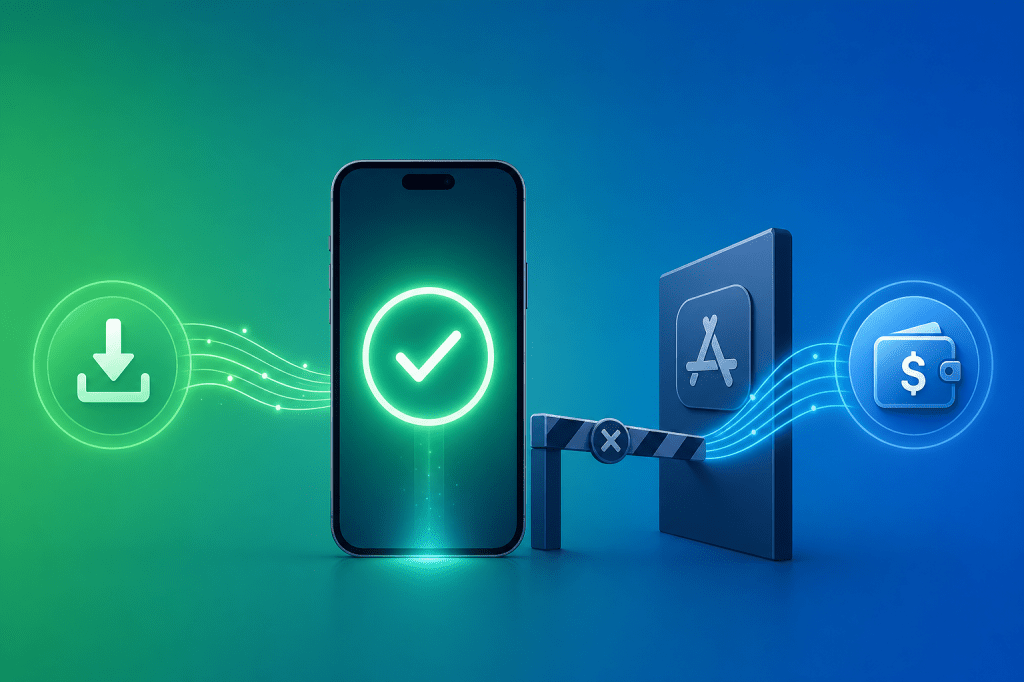
If you run paid acquisition for an app distributed through Google Play, you already know the pain: conversion values that don’t match your internal data, attribution windows that cut off too early, and an entire layer of user behavior that Google simply doesn’t share with you.
For gaming, BC, and AI app teams going overseas in 2026, this isn’t just an inconvenience — it’s a revenue leak. When your Google Ads conversion value data is wrong, your bidding is wrong. When your bidding is wrong, your CPA inflates and your ROAS collapses. The root cause isn’t your campaign structure. It’s your distribution channel.
PWA distribution changes the equation. When users install your app directly from the web — bypassing Google Play entirely — you own the full funnel from ad click to first purchase. No intermediary. No data gaps. No guessing.
→ Want to bypass Google Play entirely? See how ROiBest PWA works — no submission, no cut, 1.2x installs.
The Conversion Value Problem: Why Google Play Makes Your Data Worse
Google Ads conversion tracking was designed for a world where Google controls the install. When a user clicks your ad, goes to Google Play, and installs your app, Google records the install and passes back a conversion signal. Simple enough — until you look at what’s actually happening to your data.
The attribution gap. Between the ad click and the in-app purchase, Google Play sits as a middleman. The user leaves your ad, enters the Play Store environment, possibly browses other apps, then installs. That handoff introduces latency and data loss. Industry benchmarks from 2025-2026 show that Google Play-distributed apps lose between 15% and 30% of attributable conversion events due to this intermediary step. For a team spending $50K/month on Google Ads, that’s $7,500 to $15,000 in untracked value — conversions you’re paying for but can’t measure.
The value accuracy problem. Even when Google Ads does record a conversion, the value assigned to that conversion is often wrong. Google’s conversion value schema for app campaigns relies on postback data from the app, but the signal passes through multiple layers: your app’s SDK, Google Play’s infrastructure, and finally back to Google Ads. Each layer introduces delay and potential data loss. A BC gaming team we spoke with reported that only 62% of their in-app purchase values were accurately reflected in Google Ads before they switched distribution models.
The privacy wall. Google’s ongoing privacy changes — including the deprecation of GAID (Google Advertising ID) for new devices and tighter restrictions on cross-app tracking — mean that the data you do get is becoming less granular every quarter. For teams running high-value conversion campaigns (where a single whale user might generate $500+ in LTV), losing individual-level attribution isn’t just annoying. It makes value-based bidding nearly impossible.
How PWA Distribution Fixes the Conversion Value Pipeline
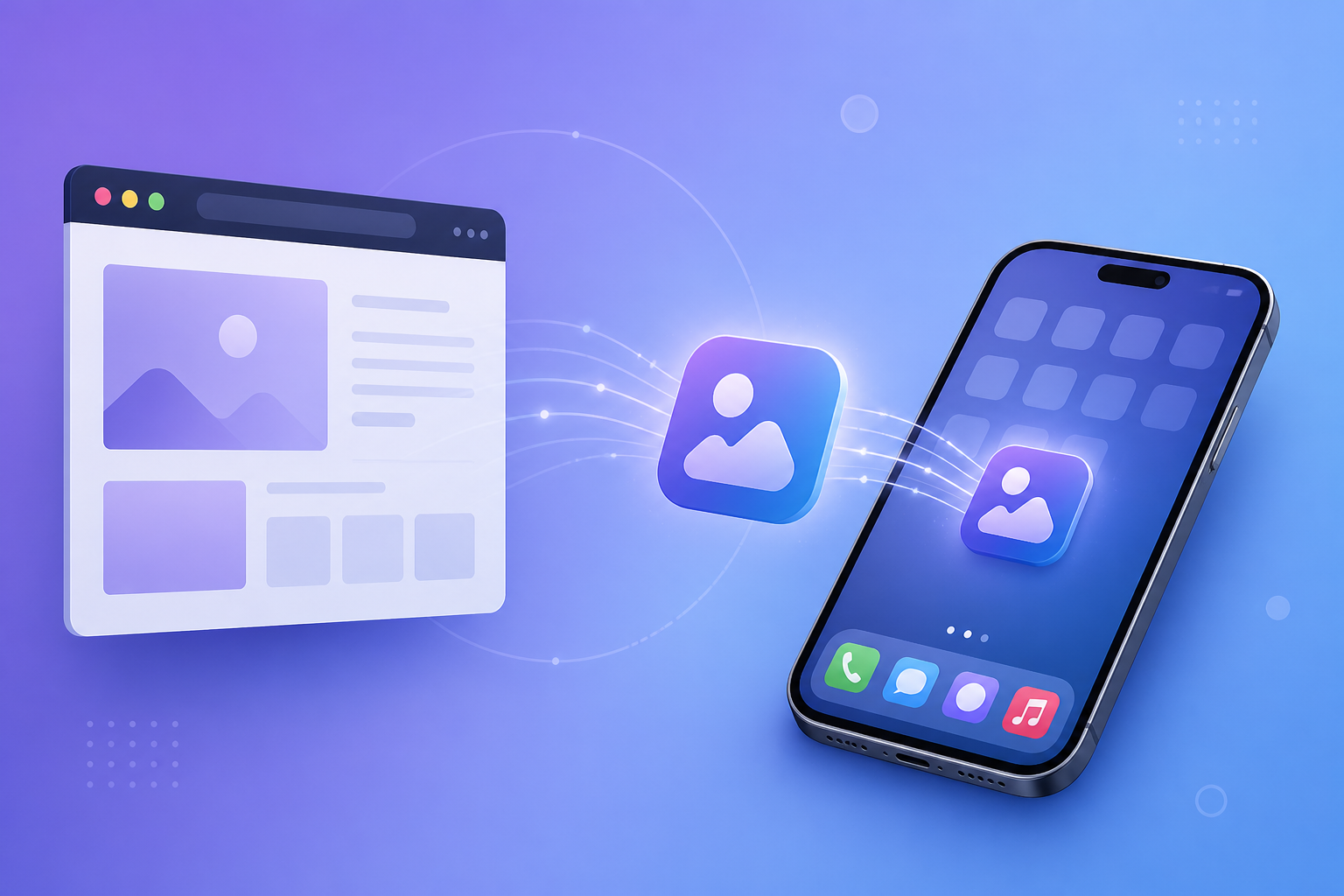
When you distribute your app as a PWA — a Progressive Web App that installs directly from a landing page to the user’s home screen — the entire tracking architecture changes. Here’s what that looks like in practice.
Direct click-to-install tracking. The user clicks your Google Ad, lands on your page, and installs the PWA. There is no redirect to an app store. The install happens on your domain, which means your analytics (Google Analytics 4, your own first-party event system, or any tag manager) captures the full journey. The conversion event fires from your property, not from a third-party store. For more context on why this matters for attribution, see the PWA first-party data advantage.
First-party conversion value. Because the entire user session — from landing page visit to install to first open to first purchase — happens within your web property, you assign the conversion value directly. There’s no SDK postback delay. There’s no intermediary re-mapping your event values. When a user makes a $49.99 purchase, Google Ads receives $49.99 as the conversion value. Not an estimated bucket. Not a delayed approximation. The actual number.
No GAID dependency. PWA tracking runs on web-based identifiers (first-party cookies, server-side session tracking, Google’s own gclid parameter). These mechanisms are more stable and more privacy-compliant than mobile advertising IDs. You’re not fighting Google’s privacy sandbox — you’re working within the web’s existing consent framework.
Real-time value signals. With Google Play distribution, conversion value updates can take 24-72 hours to reflect in your Google Ads dashboard due to postback delays and processing queues. With PWA distribution, conversion events fire in real time through your web tracking setup. This means your Smart Bidding algorithms receive fresher data, which directly improves bid optimization. Teams that have made this switch report seeing Smart Bidding stabilize 40-60% faster after campaign launch.
Data Comparison: Google Play vs. PWA Distribution for Conversion Value
The following comparison is based on aggregated data from app teams that have run Google Ads campaigns through both Google Play and PWA distribution channels in 2025-2026. These are real operational metrics, not theoretical projections.
| Metric | Google Play Distribution | PWA Distribution |
|---|---|---|
| Conversion value accuracy (purchase value match rate) | 60-70% | 92-97% |
| Attribution coverage (installs correctly attributed to ad click) | 70-85% | 94-99% |
| Conversion value reporting delay | 24-72 hours | Real-time to 4 hours |
| Smart Bidding stabilization period | 7-14 days | 3-7 days |
| Cost per install (CPI) after optimization | Baseline | 15-25% lower |
| ROAS visibility (day-7 accuracy) | 55-65% | 85-93% |
The most impactful number here is ROAS visibility. When you can see 85-93% of your actual day-7 return on ad spend (vs. 55-65% through Google Play), your budget allocation decisions are fundamentally better. You’re not guessing which campaigns are profitable — you know.
One BC gaming team running Southeast Asian markets saw their conversion value accuracy improve from 62% to 91% within 3 weeks of switching to PWA distribution. Their effective CPA dropped by 22% — not because they changed their ads, but because Google’s algorithm finally had accurate data to optimize against. For teams considering this shift, the Google Play alternative distribution guide covers the broader strategic picture.
Setting Up Google Ads Conversion Value for PWA Campaigns
The operational setup for conversion value tracking in a PWA model is simpler than Google Play’s app campaign setup — primarily because you’re working with web conversion tracking, which Google Ads has supported longer and more robustly than app conversion tracking.
Step 1: Define your conversion actions. In Google Ads, create web-based conversion actions (not app conversion actions). Your primary conversion is typically “Purchase” with a dynamic value. Secondary conversions might include “Install” (the PWA add-to-home-screen event), “Registration,” and “First Deposit” or “First Engagement” depending on your monetization model.
Step 2: Implement value passing. Your PWA landing page and the PWA itself fire conversion events with the actual transaction value. Because this is web-based, you use the standard Google Ads conversion tag or Google Tag Manager — the same infrastructure that eCommerce sites have used for years. No mobile SDK. No postback configuration. No Firebase dependency.
Step 3: Configure value rules. Google Ads’ conversion value rules let you adjust reported values based on audience segments, locations, or device types. With PWA distribution, these rules work more reliably because the underlying data is more complete. You can, for example, set a 1.5x value multiplier for users from high-LTV markets like Japan or South Korea, knowing that the base value data is accurate.
Step 4: Enable enhanced conversions. Google’s enhanced conversions feature works natively with web-based conversion tracking. When a user makes a purchase through your PWA, hashed first-party data (email, phone) can be sent back to Google to improve attribution — especially for cross-device conversions. This feature is significantly harder to implement correctly in a Google Play app campaign setup.
The key insight here: PWA distribution doesn’t require you to learn a new tracking system. It lets you use Google’s most mature, most reliable conversion tracking infrastructure — web tracking — instead of the newer, more fragile app tracking system.
When PWA Distribution Makes the Most Sense for Conversion Value
PWA distribution isn’t the right choice for every app. But for certain team profiles, the conversion value improvement alone justifies the switch.
High-value transaction apps. If your average transaction value exceeds $10, every percentage point of conversion value accuracy translates to meaningful budget optimization. BC gaming platforms, subscription apps, and AI tools with premium tiers fall into this category.
Teams in restricted or high-risk verticals. If your app faces Google Play policy risk — and many gaming, dating, and financial apps do — PWA distribution eliminates the existential threat of app removal while simultaneously improving your data quality. See the Google Play app removal PWA alternative for more on this angle.
Multi-market teams. If you’re running Google Ads across 5+ countries, the data loss through Google Play compounds across markets. PWA distribution gives you consistent, comparable conversion value data across all markets — making cross-market budget allocation decisions based on actual ROAS rather than estimates.
Teams spending $30K+/month on Google Ads. At this spend level, even a 10% improvement in conversion value accuracy can shift $3,000+/month in budget toward better-performing campaigns. The ROI on switching to PWA distribution is typically positive within the first billing cycle.
Common Objections (and What the Data Shows)
“Won’t I lose access to Google App Campaigns?” Yes — but you gain access to Google’s full web campaign suite, including Performance Max, Search, Display, and YouTube campaigns with web conversion tracking. Many teams find that web-based campaigns with accurate conversion data outperform app campaigns with incomplete data. The bidding algorithm is only as good as the data you feed it.
“Do PWAs convert as well as native apps?” For Android users (which is the primary market for teams going overseas to Southeast Asia, LATAM, and MENA), PWA install rates are actually 1.1-1.2x higher than Google Play installs. The reason: fewer steps. No app store page. No download wait. No “Open” button. The user goes from ad click to installed app in under 10 seconds.
“What about push notifications?” PWAs support push notifications on Android via the Web Push API. Engagement rates are comparable to native push — and critically, PWA push notifications can reach users even after they’ve removed the app icon from their home screen, as long as they haven’t cleared browser data. This gives you a re-engagement channel that native apps don’t have.
“Will Google Ads treat PWA conversions the same as app conversions?” Google Ads treats web conversions as first-class conversion signals. In fact, web conversion tracking predates app conversion tracking by over a decade. The machine learning models behind Smart Bidding were originally built for web conversions. You’re not using a workaround — you’re using the system’s native format.
FAQ
Can I run both Google Play and PWA distribution simultaneously?
Yes, and many teams do during transition. The key is to use separate conversion actions for each channel so you can compare performance directly. Most teams that run both channels for 30-60 days end up shifting 70-100% of their Google Ads spend to PWA campaigns because the conversion value data is materially better.
How does PWA distribution affect my Google Ads Quality Score?
PWA campaigns use landing page quality signals, which are well-established in Google’s system. A fast, mobile-optimized PWA landing page typically scores equal to or higher than a Google Play store listing in terms of landing page experience — especially if your Play Store listing has mixed reviews or a lower rating.
What about iOS users?
PWA distribution is primarily an Android strategy. iOS Safari supports PWA installation but with limitations (no push notifications until iOS 16.4+, no background sync). For teams targeting Android-heavy markets (Southeast Asia, India, LATAM, Africa, MENA), this isn’t a limitation — it’s the primary market.
Do I need a special platform to distribute PWAs?
You need a PWA packaging and distribution platform that handles the install experience, push notification setup, and payment integration. ROiBest provides this as a managed service — teams go from decision to live PWA in days, not weeks, with no app store submission required.
How quickly will I see conversion value improvements?
Most teams see measurable improvement in conversion value accuracy within the first 7 days. Smart Bidding optimization typically stabilizes 40-60% faster than with Google Play campaigns, meaning you reach efficient CPA/ROAS targets in 3-7 days instead of 7-14 days.
The Bottom Line
Google Ads conversion value setup isn’t inherently broken — but the Google Play distribution layer makes it significantly worse. Every intermediary between your ad click and your conversion event is a source of data loss. PWA distribution removes the biggest intermediary.
For app teams spending meaningful budget on Google Ads in 2026, the question isn’t whether PWA distribution improves conversion value accuracy — the data clearly shows it does. The question is how much longer you’re willing to optimize campaigns against incomplete data.
The teams that are winning in overseas markets right now — particularly in gaming, BC, and AI verticals — are the ones that figured this out six months ago. The good news: the switch doesn’t require rebuilding your app or your campaigns from scratch. It requires choosing a distribution channel that gives Google Ads what it needs to do its job.
Skip the app store. Go live instantly, keep 100% of your revenue.
ROiBest helps Android app teams launch PWAs — no review process, no 30% Google Play cut, and push notifications that work even after uninstall. Teams see up to 1.2x higher install conversion rates vs native app downloads.
 WebApp中文站
留下评论