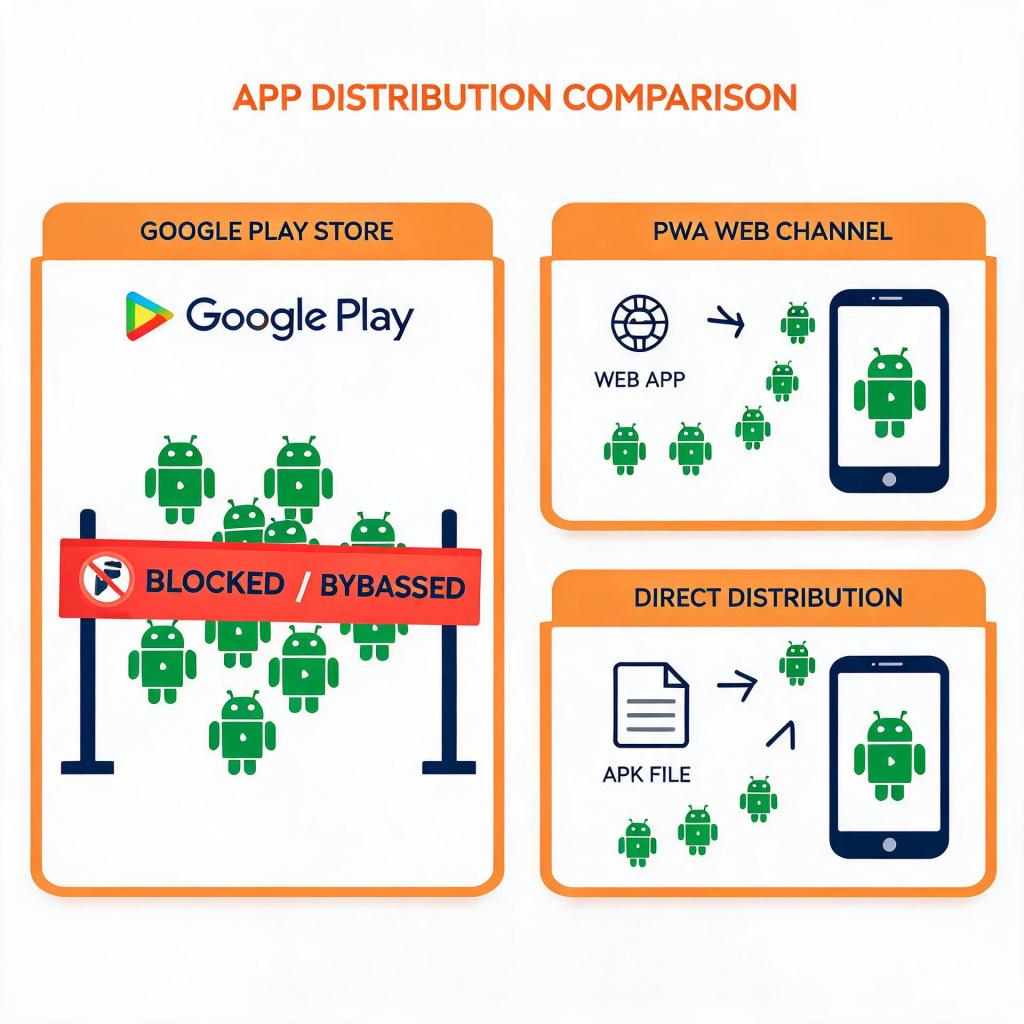
In 2026, the relationship between Android app teams and Google Play has reached a breaking point. The 30% revenue cut — once accepted as the cost of doing business — now looks indefensible when margins are thinning and customer acquisition costs keep climbing. Add unpredictable review rejections, opaque policy enforcement, and the growing gap between install attribution data and actual user behavior, and you have a situation where savvy operations managers are asking a very different question: not “how do we optimize for Google Play,” but “how do we get around it entirely.”
This guide is built for Chinese-speaking overseas operations teams making that exact decision. We cover every viable Google Play alternative for Android app distribution in 2026 — from PWA (Progressive Web App) direct distribution to third-party stores, sideloading, and hybrid strategies. No code. No implementation guides. Just the business case, the cost math, the risk analysis, and the real-world results that matter when you are presenting a distribution strategy to your leadership team.
→ Want to bypass Google Play entirely? See how ROiBest PWA works — no submission, no cut, 1.2x installs.
Why App Teams Are Leaving Google Play in 2026
The exodus from Google Play is not theoretical — it is happening across verticals, from fintech to e-commerce to content platforms. Three forces are driving the shift simultaneously, and their combined pressure makes 2026 the tipping point that previous years were not.
First, the cost structure has become unsustainable. Google’s 30% commission was designed for an era when app stores provided genuine discovery. Today, most installs come from paid media — Meta ads, TikTok campaigns, Google Ads themselves. You are paying to acquire a user, then paying Google a 30% cut on every dollar that user spends. For teams running on thin margins in competitive overseas markets, this double taxation destroys unit economics. A subscription app generating $10/month per user keeps only $7 after Google’s cut, before accounting for acquisition cost, server costs, and operational overhead.
Second, review risk has escalated dramatically. Google Play’s policy enforcement has become more aggressive and less predictable. Apps that operated without issue for months or years suddenly face suspension for policy interpretations that did not exist when the app was approved. For overseas teams, the consequences are existential — a suspended app means lost revenue, lost users, and a scramble to rebuild distribution from scratch. As we analyzed in our coverage of Meta’s ad review crackdown and its implications for PWA distribution, platform risk is not limited to app stores, but Google Play remains the single largest point of failure for most Android distribution strategies.
Third, attribution and data ownership have become critical competitive advantages. Google Play controls the install flow, which means Google controls the data. You cannot track the full user journey from ad click to install to first purchase with the granularity that modern performance marketing demands. PWA distribution and direct channels give you that data back — and in a market where first-party data strategies are becoming essential for ad targeting, owning your install funnel is not a nice-to-have. It is a strategic necessity.
PWA vs Native App: Business Comparison
The PWA-versus-native debate used to be a technical argument about capability gaps — push notifications, offline access, hardware APIs. In 2026, those gaps have effectively closed on Android. PWAs on Android support push notifications, home screen installation, offline functionality, and full-screen experiences that are visually indistinguishable from native apps. The remaining debate is purely a business one, and the business case increasingly favors PWA.
From a distribution perspective, PWAs eliminate the intermediary. There is no submission process, no review queue, no risk of rejection or suspension. You deploy your app to a URL, drive traffic to that URL through your existing marketing channels, and users install directly to their home screen with a single tap. The entire process — from deciding to launch to having a live, installable app — can happen in hours rather than weeks. For operations teams managing rapid iteration cycles or time-sensitive campaigns, this speed advantage is transformative.
From a user experience perspective, the install friction difference is significant and measurable. A Google Play install requires the user to leave their current context (whether that is a social media feed, a browser, or a messaging app), navigate to the Play Store, find the app, tap install, wait for download, then open the app. A PWA install happens in-context — the user taps a prompt, and the app appears on their home screen. This reduced friction is why teams using PWA distribution consistently report higher install conversion rates. The TikTok algorithm changes in 2026 have made this even more relevant, as PWA distribution aligns naturally with TikTok’s preference for in-platform engagement rather than off-platform redirects.
Cost Analysis: Google Play 30% Cut vs PWA Direct Distribution
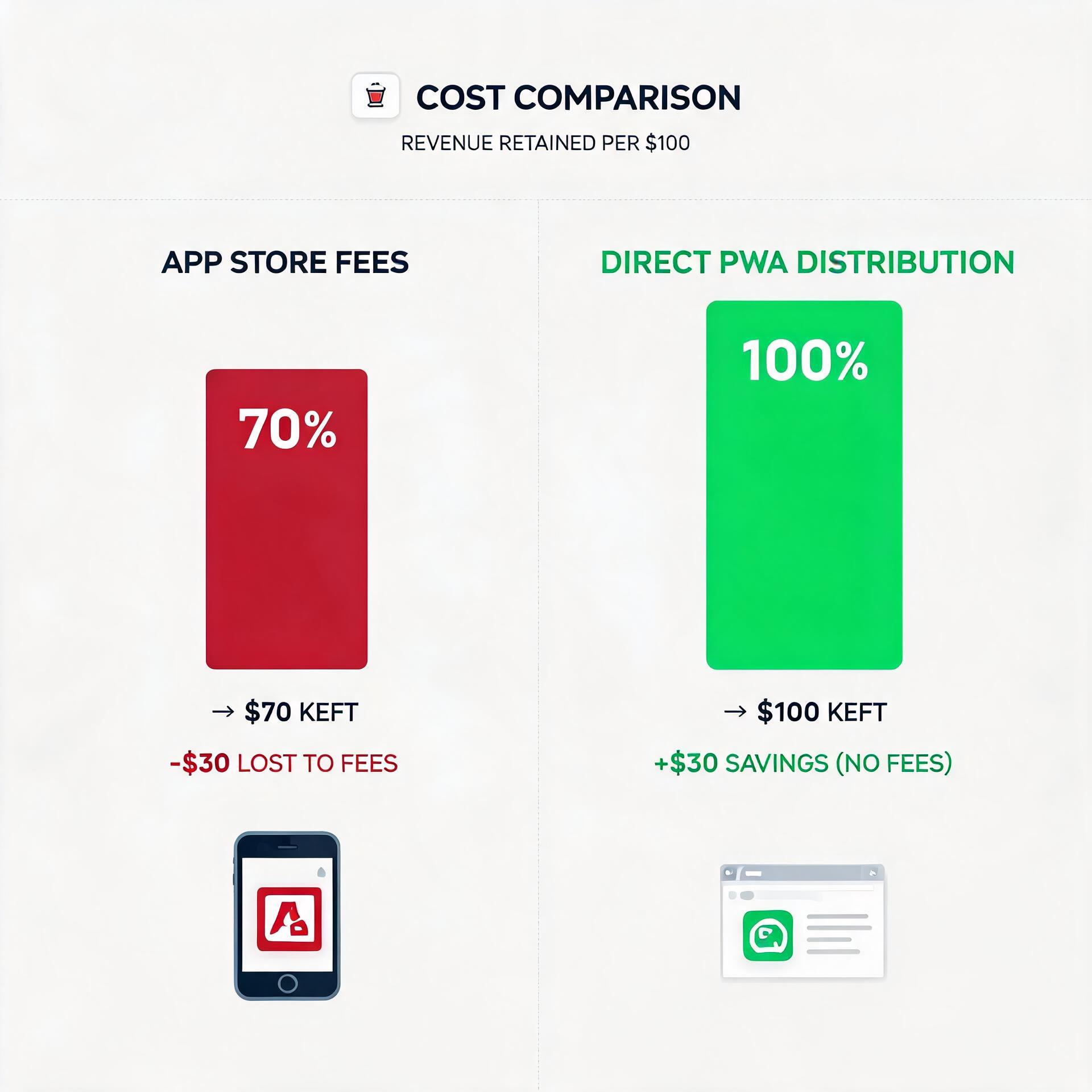
Let us make the cost comparison concrete. Consider a mid-size overseas app operation generating $100,000 per month in in-app revenue through Google Play. Google takes $30,000. Over a year, that is $360,000 — money that goes directly to Google for the privilege of being listed in a store where your users were not discovered organically but driven by your own paid marketing spend.
With PWA direct distribution, that $30,000 per month stays with you. Your costs are hosting (negligible for a PWA), a payment processor like Stripe at 2.9% + $0.30 per transaction (roughly $3,000/month on the same revenue), and the distribution platform itself. The net savings exceed $25,000 per month, or $300,000 per year. For a team operating in markets with additional tax complications — such as the digital service taxes that Meta has begun passing through to advertisers — the savings from eliminating Google’s cut become even more strategically important because they offset rising costs elsewhere in the marketing stack.
The cost argument extends beyond direct commission savings. Google Play’s review process creates hidden costs that rarely appear in financial models: developer time spent navigating policy compliance, legal review of store listing changes, the opportunity cost of delayed launches, and the catastrophic cost of unexpected suspensions. When your app is suspended, you are not just losing revenue for the duration of the suspension — you are losing users who cannot find you, losing momentum on campaigns that are still spending, and losing credibility with partners and investors. PWA distribution eliminates this entire category of risk-related cost. The rising cost pressures from DST surcharges across ad platforms make it even more critical to eliminate unnecessary commission costs wherever possible.
Review and Compliance Risk: Google Play vs PWA
Google Play’s review process has always been a black box, but in 2026, the opacity has become actively dangerous for overseas app operations. Policy updates arrive with minimal notice. Enforcement is inconsistent — identical apps in the same category receive different treatment. Appeals processes are slow, opaque, and frequently unsuccessful. For Chinese-speaking operations teams managing apps from overseas, the language and cultural barriers add another layer of difficulty when trying to resolve compliance issues.
The categories most affected are precisely the ones where overseas operations teams tend to concentrate: fintech, e-commerce, content platforms, social apps, and gaming. Google’s heightened scrutiny of financial services apps, combined with evolving regulations around AI content labeling requirements, means that apps operating in gray areas face compounding compliance risk. A policy that was acceptable last quarter may trigger a review flag this quarter, with no way to predict the change in advance.
PWA distribution eliminates review risk entirely because there is no review. Your app is a website. It is subject to the same regulations as any website — privacy laws, consumer protection, payment regulations — but it is not subject to the arbitrary, changeable, and often contradictory rules of a platform gatekeeper. You control your own compliance posture. You can update instantly when regulations change, without waiting for a re-review. And critically, no single entity can shut down your distribution overnight with an automated policy enforcement action. For operations teams that have experienced the panic of a Google Play suspension — or that live with the constant anxiety of the possibility — this peace of mind has real, if hard-to-quantify, business value.
User Retention: PWA Push Notifications vs Native
The conventional wisdom says native apps win on retention because of push notifications. In 2026, this conventional wisdom is outdated. PWAs on Android support push notifications through the Web Push API, and the notification experience is functionally identical to native push from the user’s perspective — same notification shade, same interaction patterns, same re-engagement capability.
But PWA push notifications have a structural advantage that native apps cannot match: they continue to work even after the user removes the app from their home screen. As long as the service worker is registered (which persists unless the user actively clears browser data), you can continue sending push notifications to re-engage users who have “uninstalled” your PWA. This is not possible with native apps — once a user uninstalls a native app from Google Play, your push notification channel is permanently severed. For retention-focused operations teams, this difference is enormous. It means your re-engagement campaigns have a larger addressable audience and a longer effective window.
The retention advantage compounds over time. Native app users who uninstall are effectively lost — re-acquiring them requires a fresh paid acquisition, at full cost. PWA users who remove the home screen icon can still be reached through push notifications, brought back to the app with a single tap, and re-engaged at near-zero marginal cost. Over a 12-month cohort, this difference in re-engagement capability can translate to 15-25% higher lifetime value per acquired user, depending on the vertical and the sophistication of the re-engagement strategy.
Third-Party Store Alternatives: Samsung, Huawei, APKPure
PWA is not the only Google Play alternative, and a comprehensive distribution strategy may include multiple channels. Third-party Android app stores — Samsung Galaxy Store, Huawei AppGallery, Amazon Appstore, APKPure, and others — offer distribution to specific device ecosystems or geographies. Understanding their strengths and limitations is essential for making an informed decision.
Samsung Galaxy Store is preinstalled on all Samsung devices, which gives it meaningful reach in markets where Samsung has dominant market share — parts of Southeast Asia, Latin America, and Europe. However, Samsung’s review process, while less stringent than Google’s, still exists. Commission rates are similar to Google’s 30% for most categories. The primary advantage is incremental reach, not cost savings or risk reduction. For teams whose primary motivation for leaving Google Play is cost or compliance risk, Samsung Galaxy Store does not solve the core problem.
Huawei AppGallery is essential for reaching Huawei device users in markets where Huawei retains significant share, particularly in parts of Asia, the Middle East, and Africa. Since Huawei devices do not include Google Play Services, AppGallery is not a Google Play alternative — it is a separate market entirely. The challenge is that Huawei’s ecosystem requires integration with Huawei Mobile Services (HMS) rather than Google Mobile Services (GMS), which adds development and maintenance overhead. Amazon Appstore and APKPure serve niche audiences and generally do not justify the integration cost for most overseas operations teams. The pattern across all third-party stores is the same: they add incremental reach but do not fundamentally change the distribution model. You are still subject to someone else’s review process, someone else’s policies, and someone else’s commission structure. PWA distribution is the only alternative that genuinely shifts the power dynamic back to the app team.
How PWA Distribution Actually Works: A Business Overview
For operations managers evaluating PWA distribution, the process is simpler than it appears from the outside. There are no app store submissions. There are no binary uploads. There is no review queue. A PWA is fundamentally a web application that meets certain technical criteria, enabling it to be installed on a user’s device and to behave like a native app — with its own icon, full-screen experience, and push notification capability.
From a business workflow perspective, PWA distribution works like this: your development team builds or converts your app as a PWA. You deploy it to your own domain or a distribution platform. You drive traffic to the app URL through your existing marketing channels — paid social, search ads, organic content, influencer partnerships, email campaigns. When a user visits the URL on an Android device, they see an install prompt. One tap, and the app is on their home screen. No Play Store redirect. No download progress bar. No Google account requirement. The install happens in seconds, in-context, without the user ever leaving your funnel.
The marketing implications are profound. Every click on your ad goes directly to your app, not to a Google Play listing where the user might get distracted, read negative reviews, or simply abandon the process. Your conversion funnel is shorter, more controllable, and fully measurable. You own every data point from impression to install to first action. For teams that have been struggling with the attribution gaps inherent in Google Play installs — especially as Google’s Data Manager API changes reshape how user data flows between platforms — PWA distribution provides a level of attribution clarity that native app distribution simply cannot match.
Attribution and Tracking: PWA vs Google Play Install Data
Attribution is where Google Play’s limitations become most painful for performance-driven operations teams. When a user clicks your Meta ad, gets redirected to Google Play, and installs your app, the attribution chain breaks at multiple points. The Google Play redirect introduces latency and drop-off. The install is attributed through Google’s systems, not yours. Deep linking from ad to specific in-app content is unreliable. And post-install event tracking requires SDK integration with third-party attribution platforms (AppsFlyer, Adjust, etc.) that add cost and complexity without fully solving the problem.
PWA distribution collapses this entire attribution chain into standard web analytics. A user clicks your ad. They land on your PWA. They install it. Every step happens within your web domain, tracked by your own analytics stack — Google Analytics, Mixpanel, Amplitude, or whatever you already use. UTM parameters flow through seamlessly. First-party cookies persist. The user journey from ad impression to install to purchase is a single, unbroken data stream that you own completely.
This attribution advantage has cascading benefits for campaign optimization. When you can see exactly which ad creative, which targeting segment, and which landing page variant drives the highest-value installs, you can optimize spend with precision that Google Play attribution cannot support. The teams that are winning in overseas markets in 2026 are the ones with the best data, not the biggest budgets. PWA distribution gives you better data by default, without additional attribution tools or integration work. Combined with the first-party data advantages that PWA provides for Customer Match and similar ad targeting features, the attribution story alone is often enough to justify the switch from Google Play to PWA distribution.
Real-World Results: PWA Distribution Case Studies
The business case for PWA distribution is not hypothetical. Across verticals, teams that have made the switch report consistent improvements in key metrics. The patterns are remarkably similar regardless of app category, market, or team size.
Install conversion rates consistently improve by 1.1x to 1.4x when switching from Google Play to PWA distribution. The primary driver is reduced friction — fewer steps between ad click and installed app means fewer drop-off points. A fintech app serving Southeast Asian markets reported a 1.3x improvement in install conversion after switching to PWA, with the largest gains coming from users on lower-end devices where Google Play downloads were slow and frequently abandoned. An e-commerce app targeting Latin American markets saw a 1.2x improvement, with the additional benefit of 40% faster time-to-first-purchase because users landed directly in the shopping experience rather than going through a Google Play intermediary.
Revenue retention improvements are equally compelling. Teams consistently report 25-30% revenue increases simply from eliminating Google’s commission, before accounting for any conversion rate improvements. A subscription content platform previously generating $80,000/month through Google Play switched to PWA distribution and saw monthly revenue increase to $108,000 — the combined effect of keeping 100% of revenue (previously $56,000 after Google’s cut) plus a 12% increase in subscriber conversion due to lower install friction. The alignment between TikTok’s evolving algorithm and PWA distribution has further amplified these results for teams that rely heavily on TikTok as an acquisition channel, as PWA links perform better within TikTok’s in-app browser than Google Play redirect links.
Operational risk reduction is harder to quantify but equally important. Teams that have switched to PWA distribution report dramatically lower stress levels around policy changes and review outcomes. Product iteration speed increases because updates deploy instantly without waiting for review approval. Campaign launch timelines compress because there is no review queue bottleneck. One operations manager summarized it this way: “We used to plan two weeks of buffer into every campaign timeline for Google Play review. Now we plan zero. That buffer was costing us competitive opportunities every month.”
Getting Started: Choose Your Distribution Strategy
The right distribution strategy depends on your specific situation, but the decision framework is straightforward. Ask three questions, and the answers will point you toward the right approach.
First, how important is Google Play organic discovery to your current install volume? If more than 30% of your installs come from organic Google Play search (not paid campaigns that redirect to Google Play), you have genuine discovery value that you would need to replace. For most overseas operations teams running paid acquisition, however, organic Play Store discovery accounts for less than 10% of installs. In that case, you are paying Google’s 30% commission for distribution you are already paying for through ad spend — a clear case for switching to PWA.
Second, what is your compliance risk profile? If your app operates in a category that Google Play scrutinizes heavily — fintech, gambling, social dating, content with age restrictions, or anything involving cryptocurrency — PWA distribution removes an existential risk. Even if the cost savings alone do not justify the switch, the risk reduction almost certainly does.
Third, how much do you value attribution and data ownership? If your marketing strategy depends on precise attribution, cohort analysis, and first-party data for ad targeting, PWA distribution gives you capabilities that Google Play fundamentally cannot. As privacy regulations tighten and third-party data becomes less reliable, the teams with the best first-party data will have the strongest competitive position.
For most overseas operations teams in 2026, the answer to all three questions points in the same direction: PWA distribution as the primary channel, with Google Play maintained as a secondary presence if — and only if — organic discovery provides meaningful value. The transition does not need to happen overnight. Many teams run both channels in parallel during a transition period, gradually shifting spend and focus toward PWA as they validate the performance improvements in their specific market and vertical.
Skip the app store. Go live instantly, keep 100% of your revenue.
ROiBest helps Android app teams launch PWAs — no review process, no 30% Google Play cut, and push notifications that work even after uninstall. Teams see up to 1.2x higher install conversion rates vs native app downloads.
 WebApp中文站
留下评论