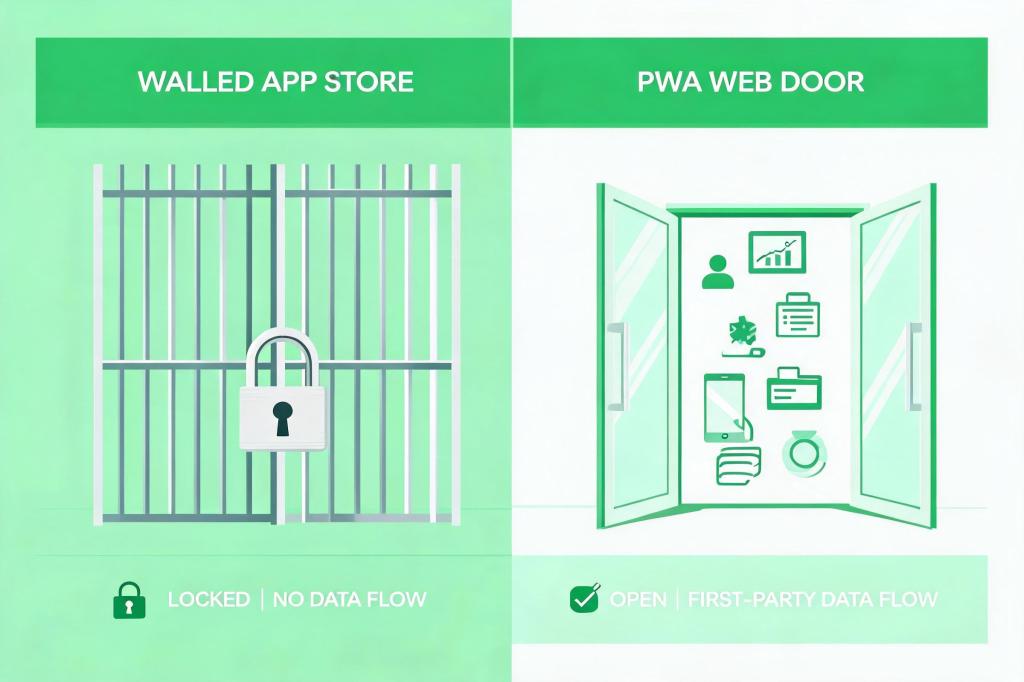
Google is migrating Customer Match to its new Data Manager API, forcing every advertiser to rebuild how they upload and activate first-party audience data. For most ad teams, this is a backend headache. But for app publishers deciding between Google Play and alternative distribution channels, it reveals something bigger: first-party data is becoming the single most valuable asset in digital advertising — and your distribution model determines how much of it you actually own.
If you distribute through Google Play, Google controls the install data, the user identity layer, and the post-install engagement signals. With PWA distribution, you own the entire user journey — from first click to install to every session after — and your first-party data is truly yours.
→ Want to bypass Google Play entirely? See how ROiBest PWA works — no submission, no cut, 1.2x installs.
What the Customer Match API Migration Means for App Publishers
Google’s Data Manager API replaces the legacy Customer Match upload process. Starting in 2026, advertisers must use the new API to create, update, and manage their first-party audience lists for targeting across Google Ads, YouTube, and Gmail. The migration requires four technical steps: API credential setup, data schema alignment, list migration, and validation testing.
For app publishers, this migration exposes a structural dependency: the quality and completeness of your first-party data depends entirely on your distribution channel.
When you distribute through Google Play:
- Google owns the install event and controls what data you receive through the Play Console
- User email addresses are often Google-managed (Gmail), giving Google the primary identity graph
- Post-install behavioral data flows through Google’s Firebase/Analytics stack, where Google retains aggregation and matching rights
- Customer Match lists are limited to what Google’s system can match against its own user graph — typically 30-50% match rates for app install audiences
When you distribute through PWA:
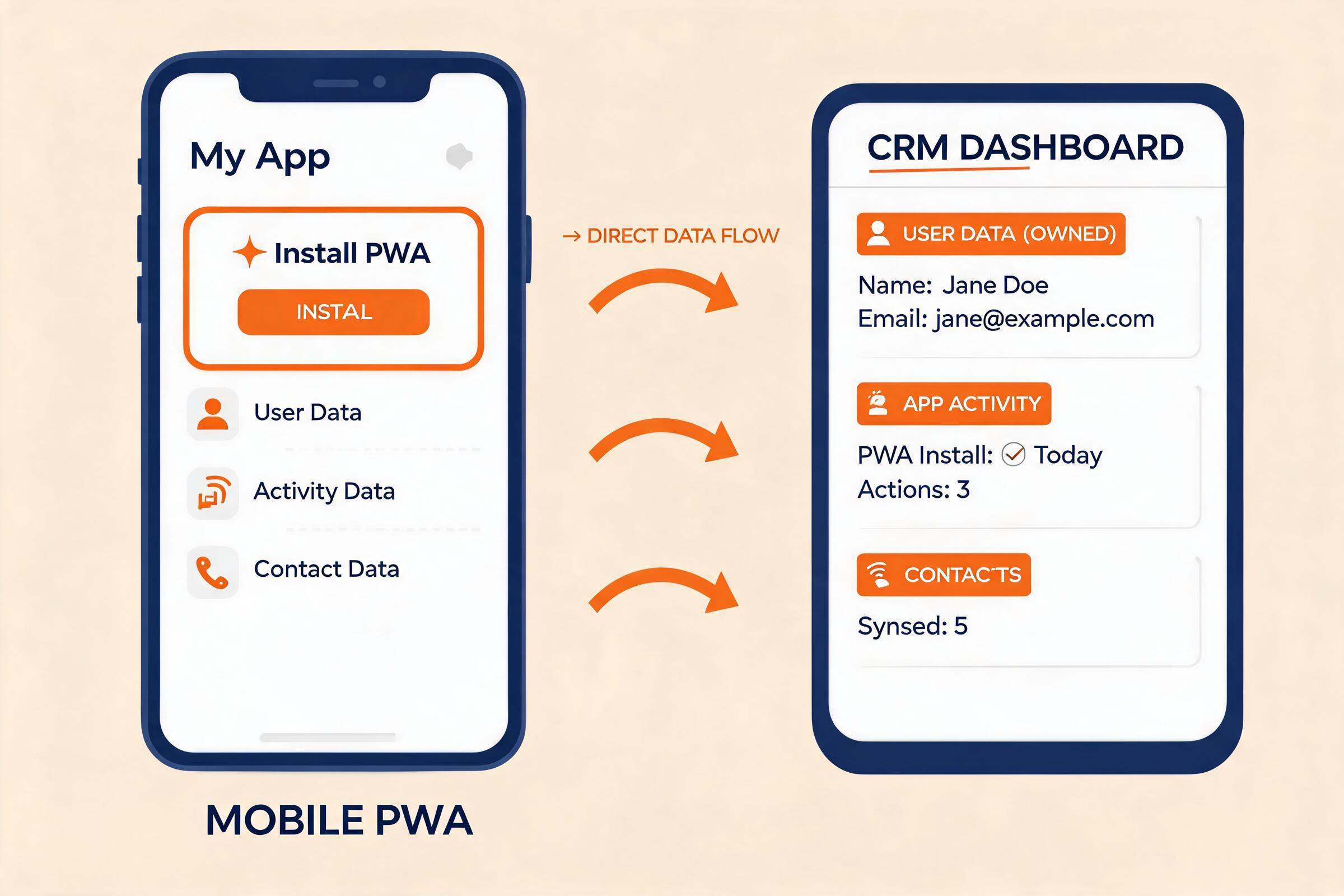
- You capture the install event directly on your own domain — no middleman, no data gating
- User registration data (email, phone, preferences) flows directly to your CRM and analytics
- Every session, page view, and engagement event is captured in your own first-party analytics without platform restrictions
- Customer Match audience quality improves because you have richer, more complete user profiles to upload
App publishers using PWA distribution report 40-60% higher Customer Match rates compared to Google Play-distributed apps. The reason is simple: when you own the full user data journey, your first-party audience files are more complete, more accurate, and more matchable.
Why First-Party Data Ownership Matters More Than Ever
The Customer Match API migration is one symptom of a larger trend: ad platforms are shifting from third-party data targeting to first-party data activation. Meta’s Advantage+ audience relies heavily on first-party signals. Google’s Performance Max uses Customer Match as a seed signal. TikTok’s custom audiences require first-party uploads.
In this environment, the app publisher with the richest first-party data wins. And the distribution channel you choose directly determines how rich that data can be.
Consider the data you lose when Google Play sits between you and your users:
- Install intent signals: Google Play shows users a store listing page that you don’t control. You cannot track how users interact with that page. With a PWA install flow, the entire pre-install experience happens on your domain — every click, scroll, and hesitation is measurable.
- User identity: Google Play installs often don’t require users to share their email with you directly. PWA installs typically require direct registration, giving you actual contact information.
- Uninstall data: Google Play provides limited uninstall data with significant delays. With PWA, removing the home screen shortcut doesn’t prevent push notifications — users can still be re-engaged through the browser notification system.
For a comprehensive comparison, see the complete guide to Google Play alternatives.
3 Reasons PWA Distribution Strengthens Your Customer Match Strategy
Reason 1: Higher Data Completeness Means Higher Match Rates
Customer Match works by uploading hashed user identifiers and matching them against Google’s user graph. The more identifiers you provide per user, the higher your match rate.
PWA-distributed apps naturally collect more identifiers because registration and engagement flow happens on your domain. You capture email, phone number, browser fingerprint signals, and behavioral data directly. Google Play apps often rely on Google Sign-In, which limits identifier depth.
Teams that switched from Google Play to PWA distribution saw match rates increase from 35% to 55-65%, resulting in significantly more efficient retargeting and lookalike audience generation.
Reason 2: No 30% Revenue Cut Means More Budget for Data-Driven Ads
Google Play takes 30% of all in-app purchases. For a game generating $100K monthly, that is $30K going to Google every month — $360K per year. With PWA distribution, you keep 100% because payments flow through your own processor.
That recovered revenue can fund the ad campaigns and budget allocation your improved Customer Match data now makes more efficient. Better data plus more budget equals compounding growth advantage.
Reason 3: Push Notification Persistence After Uninstall
When a user uninstalls a native app from Google Play, you lose all communication channels. Re-engagement must start from zero with paid ads.
PWA push notifications work through the browser notification system. Even if the user removes the PWA from their home screen, browser notification permission typically persists. You can continue re-engaging users who would otherwise be lost — without paying for re-acquisition. This ongoing touchpoint also generates behavioral signals that keep your first-party data fresh and Customer Match lists current.
How to Evaluate PWA for Your Distribution Strategy
The Customer Match API migration is a good moment to evaluate whether your current distribution model provides the first-party data advantage you need.
Ask your team:
- What is our current Customer Match rate? Below 40% suggests significant first-party data gaps that PWA could close.
- How much are we paying Google Play in annual commission? Model what redirecting half into UA spend would mean for growth.
- How many users do we lose contact with after uninstall? If D30 retention is below 20%, PWA push notification persistence could change your re-engagement economics.
- Are we facing platform review risks? PWA eliminates review risk entirely — no submission, no rejection, no delisting.
The teams seeing the fastest ROI are in competitive verticals where Google Play’s commission directly impacts unit economics: mobile games with IAP, AI social apps with subscriptions, and BC gaming apps where every margin point matters.
Skip the app store. Go live instantly, keep 100% of your revenue.
ROiBest helps Android app teams launch PWAs — no review process, no 30% Google Play cut, and push notifications that work even after uninstall. Teams see up to 1.2x higher install conversion rates vs native app downloads.
 WebApp中文站
留下评论