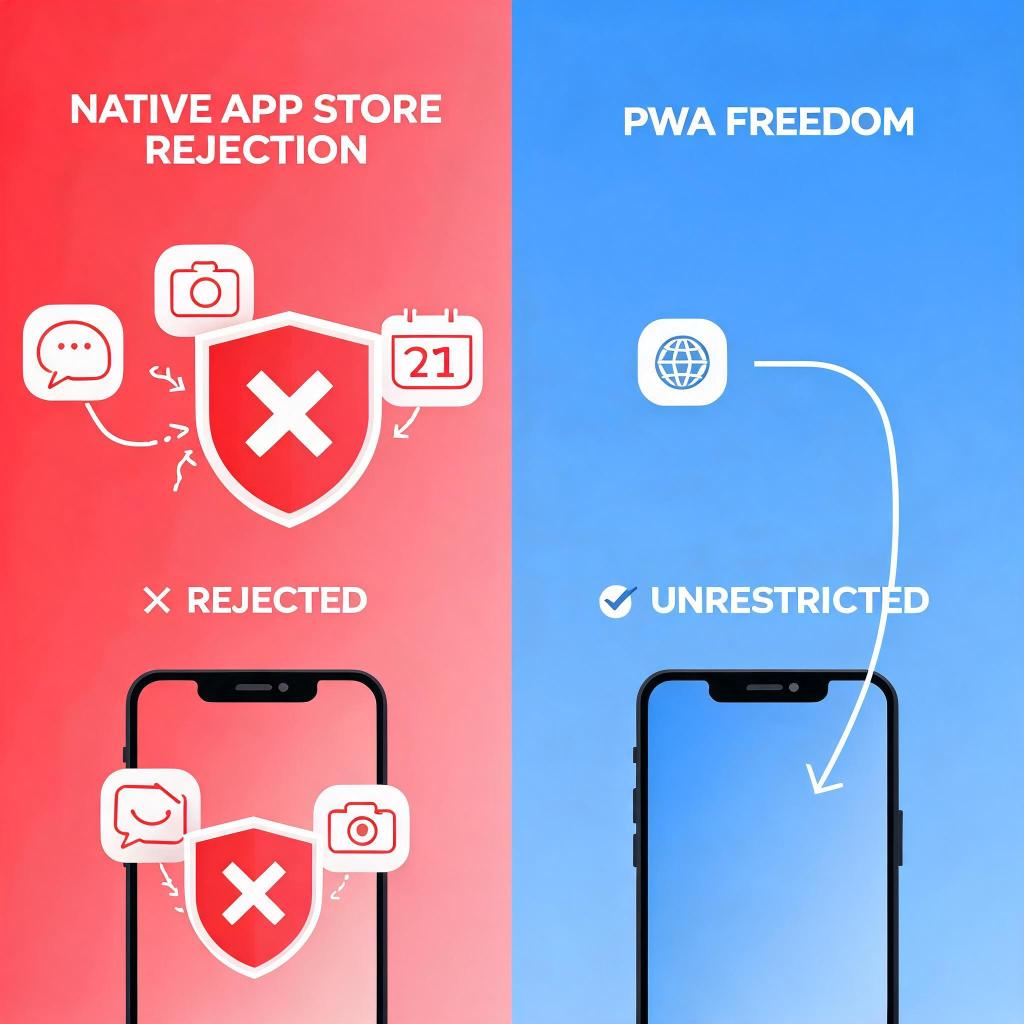
In April 2026, Meta quietly escalated its ad review enforcement — banning entire categories of law firm advertising, tightening Advantage+ campaign controls, and flagging app install ads at rates advertisers haven’t seen before. For app teams running paid acquisition through Meta’s ecosystem, this isn’t a minor policy tweak. It’s a structural warning: your ability to acquire users now depends on a platform reviewer’s judgment call.
If your Android app has ever been delayed, rejected, or shadowbanned by Google Play review, you already understand this risk. Now imagine that same unpredictability hitting your ad campaigns — the very channel you use to drive installs. The compounding effect is brutal: app store review can block your product, and ad review can block your distribution.
There is a way out. Progressive Web Apps (PWAs) bypass app store review entirely. No submission process. No waiting for approval. No risk of removal after launch. And when you pair PWA distribution with a service like ROiBest, the technical complexity disappears — you get a live, installable app with push notifications, offline support, and 1.2x higher install conversion rates than native app downloads.
→ Want to bypass Google Play entirely? See how ROiBest PWA works — no submission, no cut, 1.2x installs.
What Meta’s Ad Review Tightening Actually Means for App Teams
Let’s be specific about what happened. In early 2026, Meta began enforcing stricter ad review policies across several fronts:
- Law firm ad bans: Meta blocked advertising from entire categories of legal services, citing policy violations related to “sensitive categories.” This affected not just law firms but any app or service adjacent to legal, financial, or health verticals.
- Advantage+ opacity: Advertisers using Meta’s Advantage+ campaigns reported that creative review became a black box. Ads that previously passed review were suddenly flagged. Worse, the automated system provided no specific reason for rejections — just generic policy citations.
- App install ad scrutiny: App install campaigns, particularly for apps in gaming, social, and lifestyle categories, saw increased rejection rates. Some advertisers reported 30-40% of their creatives being rejected in review cycles that previously had near-zero rejection rates.
For overseas operations managers running Meta ad campaigns to acquire users, this creates a two-layer risk. First, your app can be removed from Google Play at any time — we’ve covered this extensively in our analysis of Google Play alternatives for Android app distribution. Second, even if your app stays live, your ability to drive traffic to it through Meta’s ad network is now unreliable.
This is not a temporary enforcement wave. Meta has been steadily increasing review automation through machine learning systems since 2024, and the trend is clear: more categories will be affected, more creatives will be flagged, and the appeal process will remain slow and opaque.
How PWA Distribution Eliminates Review Risk Entirely
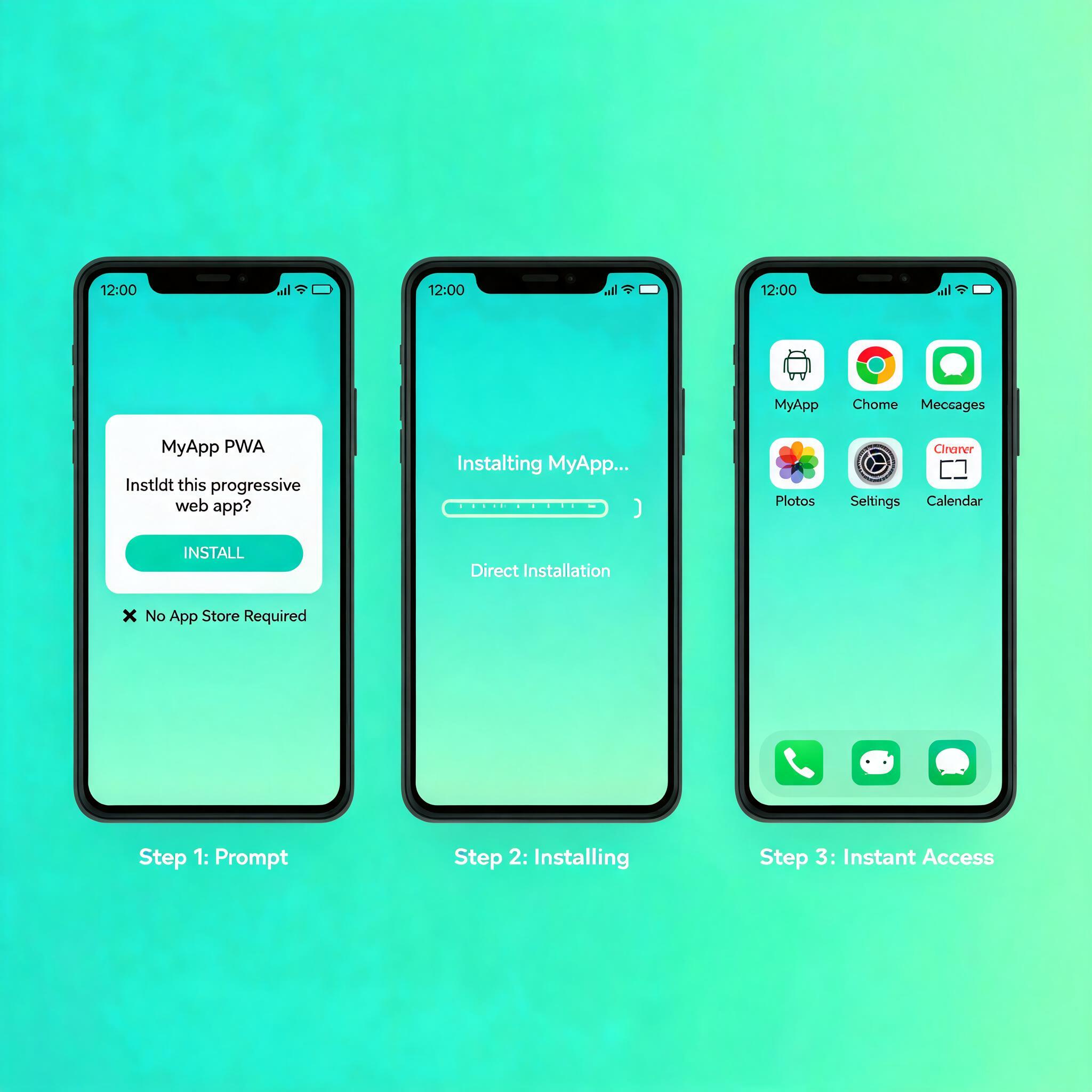
The fundamental problem with app store distribution is that you are renting shelf space. Google Play owns the store, sets the rules, and can change those rules at any time. Your app exists at their discretion. Meta’s ad platform operates the same way — your campaigns exist at Meta’s discretion.
PWA distribution changes this equation completely. Here’s what happens when you distribute your app as a PWA instead of through Google Play:
- No submission process: Your app goes live the moment you deploy it. There is no review queue, no waiting period, no approval gate. You control the timing.
- No removal risk: Because your PWA lives on your own domain (or a distribution partner’s infrastructure), no platform can unilaterally remove it. Google Play can’t pull your listing because you don’t have one.
- No content restrictions: App store review policies are notoriously vague and inconsistently enforced. PWA distribution means your content decisions are yours to make.
- No revenue sharing: Google Play takes a 30% cut of in-app purchases. PWA distribution means you keep 100% of your revenue — a 0% commission rate versus 30%.
When Meta’s ad review blocks your creative, a PWA-distributed app is still accessible via direct links, organic search, social sharing, and alternative traffic channels like TikTok. You’re not dependent on a single platform for both distribution and acquisition.
This is not about being anti-platform. It’s about reducing single points of failure. Smart operations teams use Meta ads as one channel among many — and they make sure their app’s existence doesn’t depend on any single gatekeeper.
Real Data: PWA vs App Store Install Conversion Rates
Let’s talk numbers. The most common objection to PWA distribution is that users won’t install a PWA the way they install a native app. The data tells a different story.
Teams using ROiBest’s PWA packaging service consistently report 1.2x higher install conversion rates compared to native Google Play downloads. Why? Because the install flow is simpler:
- Native app flow: User clicks ad → redirected to Google Play → reads listing → clicks “Install” → waits for download → opens app. Each step is a drop-off point. Google Play’s listing page alone can lose 40-60% of users who arrive there.
- PWA flow: User clicks link → app loads instantly in browser → “Add to Home Screen” prompt appears → one tap → done. The app is on their home screen, with an icon indistinguishable from a native app.
Beyond install conversion, PWAs offer a critical retention advantage: push notifications work even after the user removes the app from their home screen. This means your re-engagement channel survives even soft churn — something native apps cannot do once uninstalled.
Here’s a comparison that matters for ops teams evaluating their options:
| Metric | Google Play (Native) | PWA (via ROiBest) |
|---|---|---|
| Install conversion rate | Baseline | 1.2x higher |
| Platform commission | 30% | 0% |
| Review/approval required | Yes (3-7 days) | No |
| Removal risk | High (policy changes) | None |
| Push notifications after uninstall | No | Yes |
| Time to go live | Days to weeks | Same day |
For teams spending significant budgets on Meta app install campaigns, the math is straightforward. Even if Meta’s ad review doesn’t affect you today, the trend is clear: review is getting stricter, not looser. Building your distribution on a foundation that can’t be disrupted by platform policy changes is a strategic investment, not a workaround.
Common Concerns: Is My App Right for PWA Distribution?
If you’ve been building native Android apps for years, switching to PWA distribution raises legitimate questions. Here are the ones we hear most often from operations managers evaluating this path:
“Will my app lose features if it’s a PWA?”
Modern PWAs on Android support nearly everything native apps do: push notifications, offline functionality, camera access, geolocation, background sync, and full-screen mode. The gap between PWA and native has narrowed dramatically since 2024. For most app categories — gaming, social, lifestyle, e-commerce, content — users cannot tell the difference.
“Can I still run Meta ads pointing to a PWA?”
Yes. Your Meta ads point to a URL instead of a Google Play listing. In fact, this can work in your favor: URL-based landing pages give you more control over the install experience, and you can A/B test the landing page independently of your ad creative. If Meta rejects one ad creative, your app is still live and accessible through every other channel.
“What about users who specifically search for my app on Google Play?”
You can maintain a Google Play listing alongside your PWA distribution. Many teams use a dual strategy: Google Play for organic discovery, PWA for paid acquisition and direct traffic. This way, you’re not putting all your eggs in one basket. If Google Play removes your app, your PWA keeps running. If Meta blocks your ads, your Google Play listing still captures organic searches.
“Is this technically complicated to set up?”
This is where ROiBest comes in. ROiBest is a PWA packaging service — they handle all the technical work. You provide your app, they deliver a production-ready PWA with push notifications, offline support, and an optimized install flow. There’s no need for your team to learn PWA development, write service workers, or manage manifest files. ROiBest handles the tech; your team focuses on growth.
Three Action Steps to Reduce Your Platform Dependency
If Meta’s ad review tightening has you concerned — and it should — here are three concrete steps to take this week:
- Audit your platform dependency. Map out every point where a platform (Google Play, Meta, Apple) can unilaterally disrupt your user acquisition or app distribution. If more than 70% of your installs come through a single channel, you have a concentration risk that needs addressing immediately.
- Launch a PWA version of your app. You don’t need to abandon Google Play. Start by running a PWA alongside your native app and directing a portion of your paid traffic to it. ROiBest can have your PWA live within days — no submission process, no approval wait. Compare conversion rates, retention, and revenue per user against your Google Play baseline.
- Diversify your acquisition channels. Meta is one ad platform among many. If Meta’s review blocks your creatives, you need alternative channels already warmed up. TikTok, programmatic display, influencer partnerships, and organic SEO all become more effective when your landing page is a PWA — because the install flow is faster and you control the entire experience.
The Bottom Line: Don’t Wait for the Next Review Crackdown
Meta’s 2026 ad review tightening is not an isolated event. It’s part of a broader trend across all major platforms: tighter content policies, more automated enforcement, less transparency in appeals, and more categories being flagged. Google Play’s review process has followed the same trajectory. Apple’s App Store has always been strict.
The question is not whether your app will be affected — it’s when. And when it happens, the teams that already have PWA distribution in place will keep acquiring users while their competitors scramble to appeal rejections and find workarounds.
ROiBest exists to make this transition effortless. They package your app as a PWA, handle the technical infrastructure, and give you a distribution channel that no platform can shut down. Your team gets the benefits — 1.2x install conversion, 0% commission, push notifications that survive uninstall — without writing a single line of PWA code.
The smartest move you can make in 2026 is to stop depending on platforms that can cut you off at any time. PWA distribution is how you do it.
Skip the app store. Go live instantly, keep 100% of your revenue.
ROiBest helps Android app teams launch PWAs — no review process, no 30% Google Play cut, and push notifications that work even after uninstall. Teams see up to 1.2x higher install conversion rates vs native app downloads.
 WebApp中文站
留下评论