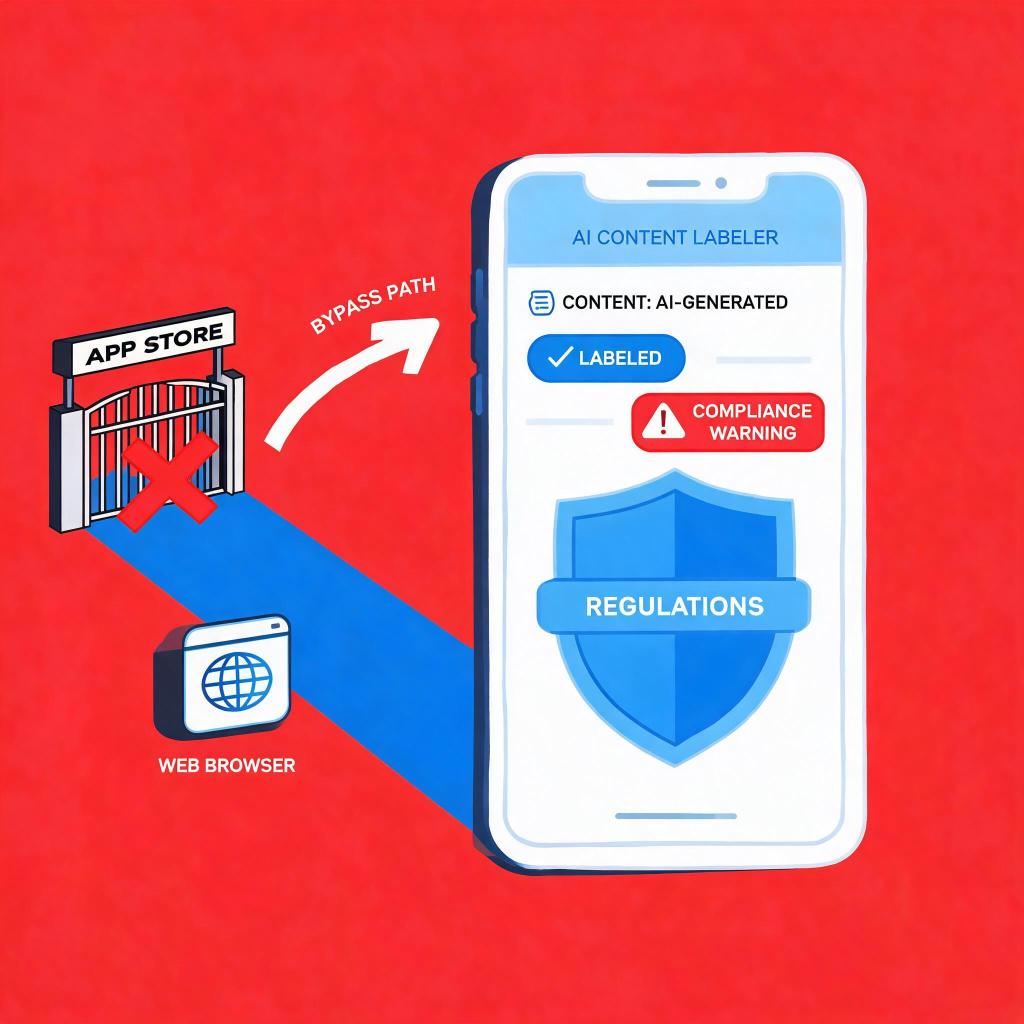
New AI content labeling regulations are rolling out across major markets — the EU’s AI Act, the US FTC guidelines, and China’s updated AIGC rules all now require clear disclosure when content is AI-generated. For AI social apps and gaming studios distributing through Google Play, this adds another layer of review risk. PWA distribution sidesteps these app store compliance gates entirely.
→ Want to bypass Google Play entirely? See how ROiBest PWA works — no submission, no cut, 1.2x installs.
The AI Content Labeling Problem for App Store Distribution
Google Play updated its Developer Program Policy in early 2026 to require apps that generate or display AI-created content to include visible labels. This applies to AI dating apps that generate profile descriptions, AI companion apps that create conversational responses, and any game that uses procedurally generated AI content in user-facing elements.
The policy isn’t just about disclosure — it’s about enforcement. Google Play review teams are now actively scanning for AI-generated content in app submissions. If your app generates content that could be mistaken for human-created (chatbot responses, AI-generated images, AI-written descriptions), you need explicit labeling or risk rejection.
For BC game studios, this means in-game AI NPCs, AI-generated event descriptions, and AI-created marketing copy within the app all potentially need labeling. The compliance overhead is real: engineering teams are spending 2–4 weeks implementing labeling systems that satisfy Google’s requirements, and each update to Google’s policy can invalidate previous implementations.
Apple’s App Store has similar requirements under its updated Human Interface Guidelines. Between both platforms, AI app teams are facing a moving target of compliance rules that change faster than they can implement.
How PWA Distribution Bypasses Content Labeling App Store Risk
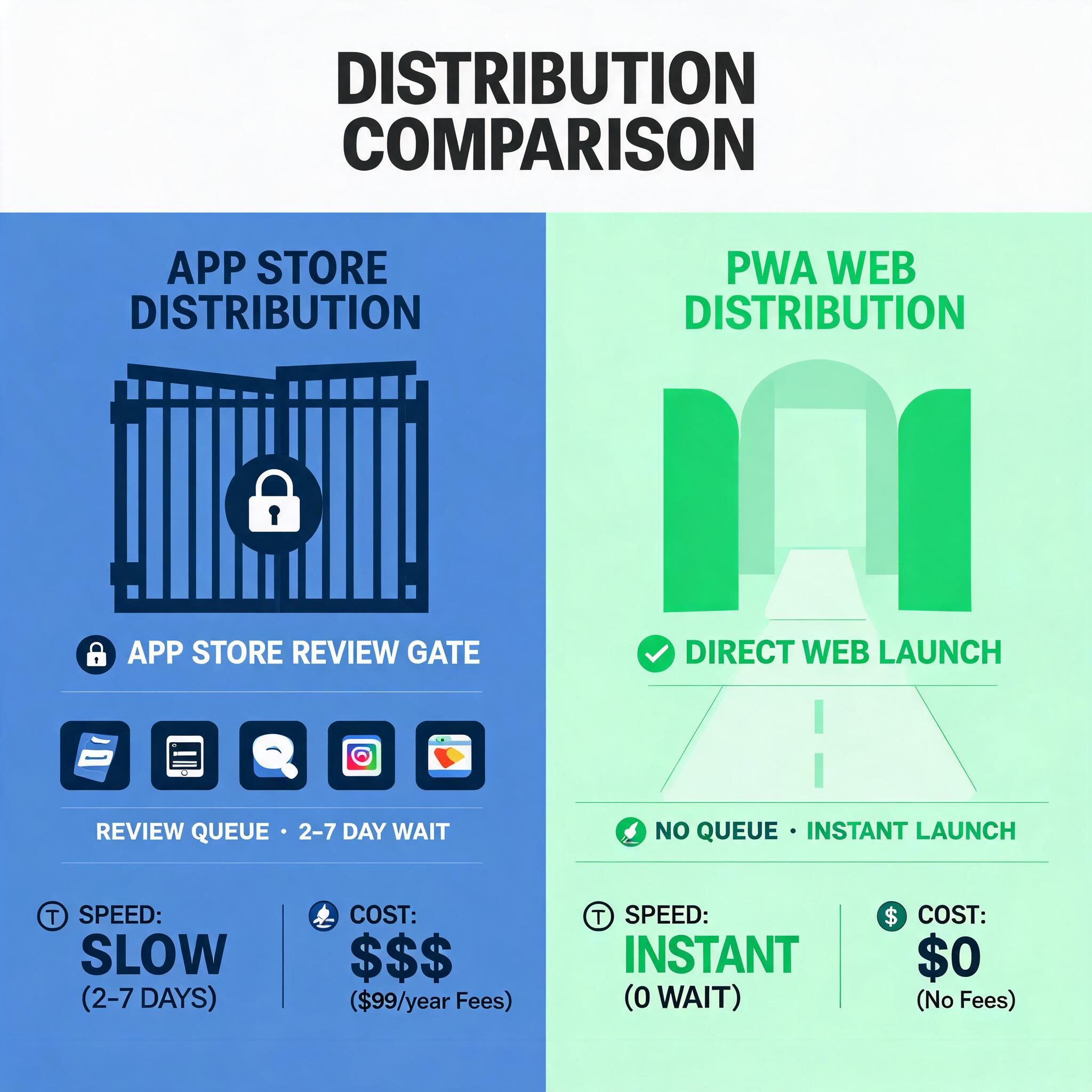
PWA (Progressive Web App) distribution operates under web protocols, not app store policies. When you distribute your app as a PWA that installs directly to the user’s Android home screen, you’re not subject to Google Play’s review process — including its AI content labeling enforcement.
This doesn’t mean you can ignore AI labeling regulations entirely. The EU AI Act and FTC guidelines apply regardless of distribution channel. But there’s a critical difference: government regulations are typically clearer, more stable, and less subjective than app store policies. You implement the regulation once and you’re compliant. With app stores, compliance is at the discretion of reviewers who may interpret policies differently on each submission.
For AI social app teams, PWA distribution eliminates the specific risk of app rejection or removal due to AI content labeling disputes. Your app can still comply with government regulations through your own disclosure UI — but you control the implementation timeline and approach, rather than waiting for a reviewer to approve or reject your interpretation of vague policy language.
The complete guide to Google Play alternatives for Android distribution covers why this structural advantage matters beyond just content labeling — it affects every aspect of your release cycle.
Real Compliance Differences: App Store vs Web Distribution
Review Speed and Predictability
Google Play reviews take 1–7 days, and AI content policy violations can add an additional 2–4 weeks of back-and-forth. A single rejected update can delay your entire release calendar. With PWA distribution, you deploy directly — updates go live in minutes, and there’s no third-party reviewer blocking your timeline.
For game studios running time-sensitive events or AI app teams shipping weekly model improvements, this speed difference is a competitive advantage measured in revenue. A 2-week review delay during a holiday promotion or viral moment isn’t just an inconvenience — it’s lost revenue that competitors with faster deployment capture.
Revenue Retention
Beyond compliance risk, PWA distribution eliminates the 30% Google Play commission on in-app purchases. For AI social apps with subscription models or BC games with in-app deposit flows, this means keeping $30 of every $100 in revenue that would otherwise go to Google.
Combined with faster deployment and no review risk, the total cost of app store distribution (commission + compliance overhead + delay costs) often exceeds 40% of revenue for AI apps. PWA distribution reduces this to near-zero — your only costs are hosting and the PWA packaging service.
Push Notification Advantage
One common concern about leaving Google Play is losing push notification capability. PWA push notifications on Android work through the Web Push API and Chrome’s notification system — they function identically to native notifications from the user’s perspective. More importantly, PWA push notifications persist even after the user “uninstalls” (removes from home screen), because the service worker remains registered in Chrome.
For user retention strategies, this is a significant advantage. AI companion app users who remove the app from their home screen can still receive re-engagement notifications — something impossible with native app uninstalls. Teams that have previously analyzed Google Customer Match migration strategies will recognize this as a valuable complement to first-party data retention.
3 Steps to Evaluate PWA Distribution for Your AI App
Step 1: Audit Your Current App Store Compliance Risk
List every AI-generated content element in your app: chatbot responses, generated images, AI-written copy, procedural content. For each, check whether it currently has labeling that would satisfy Google Play’s policy. The gap between your current implementation and Google’s requirements is your compliance risk surface.
Step 2: Estimate the Cost of App Store Distribution
Calculate your true distribution cost: 30% commission + engineering hours spent on compliance + revenue lost to review delays + risk of sudden removal. Compare this against PWA packaging costs (typically $200–500/month for a managed service like ROiBest).
Step 3: Run a Parallel PWA Channel
You don’t need to choose one channel exclusively. Launch a PWA version alongside your Google Play listing. Route a portion of your paid traffic (especially from markets with high AI regulation risk) to the PWA install flow. Compare install rates, Day 7 retention, and LTV between channels over 30 days. Historical comparisons between PWA and Google Play distribution costs consistently show PWA wins on total cost of ownership for teams spending over $10K/month on user acquisition.
Most teams that test both channels end up shifting 60–80% of acquisition to PWA within 90 days — not because they planned to, but because the data makes the decision obvious.
Skip the app store. Go live instantly, keep 100% of your revenue.
ROiBest helps Android app teams launch PWAs — no review process, no 30% Google Play cut, and push notifications that work even after uninstall. Teams see up to 1.2x higher install conversion rates vs native app downloads.
 WebApp中文站
留下评论