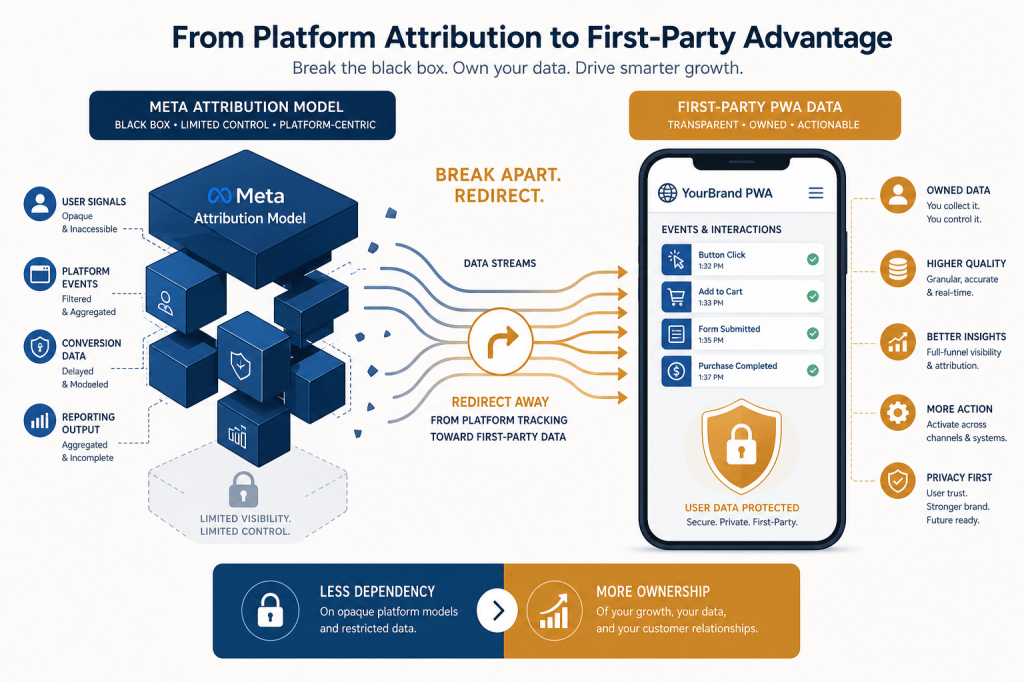
In May 2025, Meta rolled out a fundamental change to its attribution model: the shift from click-through attribution to engage-through attribution. For advertisers who’ve spent years calibrating campaign measurement around Meta’s legacy click-based windows, this isn’t a minor settings update — it’s a structural disruption to how you understand which ads drive installs, purchases, and downstream revenue. Engage-through attribution expands the definition of a “qualified interaction” beyond a click to include video views, comments, saves, and other engagement signals — which sounds reasonable until you realize it inflates conversion counts, obscures true cost-per-acquisition, and makes it nearly impossible to compare performance across platforms on a like-for-like basis. For overseas app teams running Android campaigns, this creates a dangerous data gap: you’re increasingly relying on Meta’s interpretation of your own business performance. PWA distribution offers a different path — one where you own the data layer outright, collect first-party signals independently, and never lose visibility when a platform decides to change its measurement rules.
→ Want to bypass Google Play entirely? See how ROiBest PWA works — no submission, no cut, 1.2x installs.
What Exactly Changed in Meta’s Attribution Model
To understand why this matters, you need to understand what Meta actually changed and what it replaces. Under the traditional click-through attribution model, a conversion was credited to an ad only when a user physically clicked on the ad and subsequently completed the desired action (install, purchase, registration) within a defined attribution window — typically 7 days for clicks and 1 day for views. This was relatively straightforward and gave advertisers a clear, auditable causal chain: user saw ad, user clicked ad, user converted.
Engage-through attribution changes the causal logic. Now, a conversion can be attributed to an ad if the user merely engaged with it — watched a video for a qualifying duration, left a comment, saved the post, expanded a carousel — without ever clicking through to your landing page or app store listing. Meta’s rationale is that modern user journeys are non-linear and that engagement signals are meaningful predictors of downstream intent. That’s debatable, but the operational consequences are not.
Here’s what changes in practice for overseas app teams:
- Inflated conversion counts. Actions that previously wouldn’t appear in your attribution reports now get credited. A user who watched 15 seconds of your video ad and installed your app three days later via organic search will show up as a Meta-attributed conversion — even though Meta may have had nothing to do with the install decision.
- Blurred channel economics. If Meta claims credit for conversions that also appear in your organic, ASO, or Google Ads attribution, your blended cost-per-install drops artificially. You think Meta is more efficient than it actually is. Budget allocation decisions get distorted.
- Cross-platform comparability collapses. TikTok, Google, and Meta now use fundamentally different definitions of “attributed conversion.” Comparing CPI or ROAS across platforms without normalizing for attribution methodology becomes meaningless — a problem eMarketer flagged when it noted that over 60% of performance marketers reported significant attribution discrepancies between Meta and Google in Q4 2025 (eMarketer, 2025).
- Retargeting data gets noisier. Audiences built on “converters” now include users who engaged but never truly converted with intent. Lookalike quality degrades.
The net effect is that advertisers lose granular control over their performance data precisely when they need it most. According to AppsFlyer’s 2025 State of Mobile Attribution report, mobile app install fraud rates rose to 14% globally, compounding the signal-noise problem that attribution model changes create (AppsFlyer, 2025). When your measurement layer is controlled by the same entity selling you impressions, any change to measurement methodology should be treated as a conflict of interest — not a product improvement.
How PWA Gives You Back Data Control
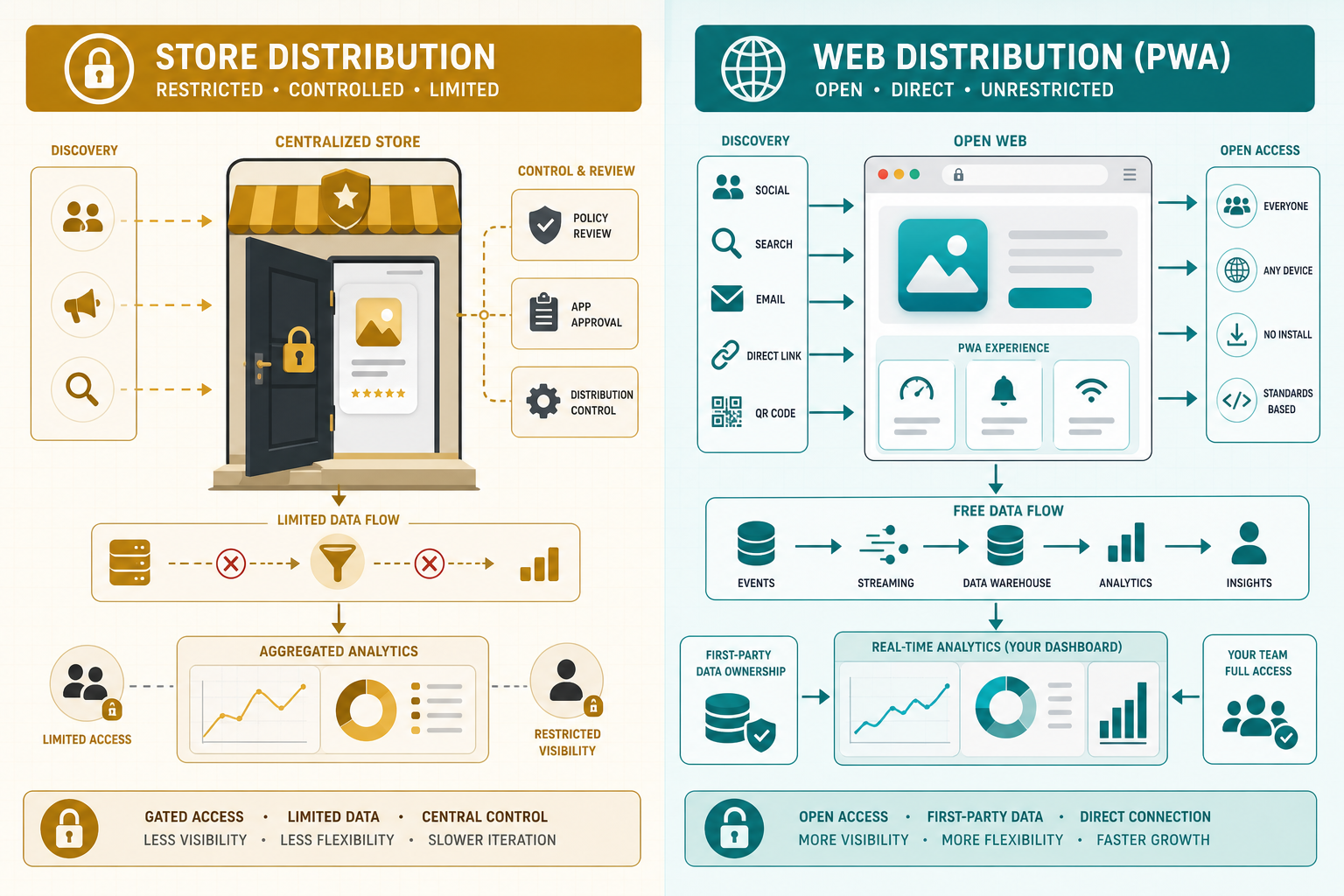
This is where the PWA distribution model fundamentally diverges from Google Play-dependent strategies. When you distribute your Android app as a Progressive Web App — served directly from your own domain, installed to the user’s home screen without an app store intermediary — you gain something that no platform attribution change can take away: a complete, first-party data layer that you own and control.
Here’s what that looks like in practice:
- First-party install tracking. When a user installs your PWA, that event is captured by your own analytics infrastructure — your server, your database, your event schema. There’s no third-party attribution layer interpreting the signal. You know exactly which URL the user came from, which campaign parameter was attached, and what happened next. UTM parameters, referrer headers, and custom event tracking give you full-funnel visibility without depending on Meta, Google, or any platform’s attribution model.
- No platform intermediary on engagement data. Post-install behavior — session frequency, feature usage, retention curves, in-app purchase events — flows directly into your analytics stack. When Meta changes how it defines “engage-through,” your first-party data doesn’t change. Your data schema is stable because you define it.
- Deterministic attribution, not probabilistic. Platform attribution models increasingly rely on probabilistic matching and modeled conversions (Meta’s own documentation acknowledges this). PWA first-party tracking is deterministic: the user arrived at your domain, you captured the referral source, you recorded the conversion. No modeling, no inference, no black box.
- Real-time data access. PWA analytics events are available to you in real time — not gated behind a 24-to-72-hour attribution processing delay that Meta and Google impose. For teams running aggressive acquisition campaigns, the difference between real-time and delayed data is the difference between optimizing today and optimizing on yesterday’s information.
The strategic advantage is structural, not incremental. Every time a major ad platform changes its attribution model — and Meta has changed its attribution methodology three times since 2021, from the iOS 14 SKAdNetwork adaptation to Aggregated Event Measurement to the current engage-through shift — advertisers who depend on platform-reported data lose weeks of comparability while they re-baseline their metrics. PWA-based first-party data is immune to these disruptions because the measurement infrastructure sits outside the platform ecosystem entirely.
Real Comparison: Google Play Attribution vs PWA First-Party Tracking
Let’s make this concrete. Consider a typical overseas app team running Android user acquisition campaigns across Meta and Google.
Scenario A: Google Play distribution. You run Meta ads driving to your Google Play listing. A user sees your video ad on Instagram, watches 20 seconds, and doesn’t click. Three days later, the same user searches for your app category on Google Play, finds your listing organically, and installs. Under Meta’s new engage-through attribution, this install gets credited to Meta. Under Google Play’s attribution, it gets credited to organic. Your data now shows two different stories — and you can’t easily reconcile them because the attribution happens inside two separate platform black boxes. Your actual CPI? Unknown. True channel contribution? Ambiguous.
Scenario B: PWA distribution via ROiBest. You run the same Meta ads, but they drive to your PWA install page hosted on your domain. The user clicks (or doesn’t — it doesn’t matter, because you’re measuring your own funnel). When the user eventually arrives at your PWA install page, you capture the referral source directly. If they came from a Meta campaign, your UTM parameters tell you. If they came from organic search, your referrer data tells you. If they came from a friend’s WhatsApp share, you know that too. There’s no ambiguity. No conflicting attribution reports. No platform deciding how to count your conversions.
The data differences are material:
- Install attribution accuracy: Google Play organic vs paid attribution has a widely acknowledged error margin. Adjust (now part of AppLovin) reported that up to 23% of app installs attributed to paid channels may actually be organic, a phenomenon they term “organic cannibalization” (Adjust Mobile App Trends Report, 2025). PWA first-party tracking, because it captures the actual referral chain, largely eliminates this ambiguity.
- Install conversion rate: Teams using ROiBest PWA distribution report install conversion rates up to 1.2x higher than equivalent Google Play listings, primarily because the PWA install flow has fewer friction steps — no app store redirect, no “Open” vs “Install” confusion, no Play Store review gating.
- Data latency: Google Play Console reports are typically delayed by 24-48 hours. PWA install events are captured in real time.
- Revenue data independence: When you sell through Google Play, Google takes 15-30% and controls the transaction data. PWA in-app purchases happen on your payment infrastructure — you keep 100% and own the transaction records.
For teams managing significant acquisition budgets, the attribution accuracy gap alone can represent tens of thousands of dollars in misallocated spend per month. When you add the revenue retention advantage (no 30% Google Play commission) and the operational independence (no risk of app removal), the business case for PWA distribution becomes difficult to argue against on pure data economics.
ROiBest specializes in exactly this transition. The platform handles the technical implementation — PWA packaging, push notification infrastructure, install flow optimization — so your team focuses on the business decision, not the engineering. The result is a distribution channel where your attribution data is entirely yours, unaffected by whatever Meta, Google, or any other platform decides to do with their measurement models.
Common Concerns
“Is PWA Data Actually Accurate?”
This is the most common question we hear from teams evaluating PWA distribution, and it’s a fair one. The short answer: PWA first-party data is more accurate than platform-mediated attribution — specifically because it’s deterministic rather than modeled.
When Meta attributes a conversion via engage-through, it’s making a probabilistic judgment: “This user engaged with an ad and later converted, so the ad likely caused the conversion.” That’s an inference, not an observation. When your PWA analytics captures an install event with a specific UTM source, campaign ID, and referrer URL, that’s an observation — a direct record of what happened, not a statistical model of what probably happened.
The accuracy advantage extends to post-install behavior. Because PWA sessions happen in the browser environment on your domain, you have access to the full range of web analytics tooling — Google Analytics 4, Mixpanel, Amplitude, custom event tracking — without the SDK integration complexity and data-sharing limitations that come with native app analytics. Your retention data, engagement metrics, and conversion funnel analytics are all captured in a unified, first-party context.
“Is the Switching Cost Too High?”
Switching cost is a legitimate concern, and it’s worth being honest about what’s involved. If your app is currently on Google Play and you want to add PWA as a parallel distribution channel, the transition is not zero-effort — but it’s significantly less than most teams expect.
With ROiBest, the PWA conversion process typically takes days, not months. ROiBest handles the technical layer: PWA packaging, service worker configuration, push notification setup, and install flow optimization. Your team’s involvement is primarily on the campaign side — updating landing page URLs, adjusting UTM parameters, and setting up your analytics to capture the new PWA-specific events.
The critical insight is that PWA distribution doesn’t have to replace Google Play immediately. Most teams run both channels in parallel initially — maintaining their existing Google Play listing while building out PWA distribution as a second channel. Over time, as the data advantages of PWA become clear and the install conversion rate lifts materialize, teams naturally shift more volume to the channel that gives them better data and better economics. For related context, see our complete guide to Google Play alternatives, which covers the full landscape of distribution options beyond the Play Store.
Teams who’ve faced sudden app removal on Google Play — a scenario we’ve documented in detail in our Google Play app removal analysis — often wish they’d started PWA distribution earlier. The switching cost of adding PWA proactively is far lower than the emergency cost of rebuilding distribution after a Play Store takedown.
Build Your Own Data Channel with ROiBest
Meta’s attribution model change is not an isolated event. It’s part of a long-running pattern in digital advertising: platforms that sell you media also control how that media’s performance is measured, and they change the measurement rules unilaterally, without advertiser input, on timelines that serve the platform’s interests — not yours.
The iOS 14 changes in 2021 forced advertisers to accept SKAdNetwork’s limited attribution. Google’s Privacy Sandbox continues to evolve in ways that reduce advertiser-level data visibility. And now Meta’s engage-through attribution redefines what counts as a conversion in ways that inflate Meta’s reported performance. Each change makes platform-reported data less reliable as a basis for business decisions.
PWA distribution — specifically, the first-party data infrastructure that comes with serving your app from your own domain — is the structural answer to this pattern. Not because PWAs are technologically superior to native apps in every dimension (they’re not, and that’s not the point), but because the data layer of a PWA is entirely under your control. No platform can change your attribution model. No app store can restrict your analytics access. No third party decides how your conversions are counted.
ROiBest makes this transition operationally simple. You get a fully functional PWA distribution channel — with push notifications, home screen installation, and offline capability — without building the infrastructure yourself. The teams using ROiBest today are the ones who recognized early that data independence isn’t a nice-to-have feature — it’s a core business requirement in an advertising ecosystem where the rules keep changing.
When the next attribution model change arrives — and it will — the question you’ll want to have already answered is: Do I have my own data, or am I renting someone else’s?
For teams evaluating how platform tool changes affect distribution strategy more broadly, our analysis of Google’s Display Planner removal and its implications for PWA distribution provides additional context on why platform dependency is an accelerating risk.
Skip the app store. Go live instantly, keep 100% of your revenue.
ROiBest helps Android app teams launch PWAs — no review process, no 30% Google Play cut, and push notifications that work even after uninstall. Teams see up to 1.2x higher install conversion rates vs native app downloads.
 WebApp中文站
留下评论