Google Removes Display and Video Planning Tools — What It Signals for App Distribution in 2026
In early 2026, Google quietly retired its Display & Video 360 planning tools — the Reach Planner and the Display Planner that ad teams had relied on for years to forecast reach, frequency, and audience overlap across display campaigns. The message from Mountain View was unmistakable: Google is moving away from reach-and-frequency thinking and toward conversion-first, measurable outcomes.
For app marketing teams that use Google’s ecosystem to acquire users, this shift is more than a tooling inconvenience. It redefines how installs get tracked, attributed, and valued — and it raises a pointed question: if Google itself is deprioritizing brand-reach formats and doubling down on conversion events, why are you still routing Android users through an install path that adds friction and obscures your data?
PWA distribution — delivering your app directly to a user’s home screen through a web landing page — was already a strong strategic choice before this change. Now it may be the most natural response to where Google’s entire advertising infrastructure is heading.
→ Want to bypass Google Play entirely? See how ROiBest PWA works — no submission, no cut, 1.2x installs.
What Google Actually Removed — and Why It Matters
The Display Planner and reach forecasting tools inside Display & Video 360 were long-standing instruments for planning upper-funnel awareness campaigns. They let teams estimate how many unique users they could reach at a given frequency cap, across display networks, YouTube, and connected TV.
Google’s rationale for sunsetting these tools centers on the same argument it has been making for two years: in a privacy-first, cookieless measurement environment, reach-and-frequency planning at the individual level is no longer reliable data — and continuing to optimize toward it is counterproductive. Instead, Google is directing budgets and engineering investment toward conversion signals: actual installs, purchases, registrations, and in-app events tracked through Google Ads and GA4.
This isn’t a neutral product decision. It reflects Google’s bet that advertisers who optimize for measurable downstream conversions will see better ROI, and that the platform’s machine-learning models (Performance Max, UAC) are better positioned to find those conversions than manually planned display schedules ever were.
For app teams, the implication is direct: your install path now needs to produce clean, attributable conversion events — or your ad campaigns will be flying partially blind inside Google’s automated systems.
The Install Path Problem: Why Google Play Adds Friction at the Conversion Moment
When a user clicks your Google ad and lands in the Google Play store, something important happens: you lose control of the conversion event. The user must scroll through a store listing, read reviews, check permissions, tap Install, wait for a download to complete — and at every one of those steps, some percentage of users drops off. More critically, the attribution chain passes through Google Play’s own infrastructure, which means your GA4 event data and your Google Ads conversion data are not coming from the same first-party source you own.
This fragmentation is exactly what Google’s new conversion-focused direction is trying to solve — but the solution requires that your landing page and install flow produce trackable, first-party conversion signals. A Google Play redirect inherently cannot do that cleanly.
Consider the comparison:
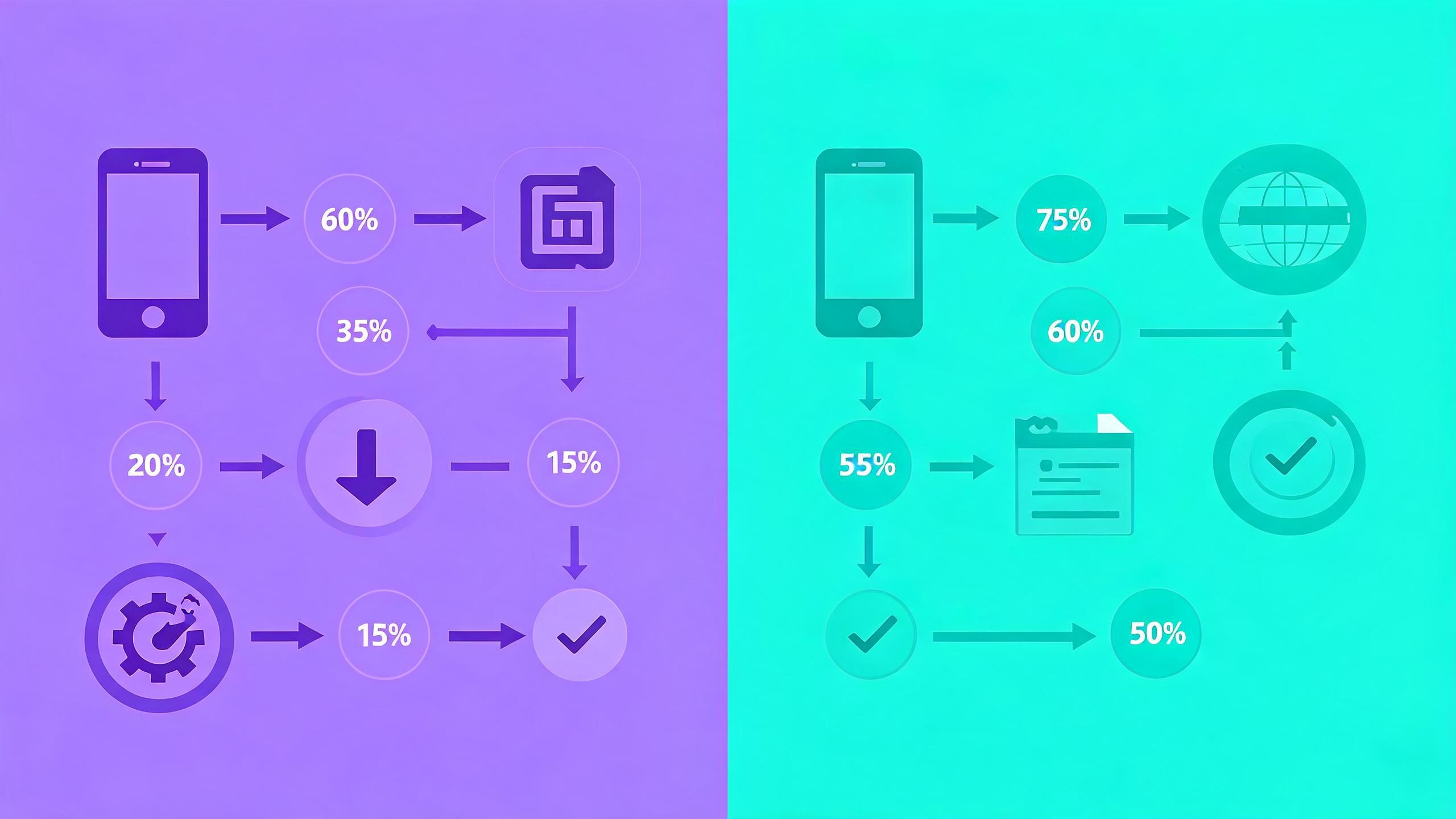
- Google Play install path: Ad click → Play Store listing → Download → Install → App open. Attribution depends on deep linking, Play referrer API, and Google’s own install tracking. If the user delays the install or switches devices, attribution breaks.
- PWA install path: Ad click → PWA landing page → Install prompt → App icon on home screen. The install event fires on your own domain, attributable directly through GA4 or any first-party tracking you set up. No app store in the middle.
The PWA install path isn’t just simpler — it’s structurally more compatible with the conversion-first measurement model that Google is now enforcing across its advertising ecosystem.
PWA Distribution: The Measurable Install Path Google’s New Direction Demands
A PWA landing page functions as a purpose-built conversion page. Every element — the install prompt, the click, the home screen addition — can be tracked as a first-party web event. This means your Google Ads campaigns can receive clean install conversion data without relying on Play Store pass-through attribution. It means your GA4 funnel shows exactly where users drop off between ad click and install. And it means your Performance Max or UAC campaigns get better signals to optimize against.
Beyond measurement, PWA distribution delivers outcomes that the Google Play path structurally cannot match:
- 1.2x higher install conversion rates. Because the install experience is instant — no download wait, no Play Store friction — the percentage of ad-click users who complete an install is consistently higher. For teams running high-volume Google Ads campaigns, this difference compounds significantly at scale.
- Zero platform commission. Google Play takes 30% of in-app purchases. A PWA distributed through your own landing page keeps 100% of revenue with you. In a market where every cost-per-install dollar is scrutinized, this directly improves LTV math.
- Push notifications that survive uninstall. PWA push notifications run through the browser (Chrome on Android), which means they can re-engage users even after they’ve removed the app icon. This is a retention capability that Google Play native apps simply do not have.
- No review process, no removal risk. Your PWA is hosted on your own web infrastructure. There is no submission queue, no policy review, and no risk of a Google Play takedown disrupting your live campaigns mid-flight.
These are business outcomes — not technical features. They are the direct result of owning your install path rather than delegating it to a platform intermediary.
Three Actionable Insights for App Teams Navigating Google’s Shift
Insight 1: Audit your current install attribution before your next campaign cycle. If your Google Ads install conversions are currently tracked through Play Store install events, you have a data dependency on infrastructure that Google is actively deprioritizing. Mapping your install funnel and identifying where you rely on Play Store pass-through attribution is the first step to understanding your exposure.
Insight 2: Treat your install landing page as a conversion asset, not a redirect. Google’s removal of display planning tools is part of a broader push to reward advertisers who control their conversion events. A dedicated PWA landing page — with a clear install prompt, first-party event tracking, and a single conversion goal — functions exactly the way Google’s current advertising infrastructure wants your landing pages to function. Teams that build this out will have an advantage in campaign optimization, Quality Score, and cost-per-install over time.
Insight 3: Separate your distribution from your acquisition channel. One underappreciated effect of the display planner removal is that it accelerates the consolidation of Google Ads toward Performance Max and UAC automation. These systems optimize toward conversion events, not toward reach. If your “conversion event” is a Play Store install, you are optimizing a Google-controlled outcome. If your conversion event is a PWA install on your own domain, you are optimizing something you own — and you can take that data anywhere.
The Bigger Picture: Google Is Forcing Advertisers to Own Their Conversions
The retirement of the Display Planner is a data point in a longer trend. Over the past three years, Google has sunset third-party cookie support, deprecated reach-forecasting tools, accelerated the shift to Privacy Sandbox APIs, and pushed advertisers toward automated campaigns that optimize on first-party conversion signals. Each of these moves points in the same direction: your ability to compete on Google’s advertising platform increasingly depends on the quality of the conversion data you bring to it.
For app teams, this means the install path itself is now a competitive advantage or a liability — depending on whether you control it.
PWA distribution through a purpose-built landing page puts you on the right side of this shift. You control the install event. You own the first-party data. You can feed clean conversion signals into Google Ads’ automated systems. And you’re not paying 30% to a platform intermediary on every dollar your app earns.
Teams that were already exploring PWA distribution for its install-rate or commission-saving benefits now have an additional, Google-driven reason to move: the advertising infrastructure they depend on is being redesigned around exactly the kind of conversion event that a PWA landing page produces.
For more on the strategic case for PWA as your primary Android distribution channel, see the complete guide: Google Play Alternatives: Android App Distribution Guide 2026.
How App Teams Are Already Making This Work
App teams that have moved distribution traffic — even partially — to PWA landing pages report consistent patterns:
- Install conversion rates from paid traffic improve because the landing page can be A/B tested and optimized in ways a Play Store listing cannot.
- Campaign ROAS improves because Google Ads receives cleaner first-party install events and can optimize more effectively against them.
- Revenue per install increases because in-app purchases are no longer subject to the 30% Play Store commission.
- Campaign continuity improves because the distribution path cannot be disrupted by a Play Store policy change or takedown notice.
These are outcomes that align precisely with what Google’s conversion-first advertising direction rewards. The teams seeing these results are not building PWAs from scratch in-house — they are using a service that handles the packaging and launch, then driving their existing ad traffic to the resulting landing page.
Related: TikTok Algorithm 2026 Update: Why PWA Distribution Wins — the same conversion-path logic applies across paid channels.
Addressing Common Concerns Before You Move
Will Android users actually install PWAs? Yes — and at higher rates than Play Store installs, when the landing page is well-designed. The install prompt on Android (Chrome) is a native browser UI element that users recognize. The install takes seconds, not minutes. There is no size download barrier.
Does this work for games and apps with complex features? PWA packaging supports the full range of app functionality that Android users expect — notifications, offline capability, home screen presence, and full-screen experience. For gaming and social apps in particular, the install experience is effectively indistinguishable from a native install.
What about users who still discover apps through the Play Store? PWA distribution does not require you to abandon Play Store presence entirely. Many teams run both in parallel, shifting paid traffic to the PWA path while maintaining organic Play Store visibility. The economics of paid acquisition, however, increasingly favor the PWA path — especially in light of Google’s conversion-focused changes.
How quickly can we have a PWA landing page live? With a service like ROiBest, the timeline is measured in days, not months. There is no app store submission, no review queue, no binary build pipeline to manage. The landing page goes live on your domain, and you can start routing campaign traffic immediately.
See also: PWA Alternative App Distribution 2026: How to Launch Apps Without the App Store — practical context on what the transition looks like.
Summary: Google’s Shift Rewards Teams Who Own Their Install Path
Google removing its Display and Video planning tools is not an isolated product decision — it is a signal about where the entire Google advertising ecosystem is heading. Conversion-first, measurable, automated, and built on first-party data. The install path that best fits this direction is one you control: a PWA landing page that fires clean conversion events, keeps your revenue, and can be live before your next campaign cycle begins.
The teams that will perform best inside Google’s evolving advertising infrastructure are the ones bringing their own conversion data to the table. A well-built PWA landing page is how you do that for app installs.
ROiBest handles the PWA packaging and launch — you focus on driving traffic and optimizing campaigns. Google Data Manager API Migration: PWA Owns Your User Data is relevant context for teams thinking about the data ownership dimension of this shift.
Skip the app store. Go live instantly, keep 100% of your revenue.
ROiBest helps Android app teams launch PWAs — no review process, no 30% Google Play cut, and push notifications that work even after uninstall. Teams see up to 1.2x higher install conversion rates vs native app downloads.
 WebApp中文站
留下评论