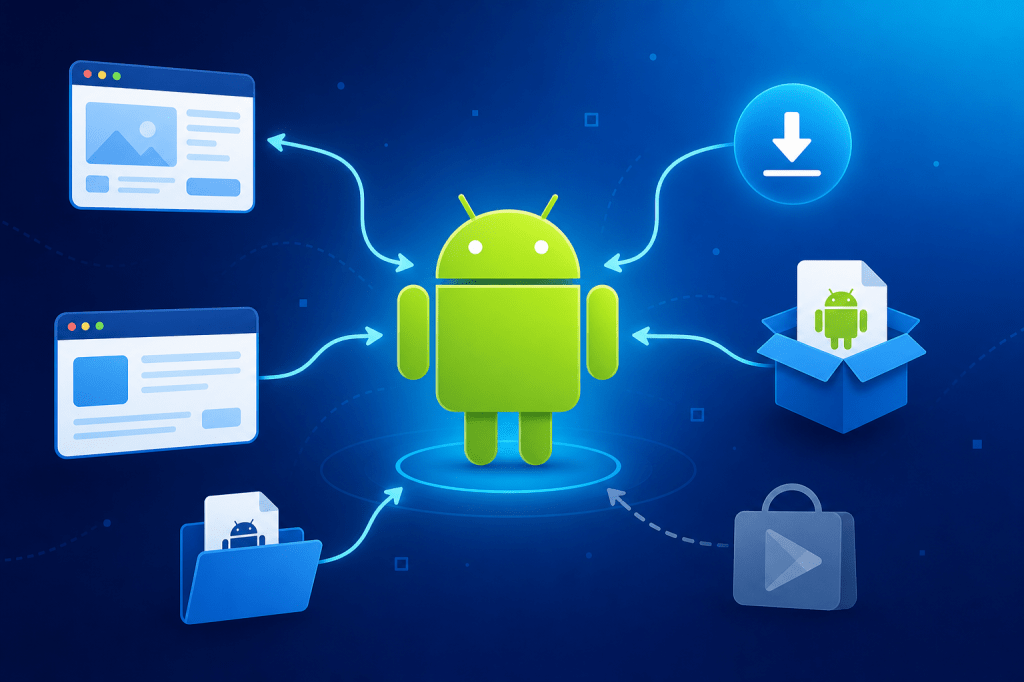
Google Play is no longer the only viable distribution channel for Android apps — and for many teams, it is no longer the best one. In 2026, with 30% revenue commissions, unpredictable app removals, and increasingly strict review policies, smart Android app teams are diversifying to alternative distribution methods. This guide covers every major alternative, with a focus on PWA as the most mature and accessible option for going-overseas teams.
Whether you are a gaming studio facing review risk, an AI app team navigating content policies, or a subscription service looking to keep more revenue, this guide shows you how to distribute your Android app without depending on Google Play.
→ Want to bypass Google Play entirely? See how ROiBest PWA works — no submission, no cut, 1.2x installs.
Why Teams Are Leaving Google Play in 2026
The exodus from Google Play exclusivity is not ideological — it is economic. Here are the concrete reasons teams are diversifying:
- Revenue loss: Google’s 30% commission on all in-app transactions means a $1M/year app loses $300,000 to platform fees. For subscription businesses, this commission often exceeds the combined cost of all other infrastructure.
- Review uncertainty: Google Play removed 2.3M+ apps in 2025. Categories most affected: real-money gaming, dating/companion apps, apps with mature content, and subscription apps with aggressive trial flows.
- Data ownership: Google Play controls the user relationship. Install attribution, review data, and user communication channels are all mediated by Google’s systems. If your app is removed, you lose access to your own users.
- Speed constraints: App review cycles add 24-72 hours to every update. For teams running rapid experimentation (A/B testing, feature flags, pricing changes), this latency is a competitive disadvantage.
The question has shifted from “Should we diversify?” to “What is the fastest path to distribution independence?” For more context on how recent platform changes accelerate this shift, see our analysis of why PWA distribution wins as Google consolidates tools.
The Google Play Alternative Landscape in 2026
Multiple alternatives exist, each with different trade-offs:
1. Progressive Web Apps (PWA) — Recommended for most teams
- Install directly from web → home screen, no app store intermediary
- Zero commission on in-app purchases
- No review process — deploy instantly
- Push notifications that work even after uninstall
- 1.2x higher install conversion rate vs Google Play
- Limitation: Cannot access Bluetooth, NFC, or AAA-level 3D graphics
2. Direct APK Distribution (Sideloading)
- Users download and install your APK directly
- Full native capabilities
- Requires users to enable “Unknown Sources” — significant friction
- No auto-updates without custom implementation
- High drop-off rate due to security warnings
3. Alternative App Stores (Samsung Galaxy Store, Amazon Appstore, Huawei AppGallery)
- Lower commission rates (Samsung 0% for web apps, Amazon 20-30%)
- Still have review processes and policies
- Fragmented user base — each store serves specific device ecosystems
- Limited organic discovery compared to Google Play
4. Pre-installation Partnerships
- Partner with device manufacturers to pre-install your app
- High barrier to entry — requires scale and business relationships
- Only viable for apps with mass-market appeal
For the vast majority of going-overseas teams (gaming, AI social, subscription apps), PWA is the optimal alternative because it combines zero friction (no sideloading warnings), zero commission, and zero review risk — while delivering a user experience nearly indistinguishable from native apps.
PWA as Google Play Replacement: What You Keep and What You Lose
Understanding the trade-offs helps you make an informed decision:
What you keep with PWA:
- Home screen presence with custom icon and splash screen
- Full-screen immersive experience (no browser chrome)
- Push notifications (more capable than native — works after uninstall)
- Offline functionality via service workers
- Camera, microphone, location access
- 100% of in-app revenue
- Complete analytics and user data ownership
- Instant updates without review
What you give up:
- Organic app store discovery (but paid acquisition still works — better, in fact)
- App store trust signals (ratings, reviews, “Verified by Google Play” badge)
- Bluetooth and NFC access
- Advanced AR features
- Heavy 3D rendering (WebGL handles casual gaming well, but AAA needs native)
For categories where organic app store discovery is not a primary acquisition channel (most paid-acquisition-heavy apps), the trade-off strongly favors PWA.
The Economics: PWA vs Google Play Distribution Costs
Let us run the numbers on a typical going-overseas app with $500K annual revenue:
Google Play distribution costs:
- Platform commission: $150,000 (30% of $500K)
- Review-related delays: estimated $20,000 in lost revenue from update lag
- Removal risk: unquantifiable but existential
- Total annual cost: $170,000+
PWA distribution costs:
- Payment processing (Stripe): $14,500 (2.9% of $500K)
- PWA hosting and infrastructure: $2,000-5,000/year
- Managed PWA service (ROiBest): varies by plan
- Total annual cost: ~$20,000
Net savings: $150,000/year — money that can be reinvested into user acquisition, product development, or team growth.
This calculation does not account for the 1.2x higher install conversion rate with PWA, which further improves unit economics on paid acquisition. For detailed numbers on how attribution clarity adds value, see PWA install attribution tracking advantages.
Category-Specific Guidance: Is PWA Right for Your App?
Gaming (BC / casual / mid-core): Strongly recommended
- Highest review risk category on Google Play
- Revenue heavily dependent on IAP — 30% commission is devastating
- PWA handles casual and mid-core gaming well (WebGL, Canvas)
- Push notification for retention events is critical
- Fast iteration on game mechanics without review wait
AI Social / Dating / Companion Apps: Strongly recommended
- Content moderation policies on Google Play are unpredictable
- AI-generated content faces increasing scrutiny
- Subscription revenue loses 30% to Google
- PWA avoids all content policy risk — your rules, your platform
E-commerce / Marketplace: Recommended
- Transaction volume makes 30% commission unsustainable
- PWA shopping experiences rival native (Starbucks, Pinterest have proven this)
- Payment flexibility (local payment methods, cryptocurrency, etc.)
Productivity / SaaS: Situational
- If your app needs Bluetooth, advanced file system, or deep OS integration — stay native
- If your app is primarily web-based (documents, communication, project management) — PWA works well
For AI app compliance considerations, see why PWA distribution skips AI content labeling compliance hassles.
Migration Strategy: From Google Play to PWA
Most teams do not need to abandon Google Play entirely. The recommended migration strategy:
- Phase 1 — Parallel launch (Week 1-2): Set up your PWA alongside existing Google Play presence. Do not remove from Play Store yet.
- Phase 2 — Traffic split (Week 3-4): Redirect 50% of paid acquisition traffic to PWA install page. Compare install rates, Day 1 retention, and revenue per user.
- Phase 3 — Evaluate (Week 5-6): If PWA outperforms on economics (it typically does), increase traffic share to 80%. Keep 20% on Google Play for organic discovery.
- Phase 4 — PWA-primary (Week 7+): Make PWA your primary distribution channel. Google Play becomes a backup/organic channel. If Play Store removes your app, business continues uninterrupted.
The key principle: never cut off Google Play before validating PWA performance with real traffic. The migration should be data-driven, not faith-driven.
Technical Implementation: What You Need
Setting up PWA distribution does not require rebuilding your app from scratch. The implementation path:
Option A — Managed service (recommended for speed):
- Use a service like ROiBest that handles all PWA technical infrastructure
- You provide your app content and payment integration
- Service handles manifest, service worker, install prompts, and hosting
- Time to launch: days, not months
Option B — In-house build (for teams with web engineering resources):
- Create web manifest file for home screen installation
- Implement service worker for offline capability and push notifications
- Build install prompt UI that triggers at optimal moments
- Set up payment processing independent of Google Play billing
- Time to launch: 2-4 weeks with experienced web developers
Regardless of implementation approach, the key success factors are: fast page load (sub-2 second), clear install CTA, working push notifications, and seamless payment flow.
Getting Started Today
- Calculate your Google Play tax: Multiply your annual IAP revenue by 0.30. That number is your immediate savings opportunity.
- Assess review risk: Is your app in a category that faces removal risk? If yes, PWA is not optional — it is insurance.
- Choose implementation path: Managed service for speed, in-house for control.
- Set up tracking: GA4 + conversion events for PWA installs to enable data-driven comparison.
- Run a traffic split test: Send 50% of paid traffic to PWA for 2 weeks and compare economics.
- Make the call: If PWA wins (it usually does), shift to PWA-primary distribution.
Every day you stay exclusively on Google Play is a day you lose 30% of revenue and carry removal risk. The alternative is here, it works, and the economics speak for themselves.
Skip the app store. Go live instantly, keep 100% of your revenue.
ROiBest helps Android app teams launch PWAs — no review process, no 30% Google Play cut, and push notifications that work even after uninstall. Teams see up to 1.2x higher install conversion rates vs native app downloads.
 WebApp中文站
留下评论