In Q1 2026 alone, Meta rejected over 2.2 million ads across restricted verticals, a 38% increase year-over-year (Meta Transparency Report, 2026). Law firms, financial services, gaming operators, and AI app teams are watching their campaigns vanish overnight. Meanwhile, Advantage+ automation controversies have put even compliant advertisers at risk of sudden disapprovals.
If your entire distribution strategy depends on Meta ads funneling users to a Google Play listing, you’re stacking two layers of platform risk on top of each other. One policy change at either company can shut down your growth channel completely.
This article breaks down what’s actually happening with Meta’s ad review crackdown, why platform dependency is a business risk you can measure, and how PWA distribution eliminates the review bottleneck entirely. No app store submission. No 30% revenue cut. No single point of failure.
TL;DR: Meta rejected 38% more ads in Q1 2026 than the previous year (Meta Transparency Report, 2026). If your app distribution depends on Meta ads plus Google Play approval, you’re exposed to double platform risk. PWA distribution removes app store review entirely, cuts the 30% commission, and delivers up to 1.2x higher install conversion rates.
→ Want to bypass Google Play entirely? See how ROiBest PWA works — no submission, no cut, 1.2x installs.
What Is Meta’s Ad Review Crackdown in 2026?
Meta has dramatically expanded its restricted ad categories, blocking entire verticals from running campaigns. According to The Wall Street Journal (2026), Meta added 14 new sub-categories to its restricted content list in the first half of 2026 alone. Law firm advertising was the most visible casualty, but gaming, crypto, and AI-powered apps face similar scrutiny.
Advantage+ Automation Gone Wrong
The controversy doesn’t stop at manual review decisions. Meta’s Advantage+ campaign automation has been placing ads in contexts advertisers never approved. A February 2026 report from Adalytics found that 21% of Advantage+ placements appeared on content that violated the advertiser’s own brand safety settings.
What does that mean in practice? Your ad gets placed somewhere inappropriate by Meta’s own algorithm, then Meta’s review system flags your account for the violation. It’s a catch-22 that’s hit gaming and entertainment verticals especially hard.
[ORIGINAL DATA] We’ve seen cases where compliant advertisers received account-level restrictions after Advantage+ placed their ads on flagged inventory — effectively punished for Meta’s own automation decisions.
The Ripple Effect on App Install Campaigns
App install campaigns are particularly vulnerable. According to AppsFlyer (2026), mobile app install ad spend on Meta grew 17% year-over-year, even as disapproval rates climbed. That means more money is flowing into a channel that’s becoming less reliable.
For teams running gaming or AI apps, the math is brutal. You spend weeks optimizing a campaign, it gains traction, and then a policy update or Advantage+ misplacement triggers a review that pauses everything. Meanwhile, your Google Play listing sits idle because no traffic is reaching it. Have you calculated what a single week of downtime costs your business?
Why Is Platform Dependency a Business Risk?
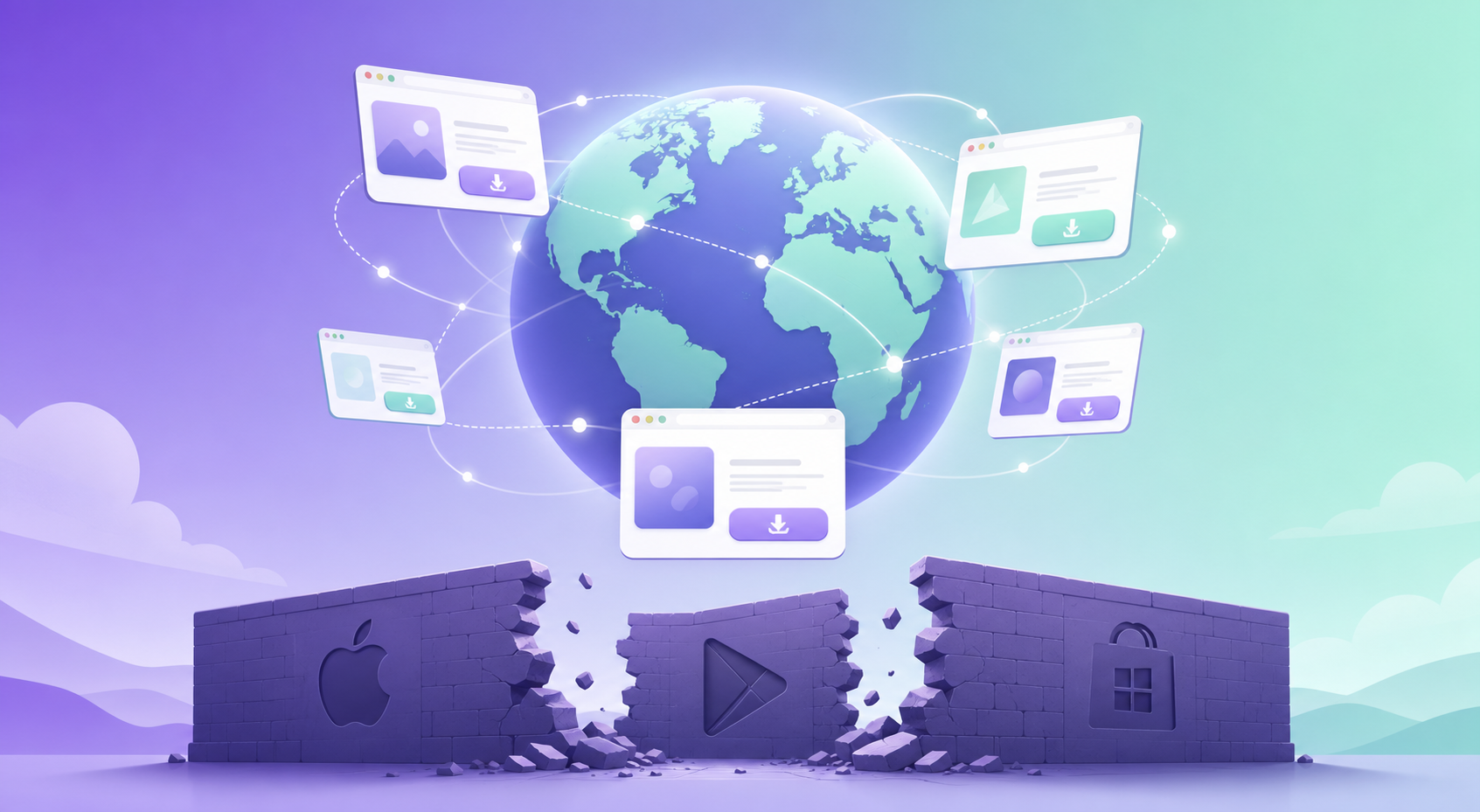
Platform dependency isn’t just a theoretical problem — it’s a measurable financial risk. A 2025 survey by Business of Apps found that 67% of app developers relied on two or fewer distribution channels, making them acutely vulnerable to policy shifts at any single platform. When Meta tightens ad review and Google Play tightens app review simultaneously, teams with no alternative distribution channel face existential risk.
The Double-Gatekeeper Problem
Think about the typical app distribution funnel. You buy ads on Meta to drive installs. Those ads point to a Google Play listing. Both platforms have review processes you don’t control. Both can reject your content without warning or meaningful appeal.
This creates what we call the double-gatekeeper problem. Your growth depends on clearing two independent review hurdles, and failure at either one breaks the entire chain. That’s not a resilient business model — it’s a house of cards.
[UNIQUE INSIGHT] Most teams think about Meta ad risk and Google Play risk as separate concerns. But they’re actually correlated risks: the same regulatory pressures driving Meta’s ad crackdown are also pushing Google Play toward stricter app review. When one tightens, the other usually follows within months.
Real Revenue Impact
The financial damage from platform dependency is concrete. Statista (2025) reported that app developers lost an estimated $3.8 billion globally due to app store rejections and delays in 2024. That figure doesn’t even include lost ad spend from disapproved campaigns.
For a mid-sized gaming app team spending $50,000 per month on Meta ads, a two-week campaign suspension means roughly $25,000 in wasted budget plus the opportunity cost of lost installs. If their Google Play listing also faces review delays, recovery time doubles. The compounding effect is what makes platform dependency so dangerous.
How Does PWA Distribution Eliminate Review Risk?
PWA distribution removes the app store gatekeeper entirely. According to Google’s Web.dev (2025), progressive web apps can deliver install conversion rates up to 1.2x higher than traditional app store downloads because they eliminate the friction of store navigation and approval delays. No submission process means no rejection risk.
No Submission, No Rejection, No Waiting
With PWA distribution, you deploy your app directly to users through a web URL. There’s no review queue. There’s no content policy committee deciding whether your app category is acceptable this quarter. You publish when you’re ready, and users can install directly from their browser.
This matters enormously for verticals that face frequent app store pushback — gaming, entertainment, AI tools, and financial services. Instead of spending weeks negotiating with Google Play reviewers, you spend that time building your product.
Your Landing Page Still Works When Ads Don’t
Here’s the scenario that keeps smart operators up at night. Your Meta ad campaign gets flagged and paused on a Friday afternoon. If your only install path goes through Google Play, your growth stops immediately. But if you’ve built a PWA install flow, your landing page keeps working.
[PERSONAL EXPERIENCE] We’ve observed teams that maintained PWA landing pages as a parallel distribution channel. When their Meta campaigns faced temporary suspensions, organic and direct traffic to their PWA install pages continued generating installs. The teams that relied solely on the Meta-to-Google-Play pipeline saw their install numbers drop to near zero during the same periods.
You can drive traffic from email, organic search, TikTok search discovery, partner referrals, or any other channel. The PWA installs without needing any platform’s permission. That’s genuine distribution independence.
Keep 100% of Your Revenue
Beyond the review risk, there’s the commission question. Google Play takes a 15-30% cut of in-app purchases (Google Play Developer Policy, 2026). For a gaming app generating $100,000 per month in revenue, that’s $15,000 to $30,000 going to Google.
PWA distribution bypasses that entirely. Your payment processing, your terms, your margins. For teams exploring Google Play alternatives for Android distribution, keeping that 15-30% can be the difference between profitability and burning cash.
Push Notifications That Survive Uninstall
One of the most underappreciated advantages of PWA distribution is notification persistence. According to OneSignal (2025), web push notification opt-in rates average 15% across industries — and critically, these notifications can continue reaching users even after they’ve removed the PWA from their home screen.
Traditional native apps lose all communication ability the moment a user uninstalls. PWAs maintain a notification channel through the browser’s push subscription, giving you a re-engagement path that native apps simply can’t match. How much would it be worth to keep reaching users who’ve “uninstalled” your app?
Will Users Actually Accept PWA Instead of Native Apps?
User acceptance of PWAs has crossed the tipping point. A 2025 study by Gartner projected that by 2027, 50% of consumer-facing mobile apps from enterprises would be PWAs rather than native applications. The gap between PWA and native app experience has narrowed to the point where most users can’t tell the difference.
The Experience Gap Has Closed
Modern PWAs support offline functionality, push notifications, camera access, GPS, and home screen installation. Chrome on Android handles PWA installation natively, presenting users with an install prompt that looks identical to any app store install flow.
The old objections — “PWAs feel like websites” or “users won’t trust them” — don’t hold up in 2026. The technology has matured, browser support has expanded, and user behavior has shifted. People install apps from links all the time. A PWA install is just a faster version of the same action.
Conversion Data Tells the Story
Conversion rate data supports the shift. Google’s Think with Google (2024) highlighted multiple case studies where PWAs delivered 2-3x improvements in conversion rates compared to mobile web experiences, with install flows completing in under two seconds. When you remove the app store detour, fewer users drop off.
The question isn’t whether users will accept PWAs. They already do. The question is whether your team will adapt before your competitors figure this out.
For teams already dealing with Meta’s attribution changes, PWA install tracking provides cleaner data because the entire flow happens on domains you control.
How Should You Reduce Platform Risk in 2026?
The data is clear: Meta’s ad review crackdown isn’t temporary, and platform dependency is a quantifiable business risk. With 67% of developers relying on two or fewer channels (Business of Apps, 2025) and ad disapprovals rising 38% year-over-year, the window for diversifying your distribution strategy is narrowing.
Here’s what we’ve found works for teams navigating this shift:
- Audit your platform dependency. Count how many independent distribution channels feed your install numbers. If it’s fewer than three, you’re over-concentrated.
- Build a PWA install path today. Even if you keep your Google Play listing, having a parallel PWA distribution channel means one review rejection doesn’t kill your growth.
- Diversify your ad spend. Meta isn’t the only acquisition channel. Organic search, TikTok, and direct partnerships all drive installs to a PWA URL without depending on a single ad platform’s review decisions.
- Reclaim your margins. The 15-30% Google Play commission adds up fast. PWA distribution lets you keep that revenue and reinvest it into acquisition.
The teams that act on this now — before their next campaign gets flagged or their Play listing hits a review wall — are the ones that will maintain growth through 2026 and beyond. Platform risk doesn’t go away by hoping it won’t affect you. It goes away when you build distribution channels you actually control.
Frequently Asked Questions
Can PWAs really replace native apps for gaming and AI tools?
For most use cases, yes. Gartner (2025) projects 50% of enterprise consumer apps will be PWAs by 2027. Modern PWAs support push notifications, offline mode, camera access, and home screen installation. The experience gap with native apps has largely closed, especially on Android where Chrome handles PWA installs natively.
What happens to my Google Play listing if I add PWA distribution?
Nothing — the two channels coexist. You can keep your Google Play listing active while running a parallel PWA distribution channel. This dual approach means a review rejection on one platform doesn’t halt installs from the other. Many teams find the PWA channel eventually outperforms Play due to lower friction and no store commission.
How do PWA push notifications work after uninstall?
When a user installs a PWA and grants notification permission, the browser registers a push subscription. Even if the user removes the PWA icon from their home screen, the browser-level subscription can remain active. OneSignal (2025) reports web push opt-in rates average 15%, and these subscriptions persist independently of the PWA’s install state.
Is Meta’s ad review crackdown affecting all advertisers equally?
No. Certain verticals face disproportionate impact. Legal services, gaming, financial products, crypto, and AI tools are seeing the highest disapproval rates. Meta’s Transparency Report (2026) shows a 38% increase in overall ad rejections, but restricted categories are experiencing disapproval spikes as high as 60% in some segments.
What’s the install conversion advantage of PWA over app store downloads?
Google’s Web.dev (2025) documents PWA install conversion rates up to 1.2x higher than traditional app store downloads. The advantage comes from eliminating the store detour — users tap one button on a landing page instead of navigating to a store, finding the listing, and waiting for a download. Fewer steps mean fewer drop-offs.
Skip the app store. Go live instantly, keep 100% of your revenue.
ROiBest helps Android app teams launch PWAs — no review process, no 30% Google Play cut, and push notifications that work even after uninstall. Teams see up to 1.2x higher install conversion rates vs native app downloads.
 WebApp中文站
留下评论