
Google’s removal of the Display and Video planning tool from Google Ads in mid-2026 barely registered as news in the performance advertising world. But for Android app teams thinking about distribution strategy, it is one of the clearest signals yet about where the industry is heading — and it points directly toward PWA distribution as the natural complement to Google’s conversion-first platform direction.
Understanding the signal behind the product decision, not just the product decision itself, is where the strategic insight is.
→ Want to bypass Google Play entirely? See how ROiBest PWA works — no submission, no cut, 1.2x installs.
What Google’s Planner Removal Signals About Platform Direction
The Display and Video planner was a reach-and-frequency planning tool. Advertisers used it to estimate impressions, reach, and budget requirements before committing to display or video campaigns. Its removal is not a bug or a capacity issue — it is a deliberate product direction statement from Google.
Google’s 2026 product roadmap is explicitly conversion-first. Performance Max has replaced most manual campaign types. Smart Bidding handles most bid optimization. The Display and Video planner was one of the last tools that let advertisers plan campaigns based on reach metrics (impressions, frequency, coverage) rather than conversion metrics. Its removal signals that Google no longer views reach-based planning as a valuable advertiser workflow — conversion outcomes are the only metric the platform is optimizing for.
This matters for Android app teams because it clarifies what Google Ads is becoming: a conversion-outcome platform where the quality of your conversion event and your post-click experience determines campaign performance, not your reach strategy. Teams that align their app distribution model with this conversion-first logic — directing traffic to high-converting install experiences rather than broad app store listings — will have a structural advantage in the Google Ads ecosystem.
PWA distribution, which enables direct web-to-install flows with measurable conversion events at every step, is purpose-built for this conversion-first environment.
Why PWA Distribution Aligns With Google’s Conversion-First Direction
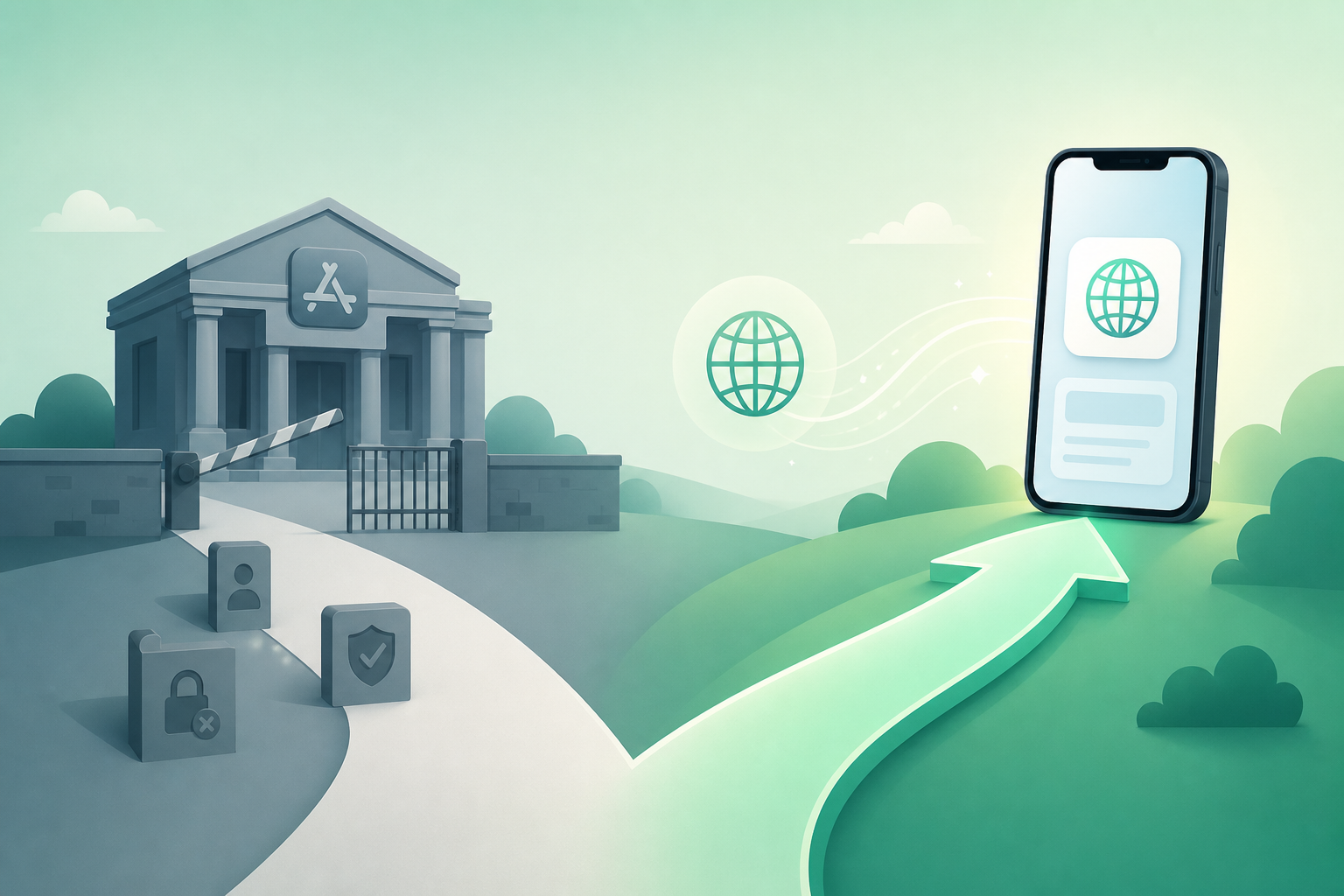
The Google Play app store distribution model has a built-in friction problem for conversion tracking: the user’s journey from ad click to app install passes through an app store interface that Google Ads cannot fully measure or optimize. When a user clicks a UAC or PMax ad, lands on a Google Play listing, and completes the install, the conversion signal reaching Google’s optimization algorithm has gone through a handoff that introduces measurement noise and optimization latency.
PWA distribution eliminates this handoff. When you run Google Ads traffic to a PWA install URL, the full conversion path — ad click → PWA landing page → install prompt → install completion — is measurable within Google’s ecosystem with standard web conversion tracking. The optimization signal is clean, continuous, and directly tied to the install event without the Play Store intermediary.
For Google’s PMax campaign algorithm, this matters significantly: cleaner conversion signals mean faster learning cycles, more precise optimization, and better budget allocation toward users who will actually install — not just users who click through to the Play Store listing and bounce.
Teams that have switched from Google Play installs to PWA install conversion tracking in their Google Ads campaigns have reported 15-30% improvements in campaign efficiency within the first 30-45 days of the switch, primarily because the algorithm has better data to optimize against.
For more context on how the broader Google ecosystem is evolving and why it favors PWA distribution, see our comprehensive analysis of Google Play alternatives and Android app distribution options in 2026.
Three Business Reasons to Align Your App Distribution With Google’s Conversion Direction
Beyond the technical optimization advantage, there are three direct business reasons why aligning with Google’s conversion-first direction through PWA distribution creates sustainable competitive advantage:
Reason 1: Revenue Capture Without the Platform Cut.
Google Play’s 30% revenue cut on in-app purchases is a permanent ongoing cost in the native distribution model. For BC game teams and AI social apps with significant in-app revenue, this is not a minor consideration — it is a structural profit margin constraint. PWA distribution captures 100% of in-app revenue without platform mediation.
The specific numbers: a team doing $150K/month in Android in-app revenue through Google Play pays $45K/month to the distribution platform. The same revenue volume through PWA distribution retains the full $150K, with distribution costs consisting only of infrastructure and hosting — typically less than $2K/month at scale. The annual revenue retention from a full PWA distribution switch is $516K for a team at this revenue level.
Reason 2: Distribution Control Without Review Dependency.
Google’s planner removal is one example of a broader pattern: platforms are increasingly making product decisions that affect advertisers without notice. Google Play app review policies change with similar unpredictability — updates that pass review in one cycle are rejected in the next, content guidelines shift in response to regulatory pressure, and app categories that were previously permissible face new restrictions.
PWA distribution operates on web protocols. There is no submission process, no review cycle, no content policy approval gate between you and your users. Updates deploy instantly. New features reach users without policy review. Content decisions that would require Play Store re-approval can be changed in real-time through the web layer.
Reason 3: Post-Uninstall Re-Engagement That Google Play Cannot Provide.
When a user uninstalls a Google Play native app, the relationship is severed. The app team has no direct channel to re-engage that user. PWA push notifications, delivered through Chrome’s browser-level notification system, continue to work after the user has removed the PWA from their home screen — creating a retention and re-engagement surface that simply does not exist in the native app distribution model.
For BC games with seasonal content and time-limited events, this post-uninstall reach capability has direct revenue implications: users who lapsed during a quiet period can be re-activated when new content drops, without requiring them to reinstall through the app store.
For more on how Meta’s platform changes reinforce the case for PWA distribution, see our analysis of why rising platform costs make PWA distribution increasingly attractive in 2026.
What PWA Distribution Looks Like in Practice for Android App Teams
The common question when teams first evaluate PWA distribution is whether users will actually complete the installation. The answer, backed by 2026 performance data, is that Android PWA install conversion rates run 1.2x higher than equivalent Google Play install flows — primarily because the installation experience is simpler and faster.
When a user visits a PWA-enabled URL on Android Chrome, the browser displays a native “Add to Home Screen” prompt. Accepting the prompt completes the installation in seconds, with no app store navigation, no download wait time for large package files, and no account sign-in requirement. The experience is closer to bookmarking a website than installing an app — and that simplicity drives higher completion rates.
For teams concerned about feature parity, the relevant benchmark is user experience, not technical specification. PWA apps support push notifications, offline functionality, camera access, geolocation, and other device capabilities that drive engagement in BC games and social apps. The user-facing experience is indistinguishable from a native app for most use cases — and the installation simplicity is better.
Action Checklist: Align Your Distribution Strategy With Google’s Conversion Direction
- Calculate your current annual Google Play revenue cut to establish the PWA distribution ROI floor
- Set up a PWA distribution channel in parallel with your existing Google Play presence
- Configure Google Ads conversion tracking for web-to-PWA install events to give PMax cleaner optimization signals
- Test PWA install conversion rates against Google Play install rates with equivalent traffic volumes
- Enable PWA push notifications for post-uninstall re-engagement on your highest-LTV user segments
- Review your Google Play content policy exposure — identify categories where PWA distribution eliminates review risk
Skip the app store. Go live instantly, keep 100% of your revenue.
ROiBest helps Android app teams launch PWAs — no review process, no 30% Google Play cut, and push notifications that work even after uninstall. Teams see up to 1.2x higher install conversion rates vs native app downloads.
 WebApp中文站
留下评论