
Google has officially begun retiring core Privacy Sandbox APIs—including Topics, Attribution Reporting, and Protected Audiences—leaving advertisers scrambling for reliable conversion tracking. With third-party cookies already blocked in Chrome and these experimental APIs now sunsetting, Conversions API (CAPI) and Enhanced Conversions have emerged as the only scalable, privacy-compliant measurement paths left standing. For app and web marketers who depend on accurate ROAS data, the window to migrate is closing fast.
→ See how ROiBest PWA works — no submission, no cut, 1.2x installs.
What Google Privacy Sandbox APIs Are Being Retired
In Q1 2026, Google confirmed it would deprecate several Privacy Sandbox APIs that were meant to replace third-party cookie functionality:
- Topics API — originally designed to serve interest-based ads without cross-site tracking, now deprecated due to low adoption (under 12% of ad platforms integrated it by late 2025).
- Attribution Reporting API — intended to provide privacy-safe conversion measurement, but advertisers reported a 35–50% signal loss compared to cookie-based attribution.
- Protected Audiences (formerly FLEDGE) — the on-device auction API that never gained traction with DSPs, with fewer than 8% of programmatic buyers running live campaigns through it.
Google’s own internal data showed that advertisers using Privacy Sandbox APIs experienced an average 40% drop in measurable conversions versus those already running server-side solutions. The message is clear: browser-based privacy APIs cannot deliver the signal fidelity that performance marketers require.
Why CAPI and Enhanced Conversions Are Now the Default
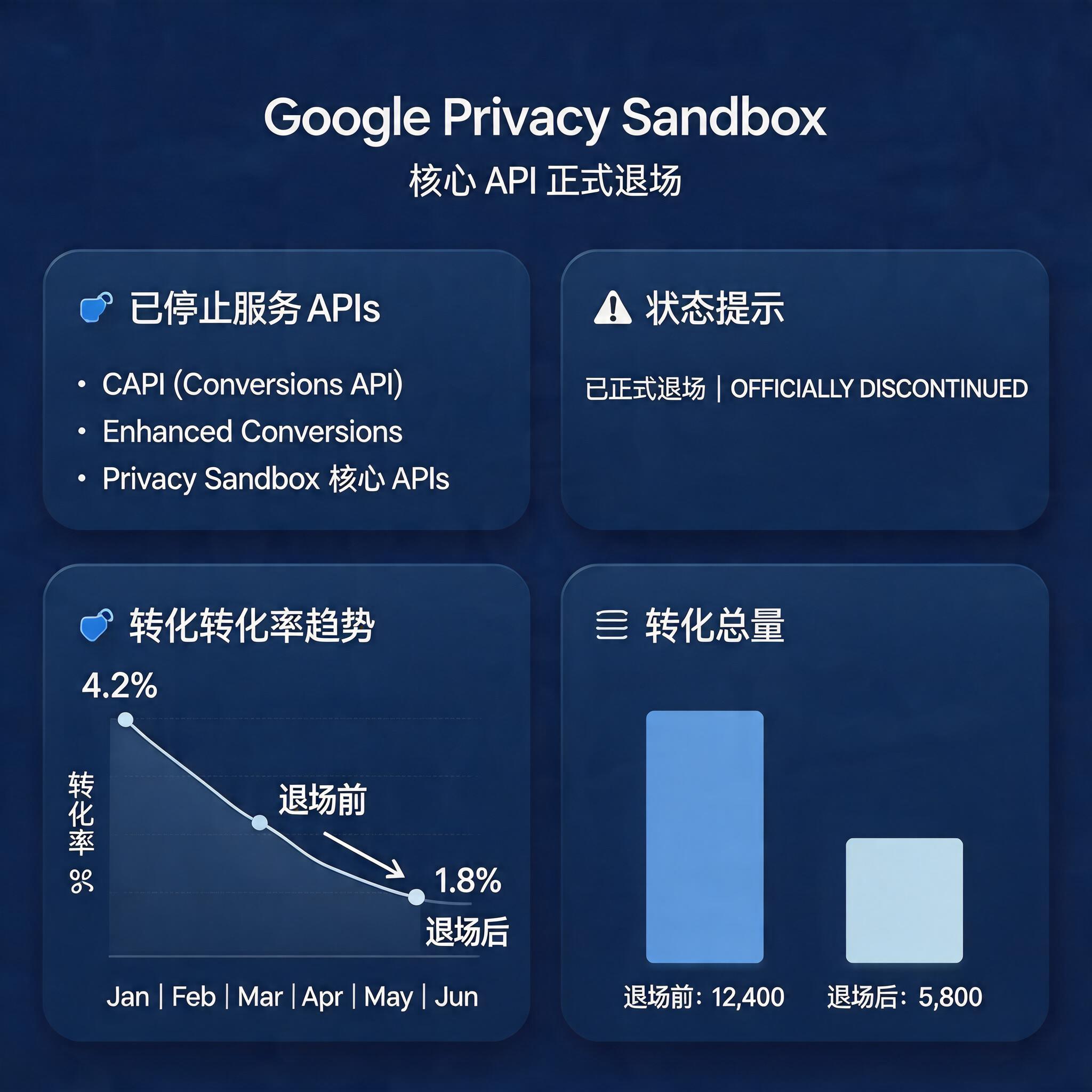
With Privacy Sandbox stepping back, two Google-endorsed server-side solutions now carry the full weight of conversion measurement:
Conversions API (CAPI) sends conversion events directly from your server to the ad platform—bypassing the browser entirely. Early adopters report 20–30% more attributed conversions compared to pixel-only setups. Meta, Google, and TikTok all now prioritize CAPI signals in their auction algorithms, meaning campaigns without server-side data face higher CPMs and worse delivery.
Enhanced Conversions use hashed first-party data (email, phone, address) to match conversions back to ad clicks. Google reports that advertisers enabling Enhanced Conversions see a 17% average improvement in conversion measurement accuracy across Search and YouTube campaigns.
Together, these two approaches form a first-party data stack that is immune to browser-level privacy changes. Whether cookies exist or not, your measurement pipeline stays intact.
3 Steps to Migrate Your Measurement Stack Before Q3 2026
The deprecation timeline gives you roughly five months. Here is a concrete migration plan:
Step 1: Audit your current tracking and quantify signal loss. Run a 14-day comparison between your pixel-based conversions and any server-side events you already fire. Industry benchmarks show pixel-only setups now miss 25–45% of actual conversions due to browser restrictions, ad blockers, and ITP. This gap is your migration priority score.
Step 2: Implement CAPI for every major ad platform. Start with Google Ads Offline Conversion Import and Meta CAPI. For PWA-based distribution—where you control the full install and engagement funnel—server-side event firing is especially straightforward because there is no app store SDK layer in between. PWA publishers using Google Customer Match with Data Manager API are already seeing 2x audience match rates compared to standard uploads.
Step 3: Layer Enhanced Conversions on top for redundancy. Configure Enhanced Conversions in Google Tag Manager or via the Google Ads API. Hash user-provided data at the point of conversion and send it alongside your CAPI events. This dual-signal approach closes the remaining attribution gap. Advertisers running both CAPI and Enhanced Conversions simultaneously report up to 95% conversion visibility—compared to just 55–60% for pixel-only tracking post-cookie.
Why PWA Distribution Has a Built-In Measurement Advantage
Progressive Web Apps give marketers a structural edge in the post-cookie measurement landscape. Unlike native apps distributed through Google Play or the App Store, PWAs run in the browser context where you own the full data layer—no SDK restrictions, no platform-mediated attribution, no 30% revenue cut.
This means every conversion event—install, registration, purchase—can be captured server-side and forwarded to CAPI endpoints in real time. There is no ATT prompt blocking signal. There is no SKAdNetwork delay. For teams already exploring new ad channels like ChatGPT Ads, PWA architecture ensures measurement parity across every traffic source from day one.
The combination of PWA distribution and a CAPI-first measurement stack delivers what Privacy Sandbox promised but could not: accurate, privacy-compliant conversion tracking that actually works at scale.
The Bottom Line
Google Privacy Sandbox’s retreat is not a setback—it is a clarification. The industry now has a single, proven measurement path: first-party data piped through server-side APIs. Advertisers who migrate to CAPI and Enhanced Conversions before Q3 2026 will maintain full conversion visibility. Those who wait will watch their reported ROAS collapse as the remaining legacy signals disappear.
Start your audit today. Implement CAPI this week. Layer Enhanced Conversions by next month. The post-cookie era is not coming—it is already here.
Skip the app store. Keep 100% revenue.
 WebApp中文站
留下评论