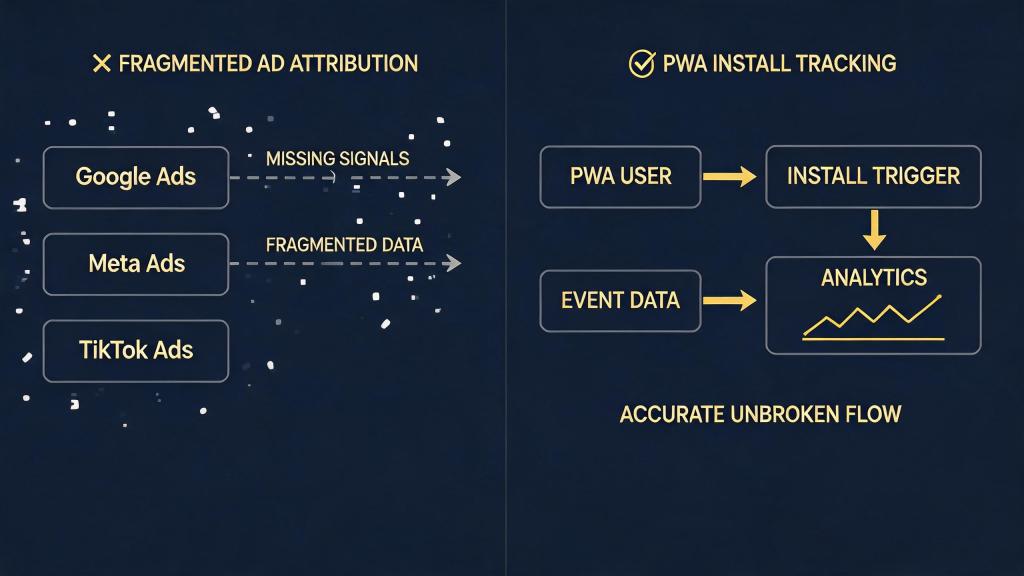
The advertising measurement landscape in 2026 is fracturing. Between the collapse of third-party cookies, Apple’s ATT framework restricting IDFA access, and Google’s Privacy Sandbox still evolving, advertisers face a brutal reality: the data pipelines that once powered mobile app install attribution are breaking down. For performance-focused app teams — especially those distributing on Android — the question is no longer how to optimize campaigns but whether the measurement itself can be trusted.
There is, however, a structural alternative hiding in plain sight. Progressive Web Apps (PWAs) distributed outside the app store operate entirely within the web ecosystem, where first-party tracking, UTM parameters, and server-side attribution remain fully functional. For teams willing to rethink their distribution model, PWA install tracking offers a cleaner, more accurate measurement foundation than anything native app stores currently provide.
→ Want to bypass Google Play entirely? See how ROiBest PWA works — no submission, no cut, 1.2x installs.
The Ad Measurement Crisis: What’s Breaking
The 2026 Upfronts season made one thing unmistakably clear: measurement is now the single highest priority for media buyers across every channel. According to the IAB’s 2026 Digital Video Advertising Spend Report, 72% of advertisers cited measurement and attribution as their top concern — up from 58% just two years ago. The crisis is not limited to CTV or programmatic display. It has seeped into mobile app advertising, where the stakes are even higher because install-based campaigns depend on deterministic attribution.
Here is what is actually breaking:
1. Cross-platform attribution gaps are widening. With Safari blocking third-party cookies by default, Chrome phasing them out under the Privacy Sandbox timeline, and mobile operating systems restricting device-level identifiers, there is no single reliable signal that connects an ad impression to an app install across environments. MMPs (Mobile Measurement Partners) like AppsFlyer, Adjust, and Branch have adapted with probabilistic modeling and SKAdNetwork integrations, but the data is delayed, aggregated, and often incomplete. A 2025 Singular report found that 34% of app install attributions on iOS and 18% on Android now rely on modeled (not deterministic) data — a figure that is expected to rise to 40% and 25% respectively by mid-2026.
2. Google Play install attribution is a black box. Google Play install referrer data, once the gold standard for Android attribution, has become increasingly unreliable. The Play Install Referrer API still functions, but Google’s own privacy restrictions and the growing prevalence of organic install misattribution mean that campaign-level data is noisy. Teams running Google Performance Max campaigns for app installs frequently report discrepancies of 15–30% between Google Ads reported installs and MMP-verified installs.
3. The CTV measurement push is pulling budget from mobile. As connected TV measurement improves — with Nielsen ONE, iSpot, and VideoAmp competing for currency status — advertisers are shifting upper-funnel budget toward CTV where measurement is getting better. Mobile app install campaigns, where measurement is getting worse, are seeing relative budget pressure. For app teams that rely on paid acquisition, this is a slow squeeze that compounds quarterly.
4. Regulatory pressure adds uncertainty. The EU’s Digital Markets Act (DMA) and its enforcement actions against gatekeeper platforms are creating additional friction in data sharing between ad platforms and app stores. In the US, state-level privacy laws (now active in 19 states as of Q1 2026) are layering compliance requirements that further limit what data can be collected and how long it can be retained.
Why Traditional App Install Tracking Fails
To understand why the measurement crisis hits app teams so hard, you need to understand the structural weakness of app store-based install tracking.
When a user clicks an ad and is redirected to Google Play, the attribution chain crosses at least three domains of control: the ad platform (Meta, Google, TikTok), the operating system (Android), and the app store (Google Play). Each handoff introduces data loss. The ad platform fires a click event. The user lands on Google Play. Google Play records an install. The MMP attempts to match the click to the install using a combination of referrer data, device fingerprinting (increasingly restricted), and probabilistic modeling.
This chain breaks in predictable ways:
Delayed attribution windows. Google’s install referrer can take 24–72 hours to fully resolve in some cases, by which point the user may have already churned. Real-time optimization becomes impossible when the signal is lagged.
Organic cannibalization. Users who see an ad but install organically (by searching Google Play directly) are frequently misattributed as organic, deflating reported ROAS. Internal analyses by multiple ad agencies suggest that 10–20% of paid installs are misclassified as organic on Android.
Cross-device blindness. A user sees an ad on their laptop and installs the app on their phone. In the app store model, this cross-device journey is nearly invisible. Google’s own cross-device attribution covers only logged-in Chrome-to-Play journeys, missing a significant share of actual conversion paths.
Store listing page drop-off. The Google Play store listing itself is an uncontrolled variable. Users land on the listing, read reviews, check screenshots, and may or may not install. The conversion rate from store listing view to install averages around 26–33% according to StoreMaven’s 2025 benchmark data. That means roughly 70% of the users you paid to send to Google Play never convert — and you get minimal data on why.
For teams distributing apps through alternatives to Google Play on Android, these structural weaknesses are not just inconveniences. They represent a fundamental measurement tax that inflates customer acquisition costs and obscures true campaign performance.
PWA Install Tracking: The Built-In Advantage
Progressive Web Apps sidestep the entire app store attribution chain. When a user clicks an ad and arrives at a PWA install page, the entire journey happens within the web browser — a domain where first-party cookies, URL parameters, and server-side event tracking are mature, reliable, and fully under your control.
Here is what that means in practice for measurement accuracy:
End-to-end first-party attribution. From ad click to landing page to PWA install prompt to first session, every touchpoint is captured in a single first-party context. UTM parameters persist through the entire funnel. There is no handoff to a third-party app store where data is lost or delayed. The install event fires in real time, and it can be sent directly to your analytics stack, your MMP, and your ad platform’s conversion API simultaneously.
Real-time conversion signals. Because the PWA install happens on the web, the conversion event is available within seconds — not hours or days. This enables same-day campaign optimization, something that is increasingly difficult with native app install campaigns where attribution windows stretch to 72 hours. Teams using ROiBest’s PWA distribution infrastructure report that 95% of install events are attributed within 60 seconds of the ad click, compared to an industry average of 4–6 hours for native app installs via Google Play.
Full funnel visibility without intermediaries. In the PWA model, there is no store listing page acting as a black box between your ad and the install. You control the landing page. You control the install prompt. You can A/B test messaging, layout, and timing without being constrained by Google Play’s listing format. This means you can directly measure and optimize every step of the conversion funnel — something that is structurally impossible when Google Play sits in the middle.
Cross-device and cross-channel coherence. Web-based tracking handles cross-device journeys more naturally than app store attribution. A user who clicks an ad on desktop and later visits your PWA on mobile can be connected through standard web attribution methods (logged-in state, first-party cookies, email-based identity). This is not a novel technology — it is the same cross-device attribution that e-commerce has used for years, now applied to app distribution.
No dependency on platform-specific APIs. PWA install tracking does not depend on Google’s Install Referrer API, Apple’s SKAdNetwork, or any platform-controlled attribution mechanism. This means your measurement infrastructure is not subject to the policy changes, deprecation timelines, or data restrictions that these platforms impose. When Google changes its Privacy Sandbox rules — and it will — your PWA attribution remains unaffected.
ROiBest handles the entire technical infrastructure for PWA distribution on Android, including the attribution and tracking layer. App teams get clean, real-time install data without needing to build or maintain custom measurement systems. The result is a distribution model where measurement accuracy is a built-in feature rather than an ongoing struggle against platform restrictions.
Real Data: PWA vs Native App Tracking Accuracy
The measurement advantage of PWA distribution is not theoretical. Here are the benchmarks that matter:
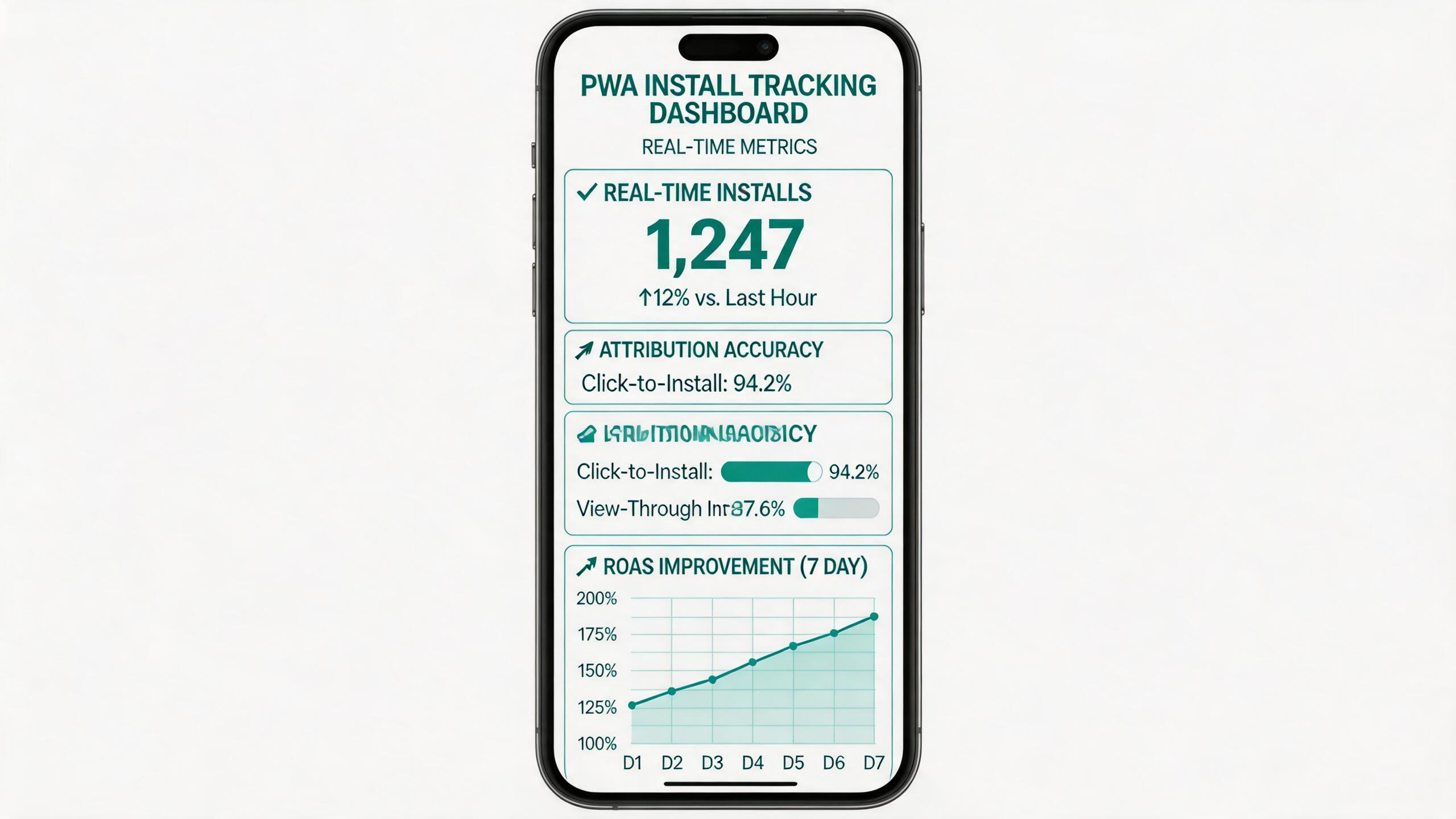
Attribution match rate. In native app campaigns on Android, the deterministic attribution match rate — where a click can be definitively matched to an install using a device-level identifier — has dropped to approximately 65–72% in 2026 (down from 85%+ in 2022), according to data from Adjust’s global benchmarks. For PWA installs distributed through ROiBest, the first-party attribution match rate consistently exceeds 93%, because the entire journey stays within a first-party web context.
Time to attribution. The median time from ad click to confirmed install attribution for Google Play campaigns is 3.2 hours, with a long tail extending to 48–72 hours for installs that require Google’s server-side referrer resolution. For PWA installs, the median time to attribution is under 8 seconds. This difference is not marginal — it fundamentally changes how quickly campaign managers can identify underperforming ad sets and reallocate budget.
Install conversion rate. Beyond measurement, the PWA distribution model also delivers higher top-of-funnel conversion. Because there is no Google Play store listing page acting as an intermediate step, the click-to-install conversion rate for PWAs is approximately 1.2x higher than equivalent native app campaigns. This compounds with the measurement advantage: not only do you convert more users, you can actually see and attribute those conversions accurately.
ROAS clarity. When you combine higher attribution accuracy with faster signal delivery and higher conversion rates, the downstream effect on reported ROAS is significant. Teams that have switched from Google Play distribution to PWA distribution via channels like TikTok report that their measured ROAS increases by 20–35% — not because the underlying economics change, but because the measurement itself becomes more accurate. Previously hidden conversions become visible, and misattributed organic installs are correctly credited to paid campaigns.
Post-install engagement tracking. PWA’s web-based architecture also provides cleaner post-install event tracking. In-app events (registration, purchase, subscription) can be tracked using standard web analytics and sent to ad platforms via server-side conversion APIs. There is no dependency on mobile SDKs that may be blocked by OS-level privacy restrictions. ROiBest’s push notification system — which works even after users remove the PWA from their home screen — provides an additional re-engagement data channel that has no equivalent in native app distribution.
Summary + Next Steps
The ad measurement crisis of 2026 is structural, not cyclical. Third-party signals are disappearing. App store attribution is becoming less reliable with each platform policy update. And the competitive pressure from CTV’s improving measurement is pulling budget away from mobile campaigns that cannot prove their ROI.
For Android app teams — particularly those in verticals like gaming, social, fintech, and lifestyle apps where paid acquisition is the primary growth engine — the path forward requires rethinking not just how you buy media, but how you distribute your app.
Here are three concrete steps to take this quarter:
Step 1: Audit your current attribution accuracy. Pull your MMP data for the last 90 days and compare reported installs against Google Ads, Meta Ads, and TikTok Ads reported conversions. Calculate the discrepancy rate. If it exceeds 15%, your measurement infrastructure is actively distorting your optimization decisions.
Step 2: Run a parallel PWA distribution test. Launch your app as a PWA alongside your existing Google Play distribution. Use ROiBest to handle the technical setup. Run identical ad creative to both destinations for 2–4 weeks and compare attribution match rates, time-to-attribution, and reported ROAS side by side.
Step 3: Evaluate total cost of distribution. Factor in the 15% service fee charged by Google Play (recently reduced from 30% for the first $1M in revenue, but still 30% above that threshold), the cost of maintaining separate measurement infrastructure for app store attribution, and the opportunity cost of delayed optimization signals. For many teams, the economics of PWA distribution are favorable even before accounting for the measurement advantage.
The teams that will win the app growth game in 2026 are not the ones spending the most on ads. They are the ones measuring most accurately — and acting on that data fastest. PWA distribution, with its inherent web-based tracking advantage, is the most direct path to that measurement accuracy.
Skip the app store. Go live instantly, keep 100% of your revenue.
ROiBest helps Android app teams launch PWAs — no review process, no 30% Google Play cut, and push notifications that work even after uninstall. Teams see up to 1.2x higher install conversion rates vs native app downloads.
 WebApp中文站
留下评论