In early 2026, Meta’s advertising platform delivered a jolt felt across the entire performance marketing industry. Law firms woke up to find their ad accounts suspended without notice. Fintech brands saw entire campaign portfolios wiped after years of compliant operation. And thousands of app growth teams operating in regulated or competitive verticals found their Meta-dependent acquisition engines stalled — sometimes permanently.
This is not a story about policy violations. This is a story about platform risk becoming too large to ignore. When a single platform controls your user acquisition pipeline, a single algorithmic decision can erase months of revenue momentum.
If your Android app team still routes the majority of installs through Google Play and the majority of paid traffic through Meta, you are sitting on a compounding risk position. This article explains why — and what forward-looking growth teams are doing differently in 2026.
→ Want to bypass Google Play entirely? See how ROiBest PWA works — no submission, no cut, 1.2x installs.
Meta’s Ad Account Crackdown: What Happened and Why It Matters for App Teams
The Meta enforcement wave of 2025-2026 did not arrive without signals. For years, advertisers in legal services, financial products, gambling, and adult entertainment had operated under increasingly fragile approval conditions. But the scale of the 2026 actions was different: mass suspensions swept through accounts that had cleared compliance review dozens of times previously.
The proximate cause cited by Meta in most cases was its evolving “sensitive categories” policy combined with AI-driven ad review systems that flag creative patterns rather than evaluate intent. A law firm running lead generation ads found itself categorized alongside predatory debt collectors. A regulated fintech found its creatives flagged because they mentioned “returns” — language that Meta’s automated systems increasingly associate with scam patterns.
More consequential than any single ban was the Advantage+ controversy that emerged in parallel. Meta’s Advantage+ Shopping Campaigns and Advantage+ App Campaigns, sold as AI-optimized performance solutions, came under scrutiny from advertisers who found the system increasingly opaque. Specifically:
- Audience targeting control was systematically reduced. Advertisers who had built custom audiences and exclusion lists found Advantage+ overriding their parameters, routing spend toward audiences they had explicitly excluded.
- Bid floor transparency disappeared. The auction environment became harder to read. CPMs rose sharply in Q4 2025 and continued into 2026 without a corresponding lift in conversion rates for many app categories.
- Attribution windows shifted. Changes to default attribution windows inside Advantage+ made it harder to reconcile Meta’s reported installs against what mobile measurement partners (MMPs) like AppsFlyer and Adjust were recording.
The result: app teams found themselves paying more per install, with less control over who they were reaching, and fewer reliable signals to optimize toward. For teams running thin margins on user acquisition, this was not an abstract policy debate. It was a direct hit to unit economics.
For app distribution teams specifically, the dual threat — account suspension risk plus deteriorating Advantage+ auction quality — creates a compounding problem. You may survive a Meta account suspension if your distribution channel (Google Play) remains intact. But if your Play Store listing is also subject to review delays, keyword restrictions, or removal actions, you have no stable ground at all.
This is the critical insight that has pushed progressive Android app teams toward a fundamentally different distribution model: Progressive Web Apps (PWAs), distributed outside the app store ecosystem entirely.
For a deeper look at how the Google Play ecosystem creates parallel dependency risks, see our complete guide to Google Play alternatives for Android app distribution and the practical breakdown of how to migrate from MMP-tracked app install campaigns to PWA distribution in 2026.
Why PWA Eliminates Platform Dependency — Without Sacrificing Performance
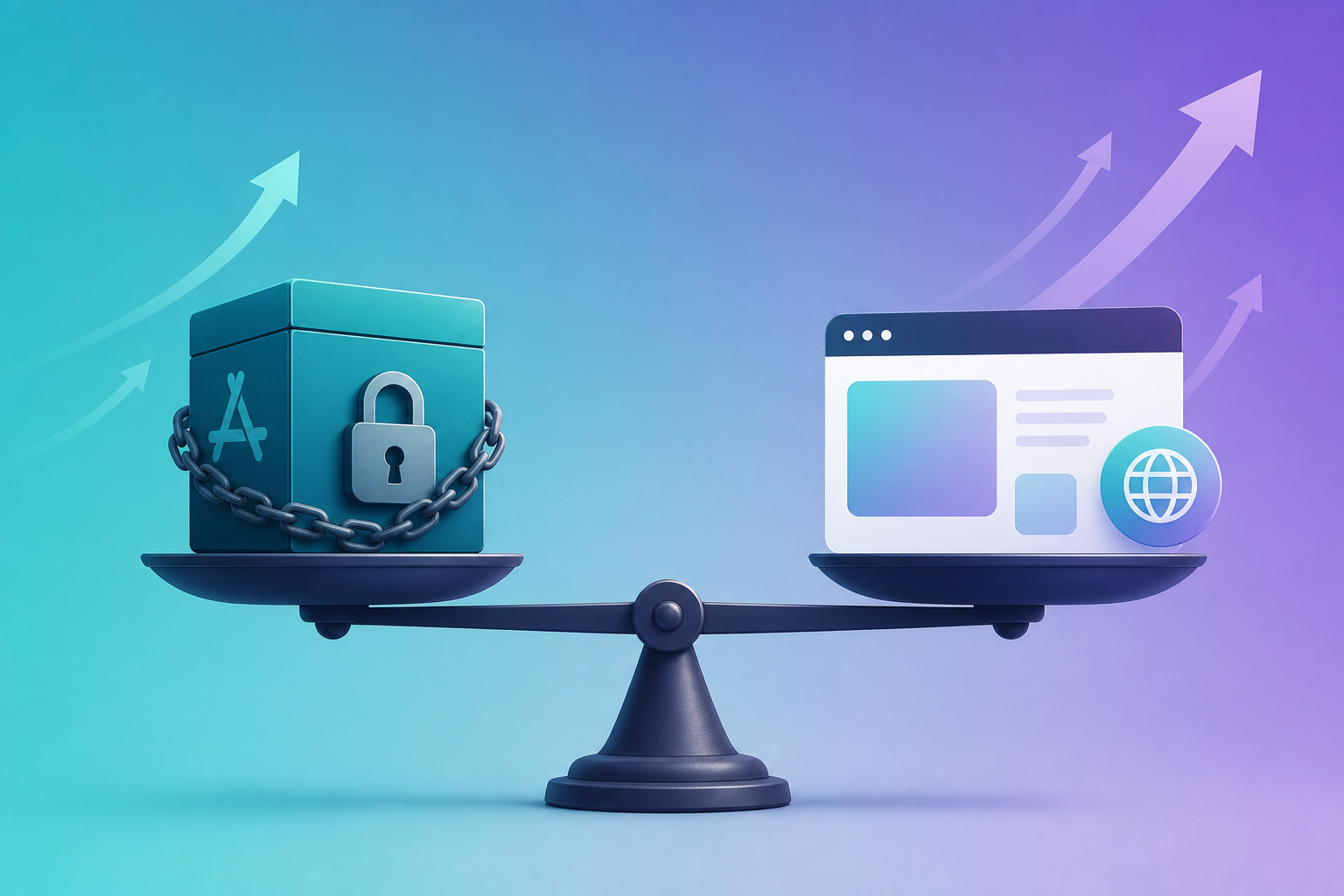
Progressive Web Apps run in the browser but behave like installed apps. They support push notifications, home screen installation, offline access, and full-screen display. Critically, they are distributed via URL — which means they bypass the Google Play submission process entirely.
For a business decision-maker, the implications are concrete:
No review, no rejection, no removal. When you distribute through a PWA, your app goes live when you decide it goes live. There is no 3-7 day review window. There is no compliance team at Google deciding whether your app category crosses a policy line this week. If Google Play changes its rules tomorrow, your PWA distribution channel is unaffected.
No 30% revenue cut. Google Play takes a 15-30% commission on in-app purchases. PWA revenue flows directly through your own payment processor. Teams that have migrated from Play Store to PWA distribution report recovering the full margin previously surrendered to the platform — often representing $50,000 to $500,000+ annually for mid-market apps.
Post-uninstall push notifications. This is the capability that surprises most growth teams. Native apps lose push notification capability the moment a user uninstalls. PWAs can maintain push notification channels even after the user removes the icon from their home screen — because the subscription is browser-level, not app-level. For re-engagement campaigns, this changes the math on LTV dramatically.
1.2x higher install conversion rates. The friction reduction in PWA installation is measurable. Users who land on a PWA install prompt convert at approximately 1.2x the rate of users directed to the Play Store. The elimination of the “open Play Store → find app → wait for download → grant permissions” flow translates directly to top-of-funnel efficiency gains.
Platform-neutral post-click optimization. When your distribution layer is a URL, your post-click optimization stack becomes fully portable. You can run the same landing page tests, the same funnel analytics, and the same re-engagement sequences regardless of which paid channel sent the traffic — Meta, Google, TikTok, programmatic. This is what makes PWA a platform-neutral lever, not just a Meta hedge.
Real Comparison: PWA vs App Store Distribution Risk, Cost, and Speed
Decision-makers need a direct side-by-side comparison to evaluate the tradeoff. Here is how PWA distribution through ROiBest compares to the Google Play status quo across the dimensions that matter for app growth teams in 2026:
Time to market:
- Google Play: 3-7 business days for initial review, with additional review cycles for updates involving new features or permission changes. Policy violations can trigger review pauses lasting weeks.
- ROiBest PWA: Same-day go-live. Updates are live in minutes. There is no review queue.
Platform suspension risk:
- Google Play: Apps can be removed for policy violations, including retroactive policy changes. Reinstatement processes average 2-4 weeks with no guaranteed outcome. Gray-area categories (fintech, gambling, adult, legal) face elevated baseline risk.
- ROiBest PWA: Zero platform removal risk. The distribution URL is controlled by your team, hosted on infrastructure you select, and subject only to your own hosting provider’s terms — which are standardly far more permissive than app store policies.
Revenue retention:
- Google Play: 15% commission for apps earning under $1M annually; 30% above that threshold. Subscription revenue is subject to the same cuts.
- ROiBest PWA: 100% revenue retention. Payment processing fees (typically 2-3%) replace platform commissions.
Re-engagement capability:
- Google Play app: Push notifications available only while app is installed. Typical 30-day churn means re-engagement window closes quickly.
- ROiBest PWA: Push notification channel persists after uninstall. Re-engagement campaigns can reach users 60-90 days post-removal, substantially extending the active LTV window.
Advertising platform compatibility:
- Google Play app: Deep linking and install attribution work well with Meta and Google Ads but require MMP setup and carry platform-specific attribution window mismatches.
- ROiBest PWA: URL-based destination works with every ad platform without MMP complexity. Attribution via UTM parameters is universal, transparent, and immune to Apple SKAdNetwork or Google Privacy Sandbox shifts.
Common Concerns Answered: Is PWA Right for My App?
App team decision-makers typically raise three categories of objection when evaluating PWA distribution. Here are honest answers based on current market conditions:
“Our users expect a native app experience. Will PWA feel downgraded?”
For the vast majority of app categories where platform risk is highest — lead generation, fintech, entertainment, gaming, and subscription services — the user experience difference between a well-built PWA and a native app is imperceptible for typical users. PWAs support full-screen display, hardware access (camera, GPS), offline caching, and home screen icons. The “native feel” gap that existed in 2020-2021 has closed substantially. ROiBest handles all optimization for install prompt timing and UX — your team does not need to manage this.
“We depend on Play Store discoverability. Won’t we lose organic installs?”
Play Store discoverability is less valuable than it appears for most performance-marketing-led app businesses. If the majority of your installs come from paid channels (Meta, Google UAC, TikTok), you are already bypassing organic store discovery. The PWA model redirects paid traffic to a URL instead of a store listing — the user acquisition logic is identical. Organic search discoverability through Google is maintained because PWA landing pages are indexable web pages.
“What about iOS? Our audience is split between Android and iOS.”
PWA distribution via ROiBest is currently optimized for Android, where Chrome and the underlying install infrastructure make the experience seamless. For teams with a primarily Android user base — which describes the majority of emerging market, Southeast Asia, and LATAM app businesses — this is not a meaningful limitation. iOS users can still access PWA URLs in Safari with a reduced feature set. Teams that need full iOS support maintain a dual-track approach: PWA for Android (primary performance channel), App Store for iOS (secondary channel).
“We don’t have engineering resources to rebuild our app as a PWA.”
ROiBest converts your existing app into a PWA — you do not rebuild anything. The process is managed entirely by ROiBest’s team. Your engineers do not need to write a single line of new code. This is the most common misconception that causes teams to delay evaluation: PWA migration through ROiBest is an operational decision, not an engineering project.
Summary: Three Steps to Reduce Platform Dependency in 2026
The Meta crackdown and Advantage+ controversy are not isolated incidents. They are data points in a longer trend: ad platforms are becoming more restrictive, more opaque, and more expensive — simultaneously. App store platforms are following the same trajectory. The growth teams that build durable businesses in 2026 will be those that design platform risk out of their distribution stack from the start.
Here is the decision process that forward-thinking app teams are following:
Step 1: Audit your platform concentration. Identify what percentage of your monthly installs depend on a single ad platform (Meta) and a single distribution platform (Google Play). If either number exceeds 50%, you have a concentration risk that warrants immediate strategic attention. Calculate the revenue impact of a 30-day suspension of either platform.
Step 2: Evaluate PWA as a parallel distribution channel. You do not need to abandon Google Play to benefit from PWA distribution. The immediate opportunity is running your paid Meta, Google, or TikTok traffic to a PWA destination in parallel with your Play Store listing — then measuring install conversion rate, revenue per install, and re-engagement reach across both channels. ROiBest can have your PWA live in days, not months, and provides the analytics infrastructure to run this comparison.
Step 3: Rebalance based on data. Once you have 30-60 days of parallel performance data, you have a factual basis for rebalancing traffic allocation. Most teams that run this comparison find the PWA channel outperforms on install conversion rate and total revenue per acquired user — at which point the strategic case for reducing Play Store dependence becomes self-evident.
The platform risk conversation that used to be theoretical — “what if we get banned?” — became concrete for thousands of teams in 2025-2026. The teams that responded fastest are already compounding advantages that their slower-moving competitors will spend years trying to close.
Skip the app store. Go live instantly, keep 100% of your revenue.
ROiBest helps Android app teams launch PWAs — no review process, no 30% Google Play cut, and push notifications that work even after uninstall. Teams see up to 1.2x higher install conversion rates vs native app downloads.
 WebApp中文站
留下评论