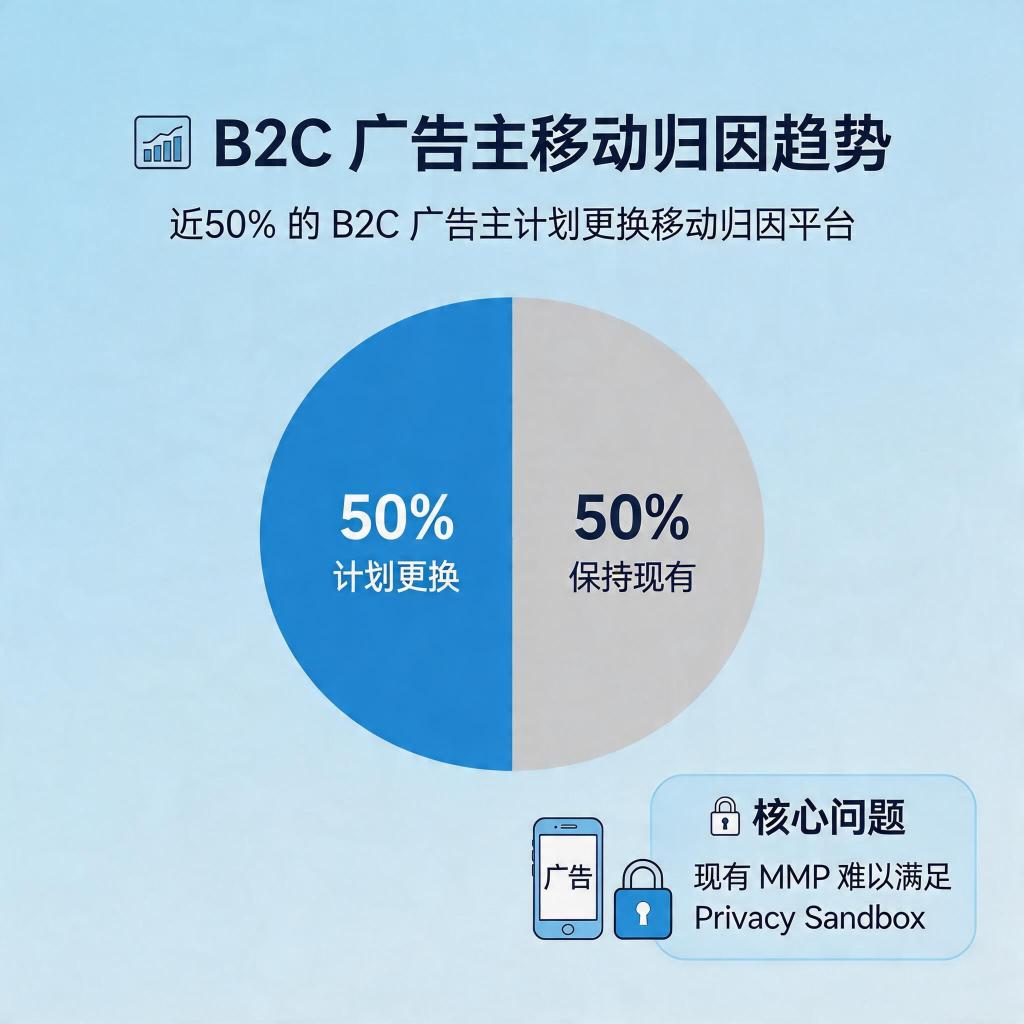
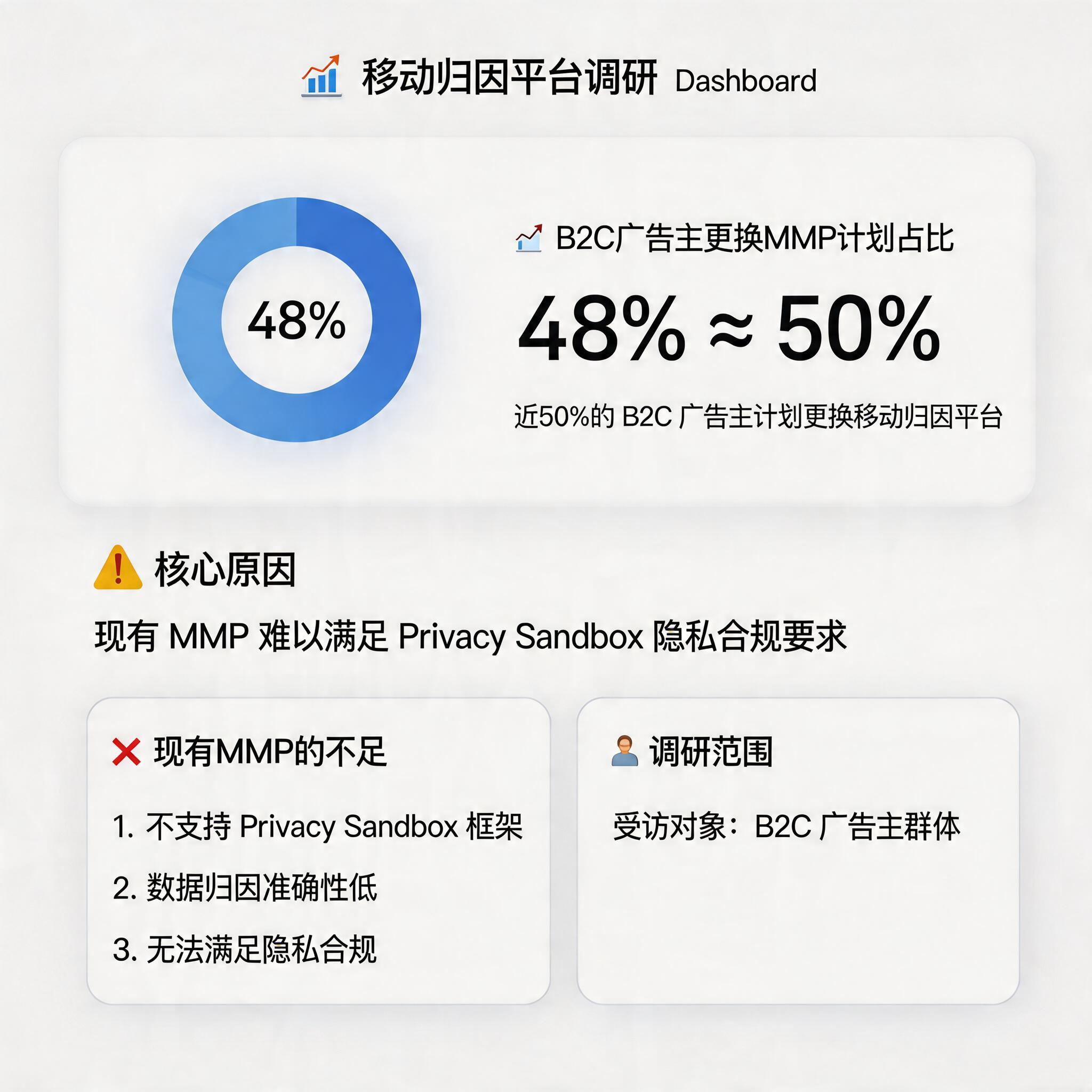
A recent survey of mobile marketing leaders reveals that nearly half of B2C advertisers are actively evaluating alternatives to their current Mobile Measurement Partner (MMP). The reason is straightforward: legacy attribution platforms were built for a world of device-level identifiers — a world that Google’s Privacy Sandbox is rapidly dismantling. As third-party cookies disappear and Android’s Advertising ID loses signal, advertisers need attribution solutions designed for privacy-first measurement, not retrofitted ones.
→ See how ROiBest PWA works — no submission, no cut, 1.2x installs.
Why Legacy MMPs Are Losing Advertiser Confidence
Traditional MMPs like AppsFlyer, Adjust, and Branch built their attribution models on deterministic device-level matching — primarily the GAID on Android and IDFA on iOS. Apple’s ATT framework already reduced IDFA opt-in rates to roughly 25%, and now Google’s Privacy Sandbox API changes in 2026 are compressing Android signal availability even further.
The core problem: MMPs are attempting to layer probabilistic modeling and aggregated APIs on top of infrastructure that assumes user-level tracking. This creates three measurable gaps that advertisers are flagging:
- Attribution accuracy decline: Industry benchmarks show a 30–40% drop in deterministic match rates on Android campaigns since Privacy Sandbox rollouts began in late 2025.
- Delayed reporting: Aggregated attribution APIs introduce 24–72 hour reporting latency, making real-time campaign optimization impossible for performance marketers running daily budget cycles.
- Rising costs without rising value: MMP contracts averaging $120K–$300K annually are harder to justify when the core value proposition — accurate, real-time, cross-channel attribution — is degraded.
What Advertisers Actually Need in a Post-Privacy Sandbox Attribution Stack
The advertisers planning to switch aren’t simply shopping for a cheaper MMP. They’re rethinking the attribution architecture itself. Based on reported priorities, here are the three capabilities driving evaluation decisions:
1. First-party data ownership and server-side measurement. Advertisers are shifting toward Conversions API (CAPI) and Enhanced Conversions pipelines that route conversion data server-to-server, bypassing browser and OS-level restrictions entirely. This aligns with Google’s Customer Match and Data Manager API direction, which rewards advertisers who own their first-party data infrastructure. Companies using server-side measurement report 20–35% more attributed conversions compared to client-side SDK-only setups.
2. Privacy-compliant cross-channel unification. With signal loss on both iOS and Android, advertisers need measurement that works across web, app, and Progressive Web App (PWA) touchpoints without relying on device IDs. PWA distribution is particularly relevant here — since PWAs operate through the browser, they naturally integrate with first-party cookies and server-side event tracking without requiring platform-specific SDK instrumentation.
3. Cost-aligned pricing models. The MMP pricing model — per-install or per-attribution fees layered on platform contracts — is under scrutiny. Advertisers spending $50K+ monthly on media are questioning whether paying a separate attribution tax makes sense when platforms like Google and Meta are building native measurement tools (Enhanced Conversions, Meta CAPI) directly into their ad systems.
3 Actionable Steps to Future-Proof Your Attribution Strategy
Step 1: Audit your current attribution dependency. Map every campaign where your MMP is the sole source of truth. For 68% of advertisers surveyed, more than half their optimization decisions rely on MMP-reported data. Identify which campaigns can shift to platform-native measurement (Google Ads conversion tracking, Meta CAPI) without losing actionable signal. This reduces your exposure to MMP accuracy degradation.
Step 2: Implement server-side conversion infrastructure now. Don’t wait for your MMP contract renewal. Deploy Enhanced Conversions for Google and CAPI for Meta in parallel with your existing MMP. Advertisers who run dual-stack measurement for 60–90 days consistently find that server-side pipelines capture 15–25% more conversions, giving you a clear benchmark for whether your MMP is still adding value. Consider how rising platform costs like Meta’s DST surcharges make efficient measurement even more critical to maintaining ROAS.
Step 3: Evaluate PWA as a distribution and measurement channel. Progressive Web Apps eliminate the app store installation friction that creates the attribution gap in the first place. When a user engages with a PWA, the entire journey — from ad click to conversion — stays within a measurable, first-party web context. No GAID required. No SDK fingerprinting. No 72-hour aggregation delay. Advertisers running PWA campaigns report 1.2x higher install completion rates compared to native app store flows, precisely because there’s no store redirect to break the attribution chain. As new ad channels like ChatGPT Ads emerge, having a PWA-ready distribution strategy ensures you can measure performance across every channel from day one.
The Attribution Market Is Resetting — Position Accordingly
The shift away from legacy MMPs isn’t a temporary trend driven by one platform’s policy change. It’s a structural reset. Privacy regulations are tightening globally, device-level identifiers are disappearing across every major OS, and advertisers are realizing that the most reliable attribution is the kind they own and control.
The advertisers who move first — building server-side measurement, owning their first-party data, and adopting privacy-native distribution channels like PWAs — won’t just survive the post-Privacy Sandbox era. They’ll gain a measurable competitive advantage in cost efficiency, attribution accuracy, and campaign optimization speed.
Skip the app store. Keep 100% revenue.
 WebApp中文站
留下评论