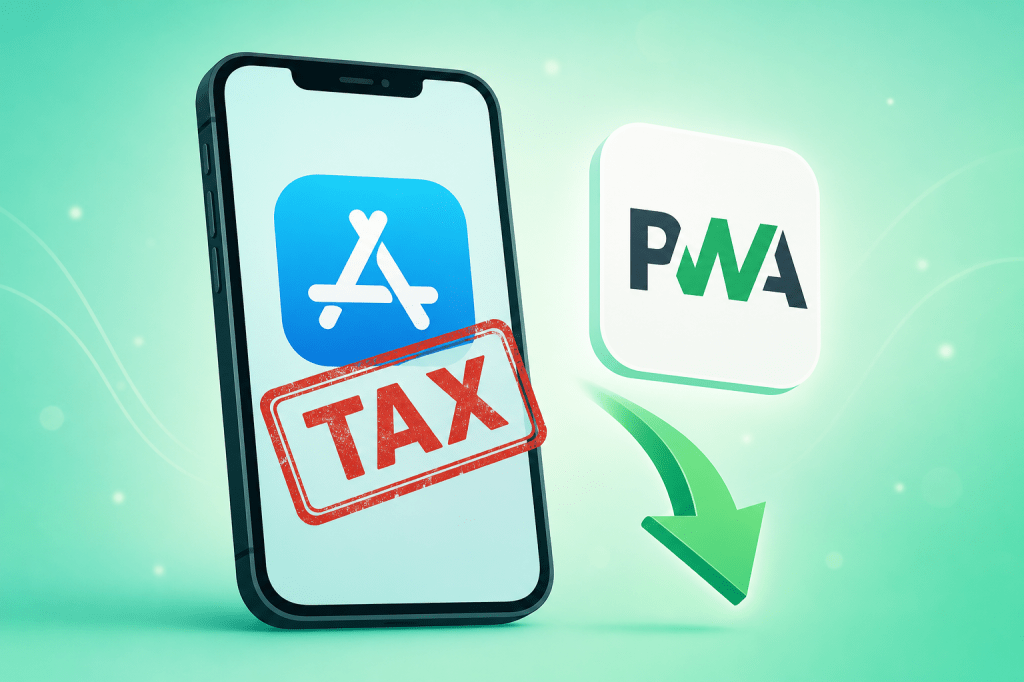
If you distribute an Android app through Google Play and advertise on Meta or Google in European markets, 2026 is the year your cost structure takes a double hit. Digital services taxes (DST) are now being passed through to advertisers as surcharges on ad invoices, while Google Play continues to take its 30% revenue cut on every in-app transaction. For gaming BC teams and AI social app teams going global, this combination means up to 33-37% of gross revenue is consumed by platform taxes and fees before you see a dollar of profit.
PWA distribution eliminates the app store cut entirely and reduces your exposure to platform-mediated tax pass-throughs. Here is how the math works, and why teams are making the switch.
→ Want to bypass Google Play entirely? See how ROiBest PWA works — no submission, no cut, 1.2x installs.
The Double Cost Problem: DST + App Store Fees
Digital services taxes are government levies on tech platform revenue. Countries including France (3%), Italy (3%), Spain (3%), the UK (2%), and Turkey (7.5%) have enacted these taxes, and Meta and Google now pass these costs directly to advertisers as surcharges on ad invoices.
For an app team spending $50,000/month on Meta ads in European markets, DST surcharges add $1,500-$2,500 to your monthly ad bill. This is a pure cost increase with zero additional reach or performance.
Now layer on Google Play’s fee structure. For every $1 of in-app revenue your app generates, Google takes $0.30 (or $0.15 for the first $1M under the reduced rate program). For a gaming app generating $100,000/month in IAP revenue, that is $30,000 going to Google — before taxes, server costs, or team salaries.
Combined: your acquisition costs are rising (DST surcharges) while your revenue per user is capped at 70% (Google Play cut). This squeeze narrows margins from both sides simultaneously. For teams already optimizing their Google PMax budget, the DST surcharge adds another leak to plug.
How PWA Distribution Changes the Cost Equation
Progressive Web Apps (PWAs) are web-based applications that install directly to a user’s home screen from a browser — no app store submission, no app store review, and critically, no app store revenue share.
When you distribute via PWA instead of Google Play, the cost equation changes fundamentally:
Zero app store commission: PWA transactions are processed through your own payment infrastructure (Stripe, PayPal, direct card processing). You keep 97-98% of revenue after standard payment processing fees, compared to 70% through Google Play. On $100,000/month in revenue, that is $27,000-$28,000 more in your pocket.
Reduced DST exposure: While DST still applies to your ad spend (you are still advertising on Meta and Google), PWA distribution removes Google Play as a revenue intermediary. Since DSTs target platform revenue, removing one platform layer from your revenue chain reduces your total platform fee exposure. Your ad-side DST remains, but your revenue-side platform fees drop to near zero.
Higher install conversion rates: PWA installation is a one-tap process directly from the browser — no redirect to an app store, no download waiting screen, no Google Play account requirement. Teams using PWA distribution consistently report 1.2x higher install conversion rates compared to Google Play installs, which means your DST-inflated ad spend generates more installs per dollar. See how PWA tracking advantages help measure these gains accurately.
Step-by-Step: Calculating Your Savings from PWA Distribution
Before switching distribution strategies, calculate the exact financial impact for your specific situation:
Step 1: Calculate your current Google Play cost. Pull your last 3 months of Google Play revenue reports. Identify total gross revenue and total Google Play commission paid. For most apps outside the Small Business Program ($1M+ annual), this is 30% of gross revenue. Note: if you are in the reduced rate program, use your actual rate.
Step 2: Calculate your DST surcharge exposure. Review your Meta and Google Ads invoices for DST line items. Sum the total DST surcharges across all affected geos for the same 3-month period. Calculate your blended DST rate (total surcharges ÷ total ad spend in affected geos).
Step 3: Model the PWA alternative. Replace the Google Play commission with standard payment processing fees (typically 2.9% + $0.30 per transaction for Stripe). Keep your DST surcharges constant (these apply to ad spend regardless of distribution method). Add the 1.2x install conversion rate improvement to calculate the reduced cost-per-install under PWA distribution.
Step 4: Calculate net savings. (Google Play commission saved) – (payment processing fees) + (CPI reduction from higher conversion rates) = net monthly savings. For a team doing $100K/month in revenue and $50K/month in EU ad spend, typical net savings are $25,000-$28,000/month — a number large enough to fund an entire additional growth channel.
Why Gaming BC and AI App Teams Benefit Most
Gaming BC teams: Games with in-app purchase models lose the most to Google Play’s 30% cut. A casual game generating $200,000/month in IAP revenue sends $60,000 to Google. Switching to PWA distribution recovers approximately $55,000 of that (after payment processing fees). Additionally, PWA games can push notifications to users even after the PWA is removed from the home screen — a capability that Google Play apps lose upon uninstall. This push persistence directly improves D7 and D30 retention metrics. For teams navigating algorithm changes across platforms, PWA offers a distribution channel you fully control.
AI social and dating apps: These apps face an additional Google Play risk — content policy enforcement. AI companion and dating apps are frequently flagged, suspended, or removed from Google Play for content policy violations, even when the violations are marginal or algorithmic false positives. Each removal means lost revenue, lost user trust, and the cost of resubmission. PWA distribution eliminates this risk entirely: your app lives on your domain, under your control, with no platform review process that can take it down.
Common Concerns About PWA Distribution
“Will users install a PWA?” Yes. PWA install rates are consistently 1.2x higher than Google Play because the install flow is simpler — one tap from the browser vs. redirect to store → find app → tap install → wait for download → open. The friction reduction more than compensates for any user hesitation about non-store apps.
“What about discoverability?” You are already driving traffic through paid ads. Your users arrive at your landing page, not through app store search. PWA distribution simply shortens the path from ad click to installed app. Store discoverability is not a meaningful traffic source for most performance-marketed apps.
“Can PWAs match native app performance?” For the vast majority of use cases — social apps, casual-to-mid-core games, content apps — PWAs deliver equivalent user experience. Push notifications, offline access, home screen presence, and smooth animations are all supported. The 5% of apps that genuinely need low-level hardware access (AR/VR, complex 3D games) remain native-only, but these are the exception.
Action Checklist
- Pull 3 months of Google Play revenue reports and calculate total commission paid
- Review Meta and Google Ads invoices for DST surcharges in European markets
- Model your net savings under PWA distribution (commission saved – processing fees + CPI reduction)
- Evaluate your app’s PWA compatibility (most social, gaming, and content apps qualify)
- Set up payment processing infrastructure independent of Google Play (Stripe, PayPal)
- Plan a parallel distribution test: run PWA alongside Google Play for 30 days and compare CPI, retention, and revenue metrics
- Assess Google Play content policy risk for your specific app category
Skip the app store. Go live instantly, keep 100% of your revenue.
ROiBest helps Android app teams launch PWAs — no review process, no 30% Google Play cut, and push notifications that work even after uninstall. Teams see up to 1.2x higher install conversion rates vs native app downloads.
 WebApp中文站
留下评论